
AMD Analyst Day Platform Announcements
- Posted in
- CPUs
Platform Strategy: 4x4, Torrenza, Trinity, and Raiden
It wouldn't be fair to completely ignore AMD Live!, as there was a fair amount of time spent talking about it. Unfortunately, AMD Live! is much like Intel's VIIV. That is to say, the "technology" is more of a suggestion about what components to include in computers built for a specific purpose in order to assist in the marketing of an idea. Certainly, the "computer as media center" idea isn't something new. Intel and AMD simply enabled the magic co-branding fairy to make end users feel all warm and squishy inside about their purchase. To be fair, mindshare is a large part of the game, and Centrino has served Intel very well on the mobile front (though I wish this early Centrino I've got had been a Pentium-M with onboard 802.11g).
Moving on, there were some very high powered (as in power draw) announcements. First off, AMD is pushing a new high end enthusiast platform consisting of dual socket motherboards for dual core processors combined with quad GPU solutions. In an incredibly unoriginal moment of indiscretion, this platform has been dubbed 4x4. Uninspired, yet very appropriate: the platform will very likely be large, loud, and so power hungry we will need a gas powered generator to run it. That doesn't mean we wouldn't want to own a system. We just aren't sure we'd want to pay for it.
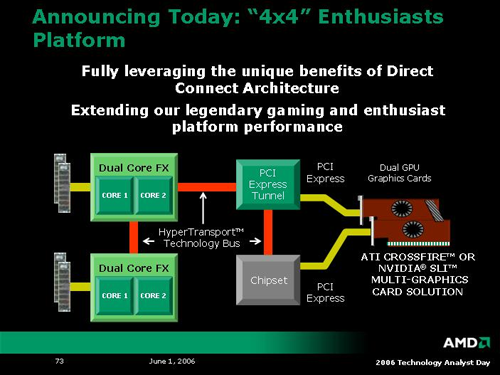
So, the first question we asked about 4x4 was: how much different is this than taking an off the shelf 2P board and dropping in a couple 2xx series Opteron processors with NVIDIA's quad SLI? Unfortunately, we haven't gotten any answer other than to say that there is something that makes it different. From what we understand, 4x4 will support unbuffered DIMMS (while Opterons still require registered memory), and the platform will be focused towards tweakable motherboards. We are looking into all the details. While the more power! kick is always interesting, we have to wonder if there will be any software in the near term that can really harness all this raw potential.
Stepping past the enthusiast platform, we have arguably the most exciting announcement of the day: Torrenza. Along with K8L, AMD plans on openly licensing it's (until now proprietary) coherent HyperTransport technology. At first glance, this may not seem exciting, but AMD is throwing in a little twist: HTX slots. These HTX slots will be standard interfaces connected directly to an AMD CPU's HyperTransport link. If both of these links are coherent, the device and the CPU will be able to communicate directly with each other with cache coherency. Because of this, latency can be reduced greatly over other buses as well, enabling hardware vendors to begin to create true coprocessor technology once again.
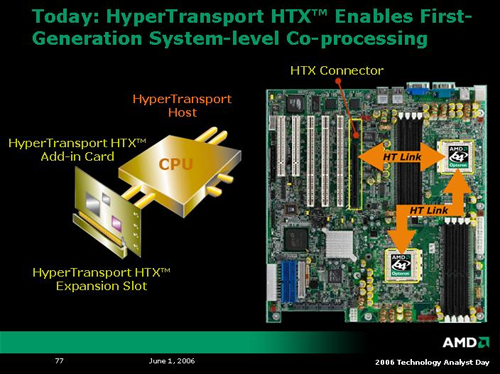
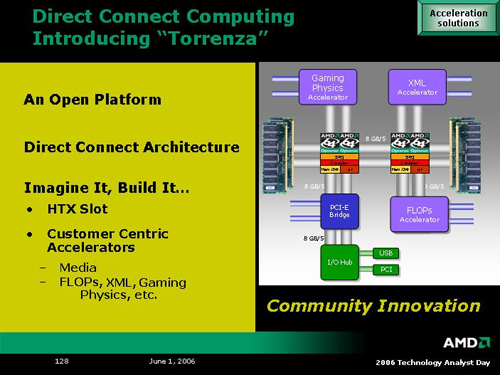
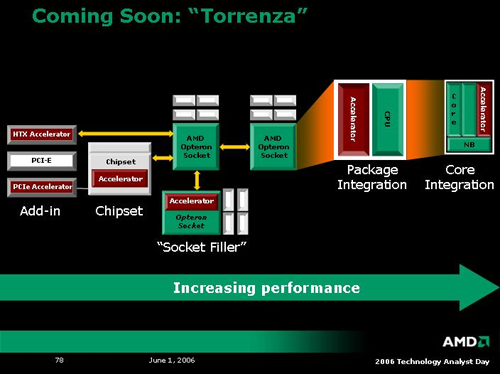
In addition to the flexibility of allowing the addition of such "accelerators" (as AMD calls them) to be added in via HTX slots, the architecture of the K8L line will be flexible enough that AMD could choose to incorporate some of these coprocessor technologies on a CPU package, or even on a CPU die itself. This is possible because the interconnect interface is the same at any level of integration. Not only will companies be able to develop their own unique solutions to extend the capabilities of the system processor, but it may even be possible to see such technology integrated into future AMD parts at a more fundamental level.
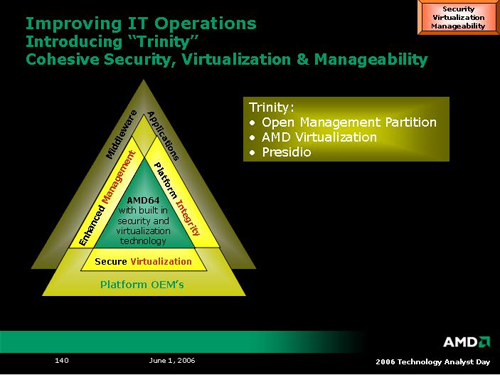
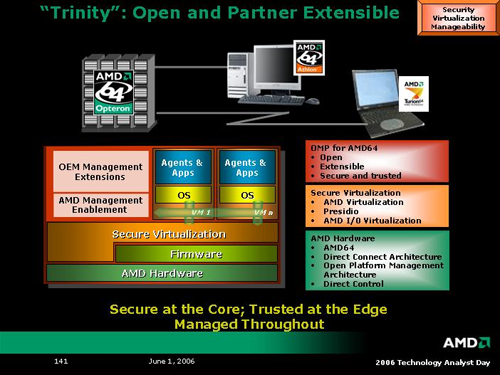
The next two platform level technologies AMD spoke on are named Trinity and Raiden. At many levels, Raiden seems more like an AMD Live! style initiative enabled by Trinity and other technologies, but we're getting ahead of ourselves. At its core, Trinity is AMD's platform level support for hardware virtualization. In addition to previously introduced Pacifica technology, AMD is working with the PCISIG to develop advanced I/O virtualization in addition to enhancing security and manageability of virtualized hardware at every level. The actual hardware that will enable Trinity wasn't explicitly expounded upon, but we did get these two slides with a brief description of how security, manageability and virtualization can't be handled as three separate problems.
Moving on to Raiden, AMD wishes to change the way businesses look at the way they provide computing to their employees. Rather than hardware, AMD believes businesses would be better served by focusing on compute cycles. Server and PC hardware can be setup in blade-like configurations, and employees can run thin clients which stream their OS from the compute server. Ideally, the reality of where their "compute power" comes from won't be important to the end user as long as there was no difference in experience. Having a large number of under utilized computers is a cost companies could avoid by sharing the processing power of fewer machines over a large number of people.
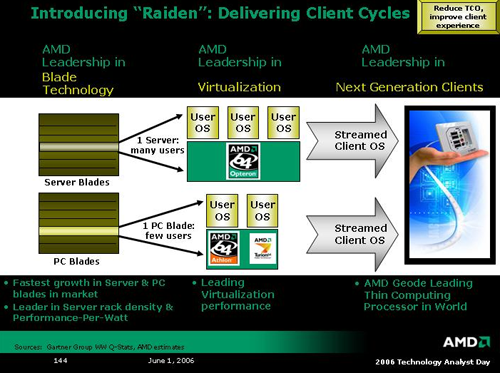
If there is any technology that is Raiden specific, AMD was not forthcoming. From what we can tell, AMD will leverage the current enthusiasm over blade systems and its Trinity virtualization platform to push customers toward a centralized computational model on the basis of power and cost savings. Certainly the benefits are there if the technology can support it, and hopefully we will be able to get some clarification on how Raiden translates to actual hardware.
It wouldn't be fair to completely ignore AMD Live!, as there was a fair amount of time spent talking about it. Unfortunately, AMD Live! is much like Intel's VIIV. That is to say, the "technology" is more of a suggestion about what components to include in computers built for a specific purpose in order to assist in the marketing of an idea. Certainly, the "computer as media center" idea isn't something new. Intel and AMD simply enabled the magic co-branding fairy to make end users feel all warm and squishy inside about their purchase. To be fair, mindshare is a large part of the game, and Centrino has served Intel very well on the mobile front (though I wish this early Centrino I've got had been a Pentium-M with onboard 802.11g).
Moving on, there were some very high powered (as in power draw) announcements. First off, AMD is pushing a new high end enthusiast platform consisting of dual socket motherboards for dual core processors combined with quad GPU solutions. In an incredibly unoriginal moment of indiscretion, this platform has been dubbed 4x4. Uninspired, yet very appropriate: the platform will very likely be large, loud, and so power hungry we will need a gas powered generator to run it. That doesn't mean we wouldn't want to own a system. We just aren't sure we'd want to pay for it.
So, the first question we asked about 4x4 was: how much different is this than taking an off the shelf 2P board and dropping in a couple 2xx series Opteron processors with NVIDIA's quad SLI? Unfortunately, we haven't gotten any answer other than to say that there is something that makes it different. From what we understand, 4x4 will support unbuffered DIMMS (while Opterons still require registered memory), and the platform will be focused towards tweakable motherboards. We are looking into all the details. While the more power! kick is always interesting, we have to wonder if there will be any software in the near term that can really harness all this raw potential.
Stepping past the enthusiast platform, we have arguably the most exciting announcement of the day: Torrenza. Along with K8L, AMD plans on openly licensing it's (until now proprietary) coherent HyperTransport technology. At first glance, this may not seem exciting, but AMD is throwing in a little twist: HTX slots. These HTX slots will be standard interfaces connected directly to an AMD CPU's HyperTransport link. If both of these links are coherent, the device and the CPU will be able to communicate directly with each other with cache coherency. Because of this, latency can be reduced greatly over other buses as well, enabling hardware vendors to begin to create true coprocessor technology once again.
In addition to the flexibility of allowing the addition of such "accelerators" (as AMD calls them) to be added in via HTX slots, the architecture of the K8L line will be flexible enough that AMD could choose to incorporate some of these coprocessor technologies on a CPU package, or even on a CPU die itself. This is possible because the interconnect interface is the same at any level of integration. Not only will companies be able to develop their own unique solutions to extend the capabilities of the system processor, but it may even be possible to see such technology integrated into future AMD parts at a more fundamental level.
The next two platform level technologies AMD spoke on are named Trinity and Raiden. At many levels, Raiden seems more like an AMD Live! style initiative enabled by Trinity and other technologies, but we're getting ahead of ourselves. At its core, Trinity is AMD's platform level support for hardware virtualization. In addition to previously introduced Pacifica technology, AMD is working with the PCISIG to develop advanced I/O virtualization in addition to enhancing security and manageability of virtualized hardware at every level. The actual hardware that will enable Trinity wasn't explicitly expounded upon, but we did get these two slides with a brief description of how security, manageability and virtualization can't be handled as three separate problems.
Moving on to Raiden, AMD wishes to change the way businesses look at the way they provide computing to their employees. Rather than hardware, AMD believes businesses would be better served by focusing on compute cycles. Server and PC hardware can be setup in blade-like configurations, and employees can run thin clients which stream their OS from the compute server. Ideally, the reality of where their "compute power" comes from won't be important to the end user as long as there was no difference in experience. Having a large number of under utilized computers is a cost companies could avoid by sharing the processing power of fewer machines over a large number of people.
If there is any technology that is Raiden specific, AMD was not forthcoming. From what we can tell, AMD will leverage the current enthusiasm over blade systems and its Trinity virtualization platform to push customers toward a centralized computational model on the basis of power and cost savings. Certainly the benefits are there if the technology can support it, and hopefully we will be able to get some clarification on how Raiden translates to actual hardware.
Originally published at https://www.anandtech.com/show/2018 (Wayback Machine).