
BFG PhysX and Performance Updates
- Posted in
- GPUs
Ghost Recon Advanced Warfighter Tests
And the short story is that the patch released by AGEIA when we published our previous story didn't really do much to fix the performance issues. We did see an increase in framerate from our previous tests, but the results are less impressive than we were hoping to see (especially with regard to the extremely low minimum framerate).Here are the results from our initial test, as well as the updated results we collected:
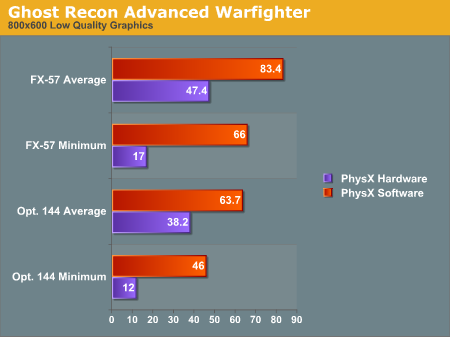
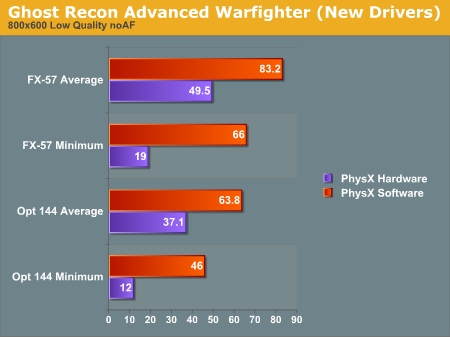
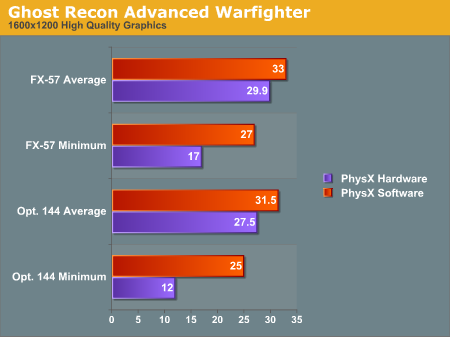
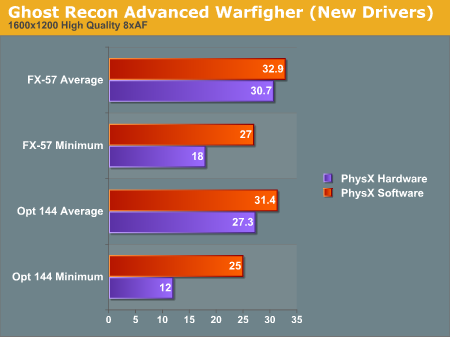
There is a difference, but it isn't huge. We are quite impressed with the fact that AGEIA was able to release a driver so quickly after performance issues were made known, but we would like to see better results than this. Perhaps AGEIA will have another trick up their sleeves in the future as well.
Whatever the case, after further testing, it appears our initial assumptions are proving more and more correct, at least with the current generation of PhysX games. There is a bottleneck in the system somewhere near and dear to the PPU. Whether this bottleneck is in the game code, the AGEIA driver, the PCI bus, or on the PhysX card itself, we just can't say at this point. The fact that a driver release did improve the framerates a little implies that at least some of the bottleneck is in the driver. The implementation in GRAW is quite questionable, and a game update could help to improve performance if this is the case.
Our working theory is that there is a good amount of overhead associated with initiating activity on the PhysX hardware. This idea is backed up by a few observations we have made. Firstly, the slow down occurs right as particle systems or objects are created in the game. After the creation of the PhysX accelerated objects, framerates seem to smooth out. The demos we have which use the PhysX hardware for everything physics related don't seem to suffer the same problem when blowing things up (as we will demonstrate shortly).
We don't know enough at this point about either the implementation of the PhysX hardware or the games that use it to be able to say what would help speed things up. It is quite clear that there is a whole lot of breathing room for developers to use. Both the CellFactor demo (now downloadable) and the UnrealEngine 3 demo Hangar of Doom show this fact quite clearly.
Originally published at https://www.anandtech.com/show/2009 (Wayback Machine).