
ASUS: The EN7600 GS Silent, and EN7800 GT TOP Silent
- Posted in
- GPUs
Overclocking, Heat & Power
We approached overclocking these cards with some caution because of what we mentioned before about heat issues. Since faster clock speeds equal higher temperatures on the GPU, more heat dissipation is needed, which can be a problem for cards with fan-less heat sinks. We found that the 7600 GS Silent did actually have trouble with overclocking, but interestingly, the Silent 7800 GT managed to achieve quite a high core and memory clock. Here are the clock speeds we achieved.| Overclocking Results | ||
| Core Clock | Memory Clock | |
| ASUS EN7800 GT TOP Silent | ||
| Default | 420 | 1240 |
| Overclocked | 481 | 1290 |
| % Increase | 14.5% | 4.0% |
| ASUS EN7600 GS Silent | ||
| Default | 400 | 800 |
| Overclocked | 442 | 874 |
| % Increase | 10.5% | 9.3% |
We tested these clock speeds by running the Splinter Cell Chaos Theory benchmark stress tests to verify stability. One thing to note is that these cards tended to get incredibly hot to the touch after several minutes of testing. Here are the performance results in Splinter Cell of the overclocked cards.
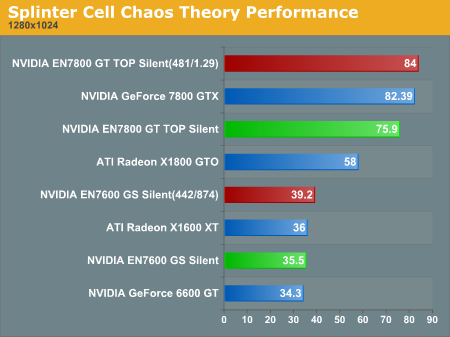
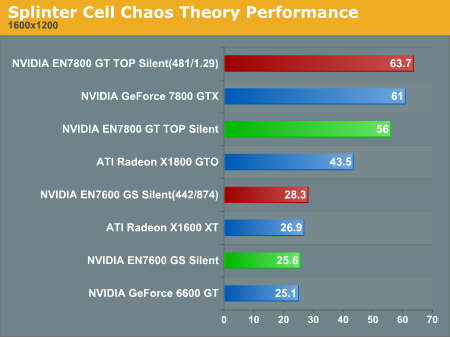
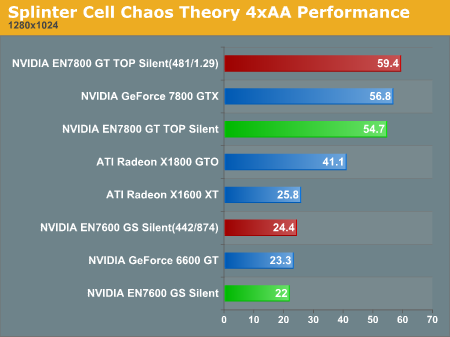
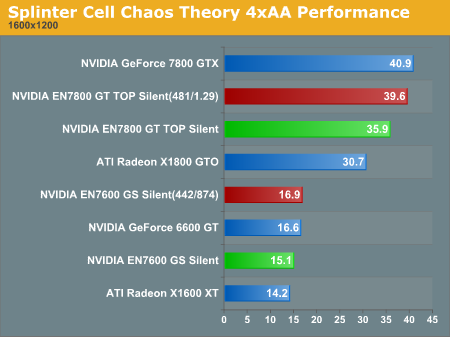
There's not much difference at all between the factory and user overclocked silent 7600 GS. This card was the worst of the two at overclocking and had a lot of trouble running stable (i.e. without graphical artifacts) during our stress tests. However, once we established the overclock of 442MHz/874MHz, the artifacts left and our tests ran cleanly. With the silent 7800 GT, the difference our overclocking makes is fairly significant. It did manage to boost performance by several fps, which may be a noticeable improvement during gameplay.
Power Consumption
We also tested the power consumption of these cards to see how much power they drew and if there was anything out of the ordinary. We acquired our power numbers by measuring the wattage of the total system at the wall outlet while idle and under load (stress tests). These are the results we recorded.
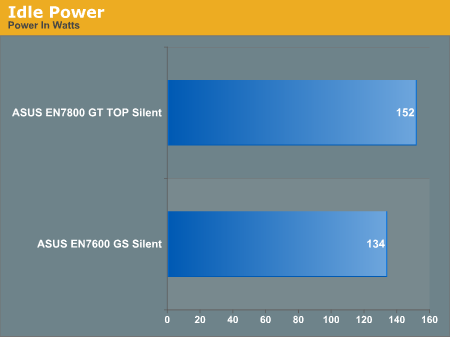
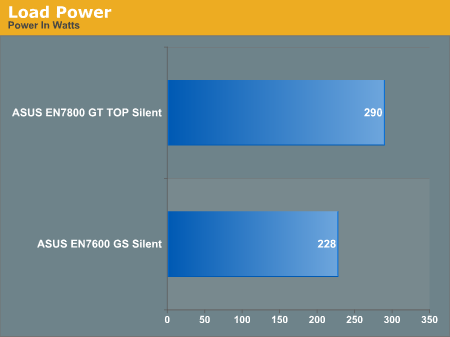
As expected, the EN7600 GS Silent drew much less power than the EN7800 GT TOP Silent. Neither of these cards are really power-hungry, but the fact that the EN7800 GT TOP Silent requires a 6 pin power connection reflects that its consumption is on par more with other cards of this type. The EN7600 GS Silent requires no external power connection, and its consumption is fairly low, which is good for those concerned with power draw.
Heat
We tested the temperatures of these cards as well to get a good idea of their heat levels generated during operation. We acquired the results here similarly to the power test, by taking the temperature of the GPU (in Celsius) while the system was idle and under stress testing. Here are the results.
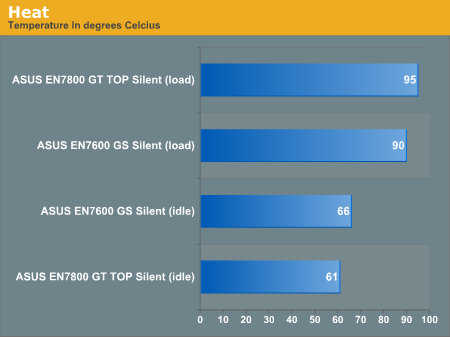
As we mentioned above, both cards do get very hot to the touch after running any 3D application for a bit. Something interesting here is that the EN7800 GT TOP Silent runs cooler at idle than the smaller EN7600 GS Silent. At load however, the 7800 GT gets about 5 degrees C hotter than the 7600 GS. The EN7800GT cooler is obviously larger and better at dissipating heat, yet the card still gets hotter because it is a much more powerful part.
Originally published at https://www.anandtech.com/show/2006 (Wayback Machine).