
Khadas Mind Premium Review: Raptor Lake-P in a Modular Portable Workstation
System Performance: UL and BAPCo Benchmarks
Our 2022 Q4 update to the test suite for Windows 11-based systems carries over some of the standard benchmarks we have been using over the last several years, including UL's PCMark. New additions include BAPCo's CrossMark multi-platform benchmarking tool, as well as UL's Procyon benchmark suite.
UL PCMark 10
UL's PCMark 10 evaluates computing systems for various usage scenarios (generic / essential tasks such as web browsing and starting up applications, productivity tasks such as editing spreadsheets and documents, gaming, and digital content creation). We benchmarked select PCs with the PCMark 10 Extended profile and recorded the scores for various scenarios. These scores are heavily influenced by the CPU and GPU in the system, though the RAM and storage device also play a part. The power plan was set to Balanced for all the PCs while processing the PCMark 10 benchmark. The scores for each contributing component / use-case environment are also graphed below.
| UL PCMark 10 - Performance Scores | |||
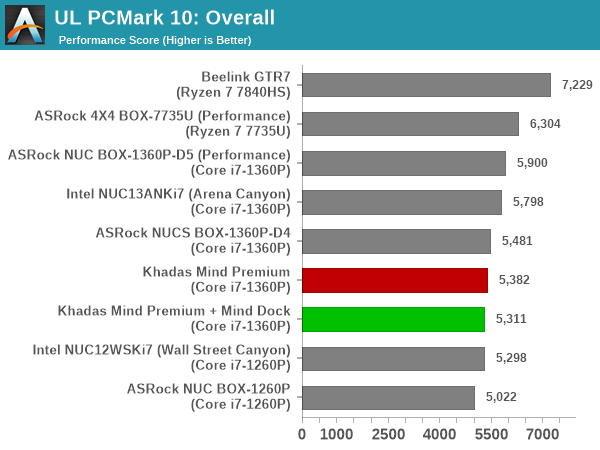
Most of the other systems equipped with the same Core i7-1360P processor manage to outperform the Khadas Mind Premium because their size and cooling solution allows them to configure a PL1 of 40W (compared to the 28W in the Mind Premium). As a result, the system makes its appearance in the second half of the pack.
UL Procyon v2.1.544
PCMark 10 utilizes open-source software such as Libre Office and GIMP to evaluate system performance. However, many of their professional benchmark customers have been requesting evaluation with commonly-used commercial software such as Microsoft Office and Adobe applications. In order to serve their needs, UL introduced the Procyon benchmark in late 2020. There are five benchmark categories currently - Office Productivity, AI Inference, Battery Life, Photo Editing, and Video Editing. AI Inference benchmarks are available only for Android devices, while the battery life benchmark is applicable to Windows devices such as notebooks and tablets. We presents results from our processing of the other three benchmarks.
| UL Procyon - Office Productivity Scores | |||
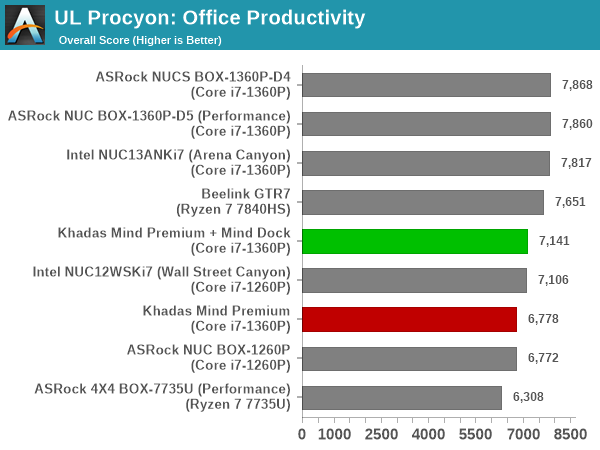
The 28W PL1 configuration dictated by the Mind Premium's form-factor means that the overall ordering is similar to what was observed for the PCMark 10 workloads.
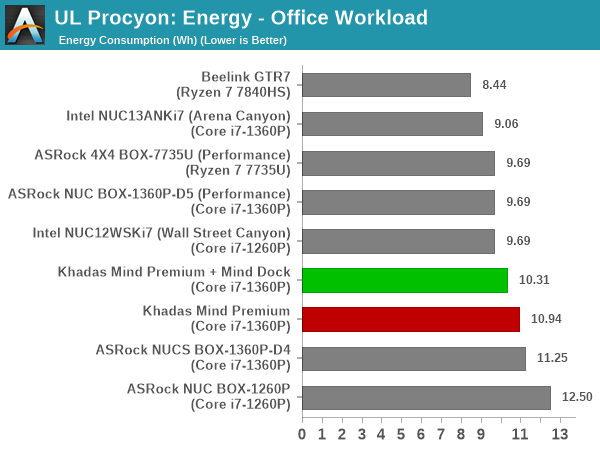
From an energy consumption viewpoint, the Mind Premium gets the job done with an energy consumption of around 10.5 Wh - well above what the Intel NUC (Arena Canyon) with the same processor (albeit, higher PL1) needed.
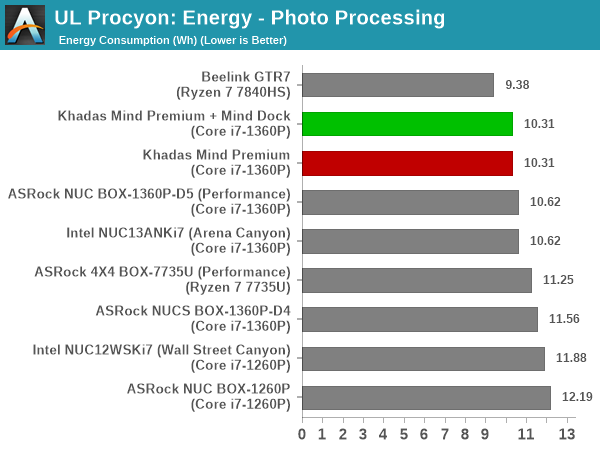
Moving on to the evaluation of Adobe Photoshop and Adobe Lightroom, we find the PL1 again negatively affecting the position of the Mind Premium, with the configurations being in the bottom half of the graphs.
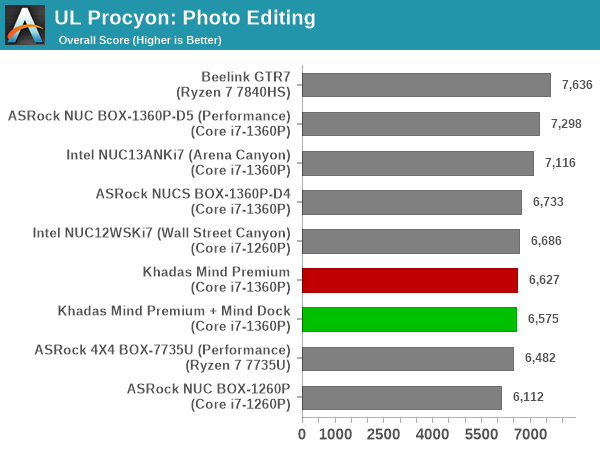
Interestingly, the energy consumption numbers are the best of all RPL-P systems, pointing to the 28W setting being the ideal from an overall energy consumption viewpoint.
UL Procyon evaluates performance for video editing using Adobe Premier Pro.
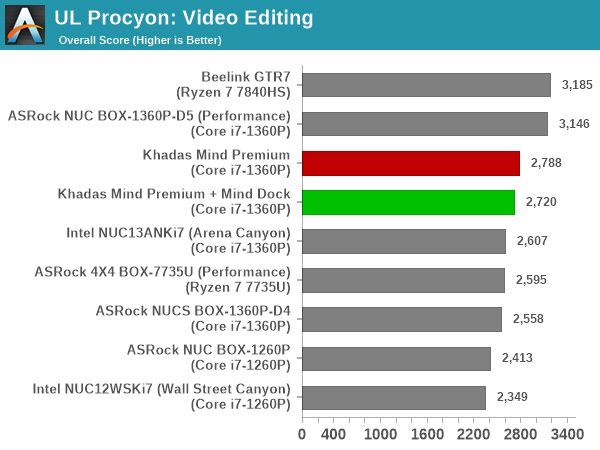
The Mind Premium puts up a much better show here, with only the DDR5-based NUC BOX-1360P/D5 in its 40W avatar notching up a better score among RPL-P systems.
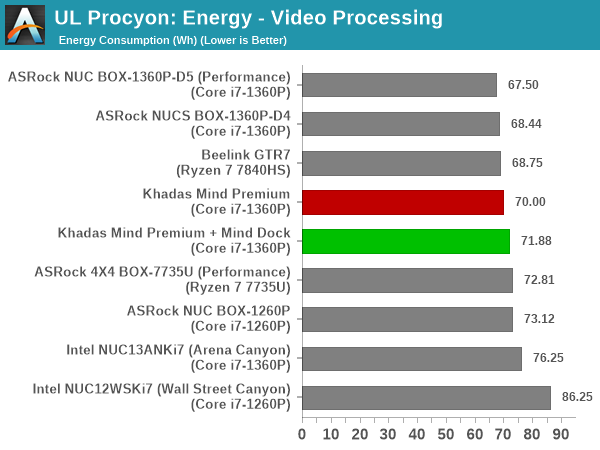
The energy consumption numbers are also reasonable, with the two configurations managing to keep themselves in the top half of the graph.
BAPCo CrossMark 1.0.1.86
BAPCo's CrossMark aims to simplify benchmark processing while still delivering scores that roughly tally with SYSmark. The main advantage is the cross-platform nature of the tool - allowing it to be run on smartphones and tablets as well.
| BAPCo CrossMark 1.0.1.86 - Sub-Category Scores | |||
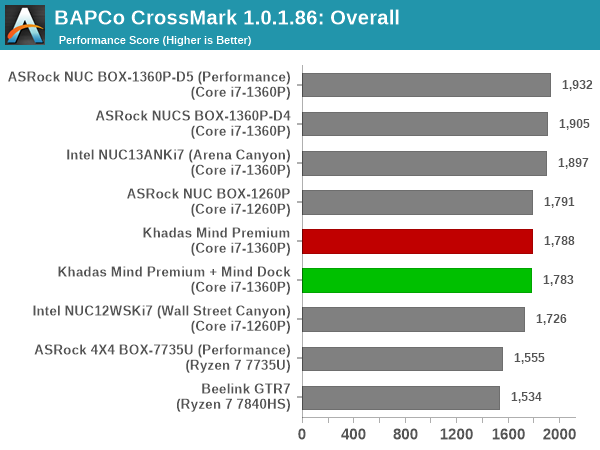
The relative performance seen in the UL benchmarks translate to CrossMark also. This is not entirely unexpected, given the difference in the PL1 / PL2 settings of different systems. The comparison of CrossMark results to those from the other benchmarks above becomes interesting when the systems have similar TDPs but differing PL2 values - in such cases, CrossMark with its idle-time compression methodology may not yield realistic results (where throttling can take place when it wouldn't in the actual use-case). That is not the case here, and so the two Mind Premium configurations end up in the middle of the pack.
Originally published at https://www.anandtech.com/show/20038/khadas-mind-portable-modular-workstation-review-raptor-lakep-in-a-different-avatar (Wayback Machine).