
DFI CFX3200-DR: ATI RD580 Tweak Attack
- Posted in
- Motherboards
General Performance
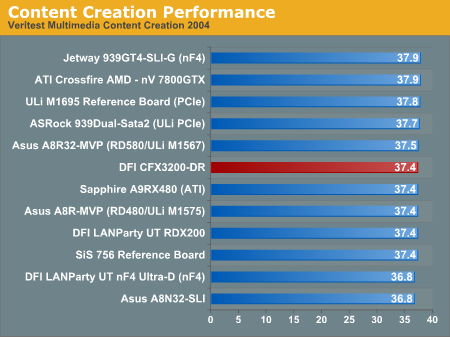
With the Memory Controller on the Athlon 64 Processor, Winstones benchmarks are no longer very revealing of motherboard performance. With the same CPU (and the same memory controller on that CPU), Winstones scores - both Business and Multimedia Content Creation - are tightly clustered. The only deviation from that is that boards that are tweaked for best gaming performance are often near the bottom of a tight range of benchmark performance numbers. The Winstones tests themselves are rapidly becoming dated, and are no longer supported by PC Magazine. While Winstones are still useful in providing real world performance data we will soon be dropping them from our motherboard test suite.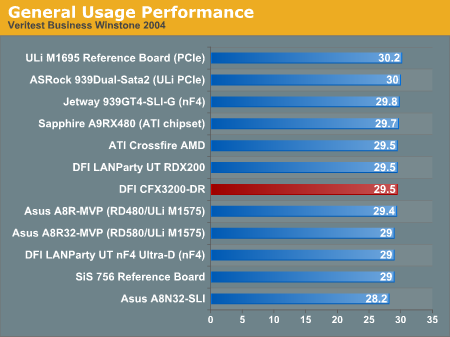
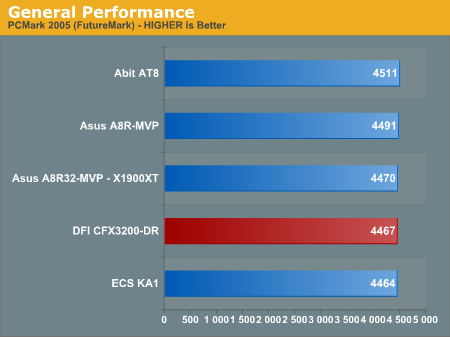
PCMark 2005 results with the DFI CFX3200 were average. Performance of the CFX3200 was in the middle of a tightly clustered group that only ranged from 4464 to 4511. Since all tested boards use ATI chipsets running X1900XT video the performance clustering is expected.
Despite the close results in these tests, PCMark05 is proving to be a useful overall performance benchmark. It is generally more sensitive than the older Winstones and PCMark04 to recent improvements in PC architecture. PCMark05 results in general relate well to the other performance results we find in our board tests, providing a quick and reliable snapshot of board performance compared to other motherboards.
3D Graphics & Encoding
The 3DMark benchmarks, published by Futuremark, are probably the most widely quoted gaming performance benchmarks available. While the benchmarks are based on game sequences written by Futuremark to reveal subtle differences in gaming performance, they still have to be considered synthetic benchmarks. They are useful for broad graphics comparisons, but they are no substitute for benchmarks with real gaming engines that are currently being played.SLI and CrossFire are also generally supported in 3DMarks, so tests were run with both single and dual video cards on all five tested boards. 3DMark06 was recently introduced and you can find more in-depth information about this new 3DMark at in the AnandTech article Futuremark's Latest Attempt: 3DMark06 Tested.
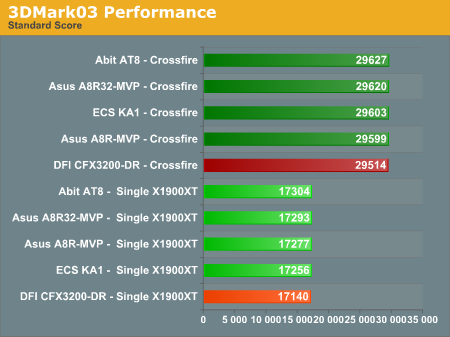
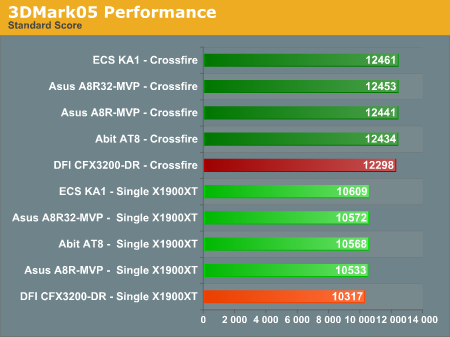
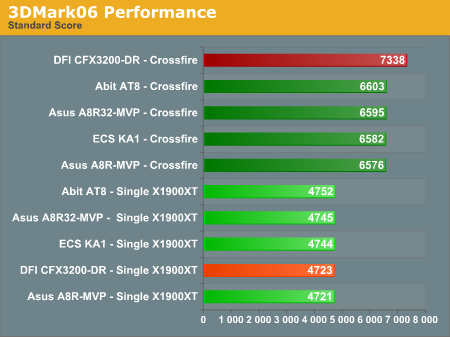
The CFX3200 holds a wide performance lead in CrossFire on 3DMark06 compared to other Rx480 and RD580 motherboards running X1900XT CrossFire. The DFI board does not hold a similar advantage in 3DMark06 when tested with a single X1900XT. 3DMark03 really gains huge performance increases with CrossFire, but results with the DFI are similar to other ATI chipset motherboards in both single and CrossFire modes. The same can be said for 3DMark05, except that CrossFire gains are in the neighborhood of 20% compared to the 70%+ CrossFire gains in 3DM03.
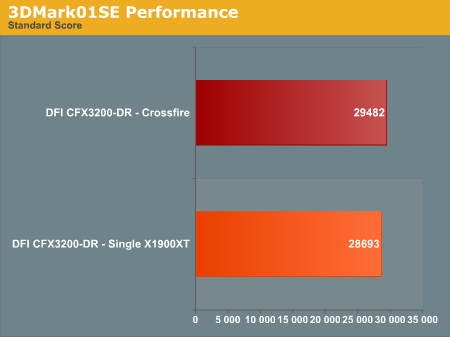
The 03, 05, and 06 are all based on DirectX 9, where 3DMark2001SE is based on DX8. While 3DMark01SE is somewhat dated in DX support it is still widely used by enthusiasts because it is more sensitive to increases in memory bandwidth and CPU speed than later 3DMarks. You can also see that the CrossFire gains in 01SE are very small compared to the DX9 based 3DMarks..
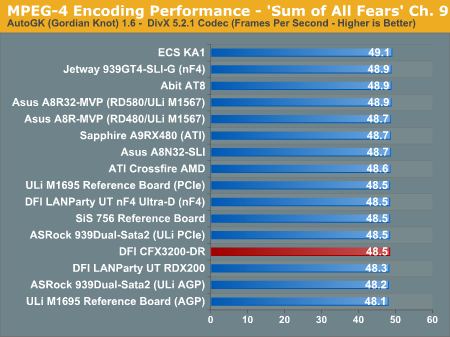
Encoding results should not be affected by the graphics card used during the encoding benchmarks. This is demonstrated again by the archive test results for AutoGK using an AMD 4000+ processor with a wide assortment of video cards. The performance range of those encoding tests is just 48.1 to 49.1 - a difference form high to low of just 1.0 FPS. Clearly the biggest influence on this encoding benchmark is the CPU used for testing. Because encoding test results vary so little on the same standardized motherboard test platform, they will be dropped from future motherboard reviews. Encoding tests are useful in CPU testing, but they have been shown to be poor motherboard tests - particularly on the AMD platform with the memory controller on the CPU.
Originally published at https://www.anandtech.com/show/2002 (Wayback Machine).