
DFI CFX3200-DR: ATI RD580 Tweak Attack
- Posted in
- Motherboards
Board Layout
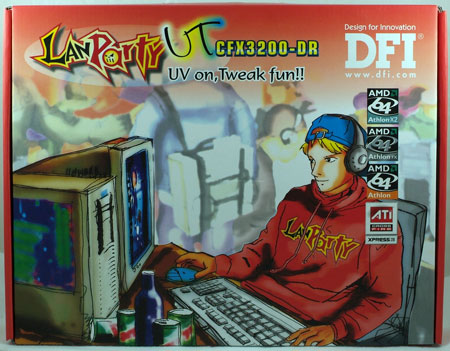
It has been quite a while since DFI released a new LANParty board with all the bells and whistles. Lately the new DFI boards seem to be LANParty UT - basically a LANParty board without the FrontX unit and Carrying harness. Since there are no full-blown LANParty versions of any of these recent boards, DFI should probably just drop the LANParty name since it no longer has any real meaning in their product line. The DFI CFX3200-DR is selling for over $200, however, which is still a LANParty price tag.
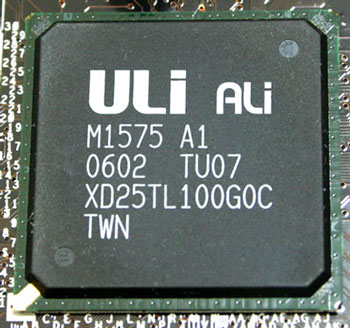
The DFI CFX3200-DR uses the ULi M1575 south bridge instead of the SB450 that was used on the RDX200. That means full support for 4 SATA2 devices, and fully competitive USB performance with 8 USB 2.0 ports. Of the current choices available to ATI chipset builders the ULi looks like the best choice. There are concerns about continued availability since NVIDIA bought ULi. Manufacturers fear that NVIDIA will limit or stop distribution of the M1575 Southbridge. Despite NVIDIA and ULi assurances it certainly appears that the M1575 is getting harder and harder to find these days. The good news is that the updated ATI SB600 with a much updated feature set is now sampling. With the SB600 expected at AM2 launch in a few weeks manufacturers will finally have a competitive ATI SB option for use with the RD580 Northbridge.
DFI decided to pass on the 2-chip NVIDIA dual X16 solution, so this CFX3200-DR is their first and only dual X16 board. Careful thought went into the X16 slot spacing, as DFI chose the 2-slot spacing to allow plenty of room for GPU cooling options.
 |
| Click to enlarge |
Appearance of the board is typical LANParty, with Day-Glo slots and matching neon cables. This is a love/hate kind of thing - some love the LANParty look while others prefer a more sedate appearance. The functional layout, on the other hand, is one that should work well for any system builder.
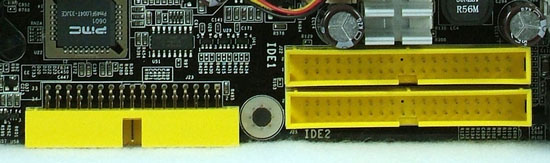
IDE/Floppy connectors are on the preferred right edge of the board, but it will be easiest to connect the floppy edge connector before screwing down the board.
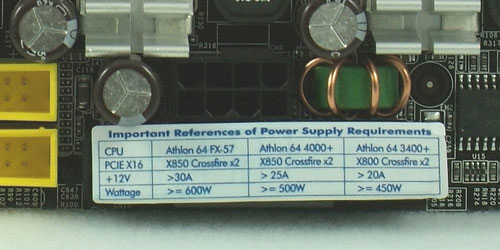
Both the 24-pin ATX and the robust 8-pin 12v connectors are at the right board edge, out of the way of CPU and memory cooling.
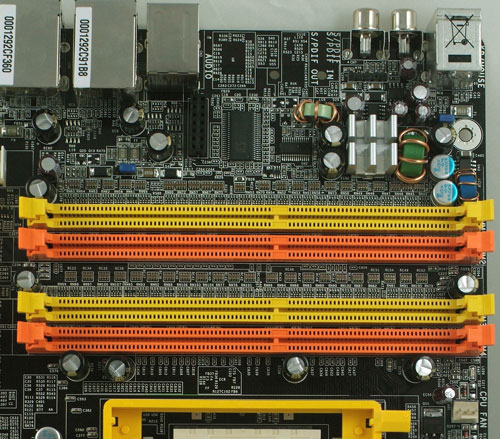
Memory is in an unusual location, between the back IO ports and the CPU. This is not a common location but it works just as well as the more common location to the right of the CPU. Since the AM2 version will be the same except for DDR2 slots it will be interesting to see if DDR2 memory trace design may have influenced this new location. With many systems now using rear case fans, the RAM location may also provide for better cooling of the DIMMs, so while different the change certainly isn't bad.
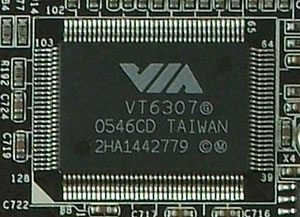
Firewire has been ignored by DFI on many recent boards, but that is not the case on the CFX3200. A rear firewire port is included as well as a header for an additional IEEE1394 port. Firewire is driven by the VIA VT6307 chip. Some Firewire users would probably still like to see 1394B support, but 1394A is better than nothing.
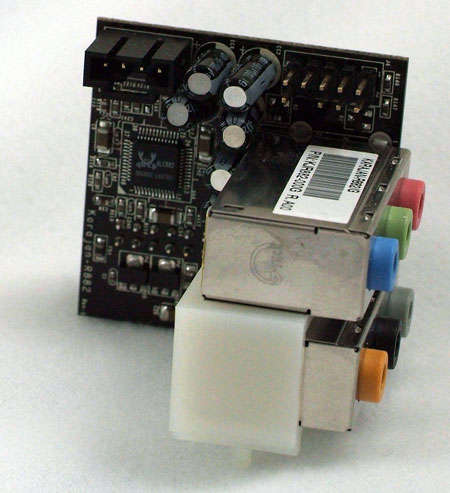
As in previous LANParty motherboards, DFI has isolated HD audio on their ATI chipset designs to improve performance and signal-to-noise ratio. The Karajan module provides 8-channel High Definition Azalia audio using the Realtek ALC882. The Realtek is a well-regarded High Definition codec that has performed well in recent tests. Realtek has been upgrading their HD drivers frequently, and each new version seems to improve the performance a bit more. You can find more information on ALC882 HD at Realtek's site.
The ALC882 has superb specifications, providing five 24-bit stereo DACs and three 20-bit stereo DACs driving the multimedia features. All DACs provide sample rates to 192kHz and up to 4 channels of microphone input are supported. Signal-to Noise ratio is specified to be greater than 103dB. Realtek features the ALC882 as a premium HD part.
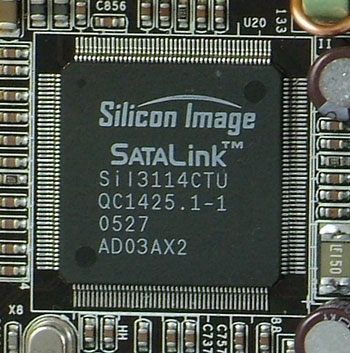
It is a real puzzle that DFI continues to use the Silicon Image 3114 SATA controller on their motherboards. This chip only supports the older SATA spec of 1.5Gb/s, and it has not been a stellar performer in our earlier reviews. With so many excellent and more recent choices available from Silicon Image, it appears DFI must have a warehouse full of these chips to get rid of. Better choices would have been the 3132 or the 4-channel version of that chip. The use of the SIL3114 is not a critical problem on the CFX3200 because the ULi M1575 does provide 4 SATA2 3Gb/s channels for SATA drives. It is just odd the SATA add-on chosen would be the older, less featured 3114.
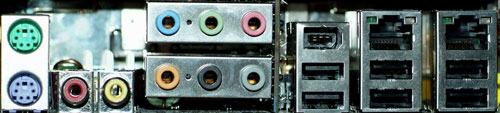
The DFI CFX3200-DR provides a large compliment of rear IO connectors, including both in/out coaxial S/PDIF; however, there are no connections for Optical S/PDIF. 6 USB ports and 6 programmable audio mini jacks are accessible on the rear panel. There are also two Gigabit PCIe connections, Firewire, and the typical PS2 mouse and keyboard ports. If a parallel port is still important to you for printer connections you won't find one on this board. Serial port connectors are also absent from the real panel, but you will find a COM header on the motherboard in case you need a serial port.
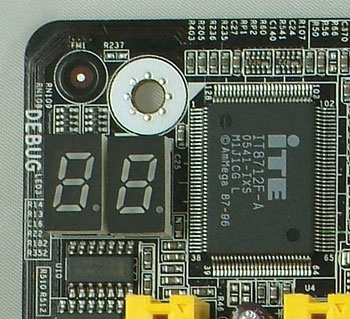
A standard and welcomed feature on top DFI boards is the diagnostic display and the power on and reset momentary switches. These are both very useful for a diagnostic testing when errors occur and for testing the board outside a case. DFI is very serious about the enthusiast target market for their motherboards. This shows in features like the diagnostic display and on-board switches. It is also reflected from the design of the board to the use of the best components rationally available for capacitors and other components.
Originally published at https://www.anandtech.com/show/2002 (Wayback Machine).