
Intel Core versus AMD's K8 architecture
- Posted in
- CPUs
Out of Order execution: AMD versus Intel
To make this article more accessible and to make the differences between the AMD K8 and the new Intel Core architecture more clear, I tried to make both CPU diagrams in the same style. Here's the Core architecture overview: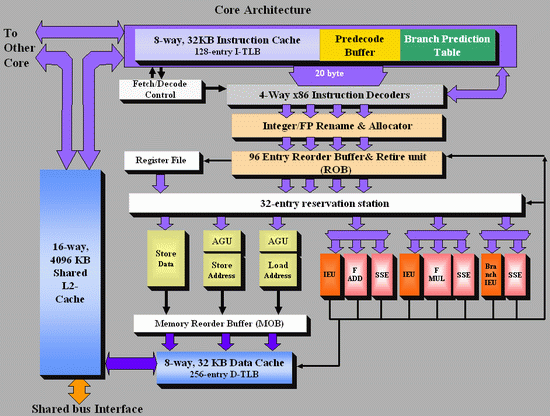
And here's the K8 architecture:
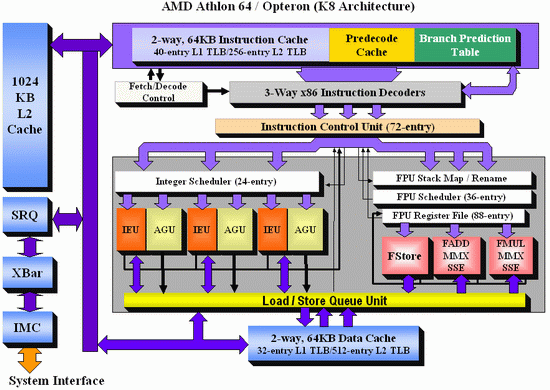
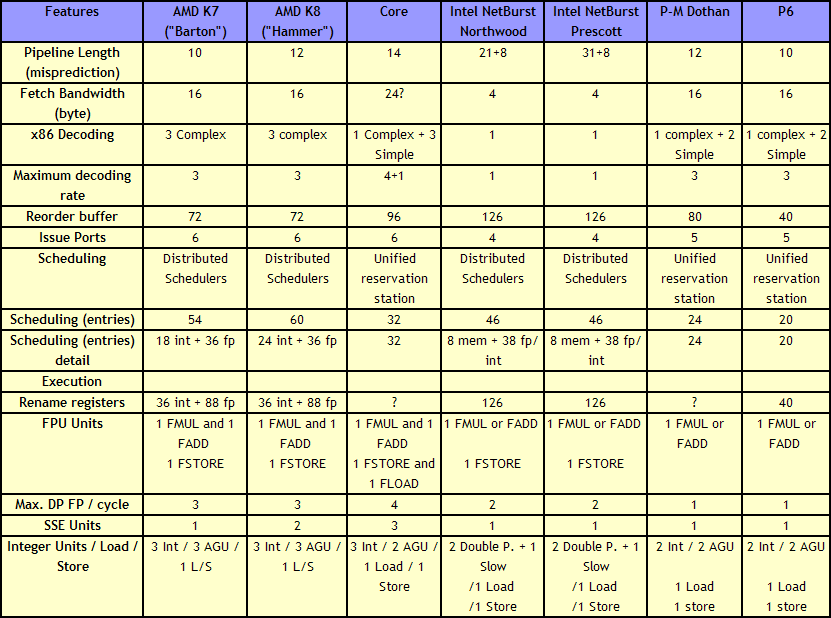
There are a few obvious differences: Core has bigger OoO buffers: the 96 entry ROB buffer is - also thanks to Macro-op fusion - quite a bit bigger than the 72 Entry Macro-op buffer of K8. The P6 architecture could order only 40 instructions, this was doubled to 80 in the P-M architecture (Banias, Dothan, Yonah), and now it's increased even further to 96 for the Core architecture. We've created a table which compares the most important architectural details of several current CPU families:
 |
| Click to enlarge |
The Core architecture uses a central reservation station, while the Athlon uses distributed schedulers. The advantage of a central reservation station is that utilization is better, however distributed schedulers allow more entries. NetBurst also uses distributed schedulers.
Using a central reservation station is another clear example of how Core is in fact the "P8", the second big improvement of the P6 architecture. Just like the P6 architecture, it uses a Reservation Station (RS) and allocates a specific execution unit to execute the micro-op. After execution, the micro-op results are stored in the ROB entry for that micro-op. This aspect of the Core design is clearly taken from the Yonah, Dothan and P6 architectures.
The biggest differences are not immediately visible on the diagrams above. Previous Intel architectures can only perform one branch prediction every two cycles, but Core can sustain one branch per cycle. The Athlon 64 can also perform one branch prediction per cycle.
Another impressive area is Core's SSE multimedia power. Three very powerful 128-bit SSE/SSE2/SSE3 units are available, and two of them are symmetric. Core will outperform the Athlon 64 vastly when it comes to 128-bit SSE2/3 processing.
On K8, 128-bit SSE instructions are decoded into two separate 64-bit instructions. Each Athlon 64 SSE unit can only do one 64-bit instruction at a time, so the Core architecture has essentially at least 2 times the processing power here. With 64-bit FP, Core can do 4 Double Precision FP calculations per cycle, while the Athlon 64 can do 3.
When it comes to integer execution resources, the Core architecture is an improvement over the Pentium 4 and Dothan CPUs, and is at the same level (if we only look at the number of execution units) as the Athlon 64. The Athlon 64 seems to have a small advantage when it comes to calculating addresses: it has 3 AGU compared to Core's 2. This could give the Athlon 64 an advantage in some less common integer workloads such as decrypting algorithms. The deeper, more flexible (Memory disambiguation, see further) out of order buffers and bigger, faster L2-cache of the Core should negate this small advantage in most integer workloads.
Originally published at https://www.anandtech.com/show/1998 (Wayback Machine).