
ASUS A8R32-MVP: Taking the Overclocking Route via the 0404
- Posted in
- Motherboards
Performance Results
What good is an article without some actual performance numbers? If you dozed off during the last couple of pages, hopefully this information should be more enjoyable. While we are not providing numbers from the entire test suite there is enough information here to draw conclusions about what general settings work best in some of today's latest game engines.
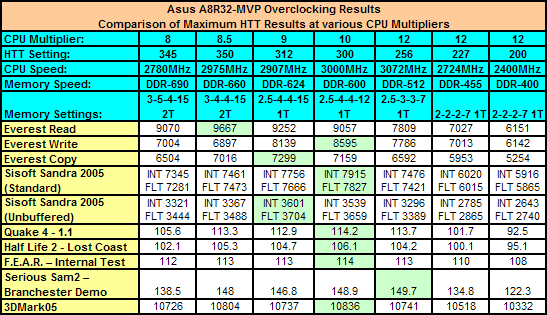
In our tests it is clear a balanced setting between maximizing the CPU clock speed while maintaining a 1:1 memory ratio with the lowest latency possible will provide the best results. No surprises there but we really expected the 9x312HTT settings to perform better. This leads us to wonder if our issues with the 9X multiplier are creating lower than anticipated results. Our favorite and highly recommended setting with this CPU/Memory/Motherboard combination is the 12x256HTT setting as it performs within 1% of the 10x300HTT setting while allowing a larger variety of memory module options to be utilized. The system also requires lower memory and chipset voltages with the added benefit of better memory timings when using higher performance modules.
In essence, you are placing your system's performance capability primarily on the CPU's ability to overclock instead of the CPU and Memory overclocks when operating at the 10x300HTT setting. There is some additional overclocking headroom on this board at the 12x256HTT setting while we just barely eked by with the 10x300HTT setup. A 12x260HTT (or higher) setting should match or exceed the 10x300HTT setup in actual application and game benchmarks.
When comparing the top results generated by the 10x300HTT setting to the stock settings we see a CPU speed increase of 25%, memory clock speed of 50%, and Sandra memory benchmarks increasing by 34%. However, this does not directly translate into the same percentage improvements in the game benchmarks. We notice an increase of 23% in Q4, 12% in Half Life 2: Lost Coast, 5% in F.E.A.R., and 22% in Serious Sam II. It is obvious that F.E.A.R. is GPU constrained while the balance of games respond very well to increases in both CPU clocks and memory bandwidth. At the stock CPU/Memory settings we overclocked our EVGA 7900GTX from 650/800 to a safe 690/850 and were rewarded with 112fps compared to our top 114fps score in F.E.A.R.
What good is an article without some actual performance numbers? If you dozed off during the last couple of pages, hopefully this information should be more enjoyable. While we are not providing numbers from the entire test suite there is enough information here to draw conclusions about what general settings work best in some of today's latest game engines.
In our tests it is clear a balanced setting between maximizing the CPU clock speed while maintaining a 1:1 memory ratio with the lowest latency possible will provide the best results. No surprises there but we really expected the 9x312HTT settings to perform better. This leads us to wonder if our issues with the 9X multiplier are creating lower than anticipated results. Our favorite and highly recommended setting with this CPU/Memory/Motherboard combination is the 12x256HTT setting as it performs within 1% of the 10x300HTT setting while allowing a larger variety of memory module options to be utilized. The system also requires lower memory and chipset voltages with the added benefit of better memory timings when using higher performance modules.
In essence, you are placing your system's performance capability primarily on the CPU's ability to overclock instead of the CPU and Memory overclocks when operating at the 10x300HTT setting. There is some additional overclocking headroom on this board at the 12x256HTT setting while we just barely eked by with the 10x300HTT setup. A 12x260HTT (or higher) setting should match or exceed the 10x300HTT setup in actual application and game benchmarks.
When comparing the top results generated by the 10x300HTT setting to the stock settings we see a CPU speed increase of 25%, memory clock speed of 50%, and Sandra memory benchmarks increasing by 34%. However, this does not directly translate into the same percentage improvements in the game benchmarks. We notice an increase of 23% in Q4, 12% in Half Life 2: Lost Coast, 5% in F.E.A.R., and 22% in Serious Sam II. It is obvious that F.E.A.R. is GPU constrained while the balance of games respond very well to increases in both CPU clocks and memory bandwidth. At the stock CPU/Memory settings we overclocked our EVGA 7900GTX from 650/800 to a safe 690/850 and were rewarded with 112fps compared to our top 114fps score in F.E.A.R.
Originally published at https://www.anandtech.com/show/1993 (Wayback Machine).