
First Look: AM2 DDR2 vs. 939 DDR Performance
- Posted in
- CPUs
AM2 Overclocking vs. Socket 939 Overclocking
Comments are often made that any evaluation of AM2 should include overclocking. Those theorists argue that the faster processor clock will move AM2 to the higher "bus" speeds that make for better efficiencies of the DDR2 memory controller - or something along those lines. With the current state of pre-release motherboards and AM2 processors, it just isn't possible to design a test that runs the AM2 at the 666 processor clock as we would like - the hardware is just not there yet. However, we were able to overclock the CPU almost 40% and finally settled on a workable overclock of the AM2, 939, OCZ DDR2-1000, and Crucial Ballistix DDR500.
The DDR2 memory was perfectly stable at a 250x10 processor setting with a DDR2-667 strap. This results (5:3 ratio) in a DDR2-833 memory speed at 3-3-3-10 timings on an equivalent 2.5GHz x2 AM2 CPU. Similarly the Crucial Ballistix was able to run with stability at 250x10 on a downclocked FX60 x2. With 1:1 ratio this resulted in memory at DDR500 3-3-3-7 timings.
The DDR results are in the general ball park of overclocking that would yield the best bandwidth, as is the AM2 overclocking. Both test setups are running at speeds an Enthusiast might run on an overclock with air. We are thus comparing a fast DDR overclock to a fast DDR2 overclock, within each architecture's capability. We are also running the same memory timings, though the DDR2-800 is running at a faster, but typical, speed for DDR2 on the upcoming AM2 and Conroe processors.
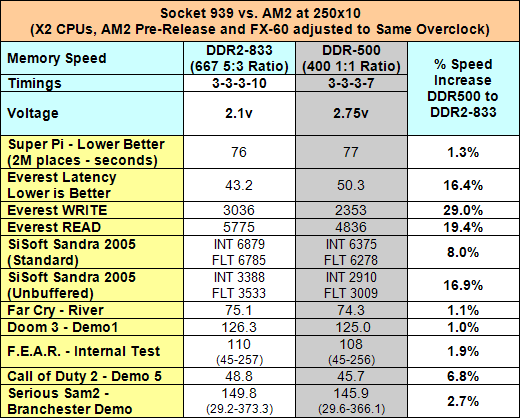
The overclocked test results are very interesting. Comparing DDR500 3-3-3 to DDR2-833 3-3-3 reveals an even greater improvement in latency and bandwidth for the DDR2 than we saw comparing DDR2-800 3-3-3 to DDR400 2-2-2. This is really an unexpected result. DDR2-800 latency is now down to 43.2 and Everest bandwidth increases to 8.8GB/s. DDR2 bandwidth is now 8% to 29% better than the similarly overclocked DDR setup compared to a range of 6.5% to 28.6% on the stock testing. The biggest improvement in the overclocking is Reads, which increase 29% overclocked compared to a 13.3% improvement at stock.
You might expect with an even greater improvement in memory bandwidth, in particular READ speeds, and Latency that a similar improvement in gaming performance would occur. Unfortunately that does not happen, as gaming performance improvements are even less than our stock comparisons. Once again, higher memory bandwidth and lower latency of DDR2 on AM2 just do not translate into markedly improved gaming performance.
Hopefully, this last series of overclocked performance comparisons will finally put into perspective what is and is not possible with improved DDR2 memory performance. Clearly AM2 will launch a bit faster than current Socket 939 performance when comparing the same processor speed. However it is not likely that further increases in DDR2 bandwidth or latency will translate into further improvements in performance with the current AMD/Athlon64 architecture. Further improvements in AM2 performance will have to come with revisions to the core, more cores, die-shrinks and higher speeds, and increases in cache. The move to DDR2 will bring small improvements in performance, but DDR2 alone is not likely to bring the large performance boosts many hope for.
Comments are often made that any evaluation of AM2 should include overclocking. Those theorists argue that the faster processor clock will move AM2 to the higher "bus" speeds that make for better efficiencies of the DDR2 memory controller - or something along those lines. With the current state of pre-release motherboards and AM2 processors, it just isn't possible to design a test that runs the AM2 at the 666 processor clock as we would like - the hardware is just not there yet. However, we were able to overclock the CPU almost 40% and finally settled on a workable overclock of the AM2, 939, OCZ DDR2-1000, and Crucial Ballistix DDR500.
The DDR2 memory was perfectly stable at a 250x10 processor setting with a DDR2-667 strap. This results (5:3 ratio) in a DDR2-833 memory speed at 3-3-3-10 timings on an equivalent 2.5GHz x2 AM2 CPU. Similarly the Crucial Ballistix was able to run with stability at 250x10 on a downclocked FX60 x2. With 1:1 ratio this resulted in memory at DDR500 3-3-3-7 timings.
The DDR results are in the general ball park of overclocking that would yield the best bandwidth, as is the AM2 overclocking. Both test setups are running at speeds an Enthusiast might run on an overclock with air. We are thus comparing a fast DDR overclock to a fast DDR2 overclock, within each architecture's capability. We are also running the same memory timings, though the DDR2-800 is running at a faster, but typical, speed for DDR2 on the upcoming AM2 and Conroe processors.
The overclocked test results are very interesting. Comparing DDR500 3-3-3 to DDR2-833 3-3-3 reveals an even greater improvement in latency and bandwidth for the DDR2 than we saw comparing DDR2-800 3-3-3 to DDR400 2-2-2. This is really an unexpected result. DDR2-800 latency is now down to 43.2 and Everest bandwidth increases to 8.8GB/s. DDR2 bandwidth is now 8% to 29% better than the similarly overclocked DDR setup compared to a range of 6.5% to 28.6% on the stock testing. The biggest improvement in the overclocking is Reads, which increase 29% overclocked compared to a 13.3% improvement at stock.
You might expect with an even greater improvement in memory bandwidth, in particular READ speeds, and Latency that a similar improvement in gaming performance would occur. Unfortunately that does not happen, as gaming performance improvements are even less than our stock comparisons. Once again, higher memory bandwidth and lower latency of DDR2 on AM2 just do not translate into markedly improved gaming performance.
Hopefully, this last series of overclocked performance comparisons will finally put into perspective what is and is not possible with improved DDR2 memory performance. Clearly AM2 will launch a bit faster than current Socket 939 performance when comparing the same processor speed. However it is not likely that further increases in DDR2 bandwidth or latency will translate into further improvements in performance with the current AMD/Athlon64 architecture. Further improvements in AM2 performance will have to come with revisions to the core, more cores, die-shrinks and higher speeds, and increases in cache. The move to DDR2 will bring small improvements in performance, but DDR2 alone is not likely to bring the large performance boosts many hope for.
Originally published at https://www.anandtech.com/show/1991 (Wayback Machine).