
NVIDIA Business Platform: A competitive desktop alternative to Intel?
- Posted in
- IT Computing
Intel's 2006 Desktop Platform
Intel certainly took notice of NVIDA and AMD's stable image platform initiatives and has several exciting technologies in store for their 2006 desktop Stable Image Platform Program.
After discussions with Intel's Frank Soqui, Director of Platform Market Development, and Scott Smith, Press Relations, we have confirmed the upcoming "Conroe" series of processors along with the new "Broadwater" (965) Northbridge, ICH8 Southbridge, and " NINEVEH" network interface will be an integral part of the Intel Professional Business Platform for 2006. Although the exact board level specifics of the Professional Business Platform 2006 have not been finalized, the choice of Conroe and Broadwater is definite at this time. The Fundamental Business Platform for 2006 feature list has not been revealed, but should be available within the next 45 days.
Along with the introduction of Conroe/Broadwater and the resulting increase in the overall performance of the platform, Intel will be concentrating on enhancing the network communications' ability of this platform. In addition to improved communications security and ability with the new " NINEVEH" network interface, Intel's Active Management Technology is receiving an upgrade.
The main change for 2006 is the addition of a Circuit Breaker capability that assists in protecting the network from source-level threats by proactively blocking these threats and then reactively containing infected clients before they impact the network. Intel AMT will also alert IT when critical software agents are removed and makes it easier to keep software and virus protection consistent and up-to-date across the enterprise. Third-party software can store version numbers or policy data in non-volatile memory for off-hours retrieval or updates.
Something else worth noting is that the 2006 business platform will include support for Virtualization Technology (VT). The specifics of how VT relates to the above Circuit Breaker technology - if it plays a role at all - are not yet clear, but previous demonstrations of VT indicate that it at least can be used to help with threat isolation and system management.
Intel will also be moving to a single certified driver stack that covers the chipset, CPU, graphics, network, and communication devices similar to what NVIDIA currently offers. In addition, Intel offers a stable image platform for Notebooks with a new 2006 platform featuring the Core Duo Processor series that was launched this past January. Additional specifications about the Intel SIPP program can be viewed here.
Intel certainly took notice of NVIDA and AMD's stable image platform initiatives and has several exciting technologies in store for their 2006 desktop Stable Image Platform Program.
After discussions with Intel's Frank Soqui, Director of Platform Market Development, and Scott Smith, Press Relations, we have confirmed the upcoming "Conroe" series of processors along with the new "Broadwater" (965) Northbridge, ICH8 Southbridge, and " NINEVEH" network interface will be an integral part of the Intel Professional Business Platform for 2006. Although the exact board level specifics of the Professional Business Platform 2006 have not been finalized, the choice of Conroe and Broadwater is definite at this time. The Fundamental Business Platform for 2006 feature list has not been revealed, but should be available within the next 45 days.
| Specification | Intel Professional Business Platform 2006 |
| CPU Interface | LGA775-based "Conroe" Series Processor |
| Chipset | Intel "Broadwater" 965x - Northbridge Intel ICH8 - Southbridge |
| Expansion Slots | (1) x PCI-E x16 (2) x PCI-E x1 (3) x PCI 2.3 (Proposed) |
| Onboard USB 2.0 | (8) USB2.0 ports |
| Onboard LAN | Intel "NINEVEH" Network Interface |
| Onboard Audio | High Definition Audio Codec |
| Other Features | Intel AMT - enables IT staff to diagnose, repair, and manage remote PCs regardless of OS or system state. Remote systems require a network connection and power source. Trusted Platform Module 1.2 VT Enabled ATX Form Factor |
Along with the introduction of Conroe/Broadwater and the resulting increase in the overall performance of the platform, Intel will be concentrating on enhancing the network communications' ability of this platform. In addition to improved communications security and ability with the new " NINEVEH" network interface, Intel's Active Management Technology is receiving an upgrade.
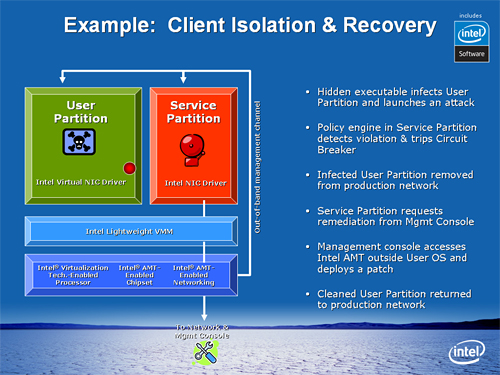
The main change for 2006 is the addition of a Circuit Breaker capability that assists in protecting the network from source-level threats by proactively blocking these threats and then reactively containing infected clients before they impact the network. Intel AMT will also alert IT when critical software agents are removed and makes it easier to keep software and virus protection consistent and up-to-date across the enterprise. Third-party software can store version numbers or policy data in non-volatile memory for off-hours retrieval or updates.
Something else worth noting is that the 2006 business platform will include support for Virtualization Technology (VT). The specifics of how VT relates to the above Circuit Breaker technology - if it plays a role at all - are not yet clear, but previous demonstrations of VT indicate that it at least can be used to help with threat isolation and system management.
Intel will also be moving to a single certified driver stack that covers the chipset, CPU, graphics, network, and communication devices similar to what NVIDIA currently offers. In addition, Intel offers a stable image platform for Notebooks with a new 2006 platform featuring the Core Duo Processor series that was launched this past January. Additional specifications about the Intel SIPP program can be viewed here.
Originally published at https://www.anandtech.com/show/1980 (Wayback Machine).