
NVIDIA Business Platform: A competitive desktop alternative to Intel?
- Posted in
- IT Computing
NVIDIA Business Platform Features
HP, Dell, Gateway, and the majority of tier-one OEMs have been offering various forms of stable image platforms through their business, education, or government solutions groups in recent years. As the complexity and size of enterprise level networks grew, along with the proliferation of networks in other sectors, it became apparent that a different level of integration between hardware and software was required. So, in mid-2003, Intel formally stepped into this market segment with their Stable Image Platform Program (SIPP), and following Intel's tremendous success, AMD introduced their Commercial Stable Image Platform (CSIP) in September of 2005.
Highlights of the program include the NVIDIA Stable Image Platform design that defines the software foundation of the NVIDIA Business Platform. It combines drivers for graphics, audio, networking, storage, and other media & communication processor functionality into a single binary image. NSIP guarantees a single binary image deployment across all platforms, regardless of integrated or discrete graphic configurations. This differs from Intel's image certification which is for integrated graphics only at this time.
Also, NVIDIA offers the only hardware-based firewall solution for a stable image platform, with NVIDIA stating their unique anti-hacking technology will secure each PC from network intrusion. We have not tested this claim and are awaiting a test system to verfiy this feature. Hardware-based firewall technology protects PCs at the network layer from most virus, worm, and spyware attacks. Unlike software-based firewall solutions, ActiveArmor cannot be disabled by malicious code according to NVIDIA. NVIDIA worked closely with Microsoft and Altiris to ensure their new ActiveArmor Firewall allows remote management traffic while still protecting against malware. Wake-on-LAN, PXE, and Firewall filtering is built into the network interface hardware to enable full remote management of the PC provided a network connection and power source is available.
HP, Dell, Gateway, and the majority of tier-one OEMs have been offering various forms of stable image platforms through their business, education, or government solutions groups in recent years. As the complexity and size of enterprise level networks grew, along with the proliferation of networks in other sectors, it became apparent that a different level of integration between hardware and software was required. So, in mid-2003, Intel formally stepped into this market segment with their Stable Image Platform Program (SIPP), and following Intel's tremendous success, AMD introduced their Commercial Stable Image Platform (CSIP) in September of 2005.
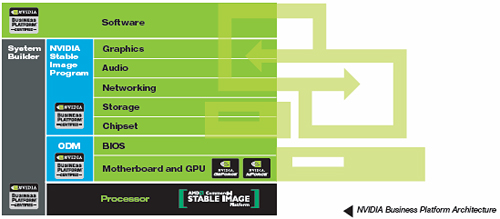
Highlights of the program include the NVIDIA Stable Image Platform design that defines the software foundation of the NVIDIA Business Platform. It combines drivers for graphics, audio, networking, storage, and other media & communication processor functionality into a single binary image. NSIP guarantees a single binary image deployment across all platforms, regardless of integrated or discrete graphic configurations. This differs from Intel's image certification which is for integrated graphics only at this time.
Also, NVIDIA offers the only hardware-based firewall solution for a stable image platform, with NVIDIA stating their unique anti-hacking technology will secure each PC from network intrusion. We have not tested this claim and are awaiting a test system to verfiy this feature. Hardware-based firewall technology protects PCs at the network layer from most virus, worm, and spyware attacks. Unlike software-based firewall solutions, ActiveArmor cannot be disabled by malicious code according to NVIDIA. NVIDIA worked closely with Microsoft and Altiris to ensure their new ActiveArmor Firewall allows remote management traffic while still protecting against malware. Wake-on-LAN, PXE, and Firewall filtering is built into the network interface hardware to enable full remote management of the PC provided a network connection and power source is available.
Originally published at https://www.anandtech.com/show/1980 (Wayback Machine).