
Sun’s T2000 “Coolthreads” Server: First Impressions and Experiences
- Posted in
- IT Computing
The Slim T1 CPU
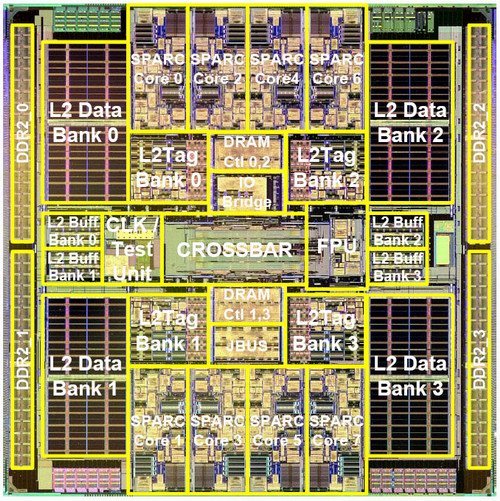
It is very unfair of us to compare one of the eight very slim T1 cores to mammoths like the Opteron or the Xeon, which have about 10 to 20 times more transistors. Still, we are curious. We know that Sun sacrificed single-threaded performance on the altar of power consumption, multi-threaded performance and die space. How far did they go? Let us find out with LMBench 3.0a. By the way, you can find much more information about the T1 CPU in our previous article.
Sun has definitely favoured power consumption here. A 3-cycle latency at 1 GHz on a 90 nm process is very conservative. A 22-cycle L2-cache latency is even a bit slow, but again, the thread Gatling gun takes care of that. The built-in memory controllers pay off: latency is about 105 cycles, while even the Pentium-M needs 147 cycles. This helps to keep the average latency (seen from viewpoint of the CPU) low.
Let us see if there is some integer crunching power in the little Sparc core.
The very common ADD instruction is executed in one cycle, but it takes no less than 29 cycles to multiply and 104 to divide. Faster mul and division would have taken up much more die space and consumed much more power. Considering that those instructions are very rare in most server workloads, this is a pretty clever trade-off. Update: the Sun documentation tell us 7-11 cycles for multiply and 72 for division.
Let us check out what the lonely FPU of the T1 can do.
FADD and FMUL are a little faster than what we first reported (40 cycles), and the main part of that latency might just consist of getting the data to the FPU of the T1. It is clear that the Sun T1 doesn't like FP code at all.
It is very unfair of us to compare one of the eight very slim T1 cores to mammoths like the Opteron or the Xeon, which have about 10 to 20 times more transistors. Still, we are curious. We know that Sun sacrificed single-threaded performance on the altar of power consumption, multi-threaded performance and die space. How far did they go? Let us find out with LMBench 3.0a. By the way, you can find much more information about the T1 CPU in our previous article.
| CPU (LMBench) | OS | Clockspeed | L1 (ns) | L1 (cycles) | L2 (ns) | L2 (cycles) | RAM (ns) | RAM (cycles) |
| Opteron 275 | SunOS 5.10 | 2211 | 1.357 | 3 | 5.436 | 12 | 67.5 | 149 |
| Pentium- M 1.6 GHz | Linux 2.6.15- | 1593 | 1,880 | 3 | 6 | 10 | 92.1 | 147 |
| Sun T1 1 GHz | SunOS 5.10 | 980 | 3.120 | 3 | 22.1 | 22 | 107.5 | 105 |
| Opteron 275 | Linux 2.6.15- | 2209 | 1.357 | 3 | 5 | 12 | 73 | 161 |
| Xeon Irwindale 3.6 GHz | Linux 2.6.15- | 3594 | 1.110 | 4 | 8 | 28 | 48.8 | 175 |
Sun has definitely favoured power consumption here. A 3-cycle latency at 1 GHz on a 90 nm process is very conservative. A 22-cycle L2-cache latency is even a bit slow, but again, the thread Gatling gun takes care of that. The built-in memory controllers pay off: latency is about 105 cycles, while even the Pentium-M needs 147 cycles. This helps to keep the average latency (seen from viewpoint of the CPU) low.
Let us see if there is some integer crunching power in the little Sparc core.
| CPU (LMBench) | OS | Bit | Add | mul | div | mod |
| Opteron 275 | SunOS 5.10 | 0.45 | 0.45 | 1.36 | 18.60 | 19.00 |
| Pentium- M 1.6 GHz | Linux 2.6.15- | 0.63 | 0.63 | 2.51 | 19.50 | 11.50 |
| Sun T1 1 GHz | SunOS 5.10 | 1.01 | 1.00 | 29.10 | 104.00 | 114.00 |
| Opteron 275 | Linux 2.6.15- | 0.45 | 0.45 | 1.36 | 18.60 | 19.00 |
| Xeon Irwindale 3.6 GHz | Linux 2.6.15- | 0.28 | 0.28 | 2.79 | 17.30 | 23.30 |
The very common ADD instruction is executed in one cycle, but it takes no less than 29 cycles to multiply and 104 to divide. Faster mul and division would have taken up much more die space and consumed much more power. Considering that those instructions are very rare in most server workloads, this is a pretty clever trade-off. Update: the Sun documentation tell us 7-11 cycles for multiply and 72 for division.
Let us check out what the lonely FPU of the T1 can do.
| CPU (LMBench) | OS | FADD | FMUL | FDIV |
| Opteron 275 | SunOS 5.10 | 1.80 | 1.80 | 10.90 |
| Pentium- M 1.6 GHz | Linux 2.6.15- | 1.88 | 3.14 | 23.90 |
| Sun T1 1 GHz | SunOS 5.10 | 26.50 | 29.30 | 54.20 |
| Opteron 275 | Linux 2.6.15- | 1.81 | 1.81 | 9.58 |
| Xeon Irwindale 3.6 GHz | Linux 2.6.15- | 1.39 | 1.95 | 12.60 |
FADD and FMUL are a little faster than what we first reported (40 cycles), and the main part of that latency might just consist of getting the data to the FPU of the T1. It is clear that the Sun T1 doesn't like FP code at all.
Originally published at https://www.anandtech.com/show/1977 (Wayback Machine).