
VIA PT880 PRO: Biostar’s Deluxe Dual Combo
- Posted in
- Motherboards
Final Words
The Biostar PT880 Pro-A7 Combo is certainly an interesting board due to its ability to bridge the upgrade path from AGP to PCI Express graphics or from DDR to DDR2 memory technology. However, the performance of the board was dismal at best in our benchmarks compared to the more recent Intel and NVIDIA chipsets. The stability of the board with the varying combinations of AGP, PCI, DDR, and DDR2 peripherals was very good at stock or auto settings, but it is definitely not made for enthusiasts.
With that said, let's move on to our performance opinions regarding this board.
In the video area, the inclusion of both a single PCI Express X4 mode slot and an AGP 3.0 slot provides an upgrade path or the ability to use an older AGP based card with your Pentium 4 LGA socket 775 CPU. This setup also allows for dual card operation and provides the ability to operate up to four monitors. While in theory each graphics card should be able to run at full 3D acceleration simultaneously, our limited testing showed that only the primary display adapter chosen in Windows XP was capable of this while the secondary display seemed to run at near or non-3D acceleration the majority of time.
In the on-board audio area, the Biostar board offers the Realtek ALC-655 AC97 audio codec. While the VIA VT8237R chipset fully supports 7.1 audio via the excellent VIA Envy24PT audio controller, Biostar only provided 5.1 AC97 capabilities. The audio output of this codec in the music, video, and DVD areas is decent for an on-board solution. The audio quality in gaming was fair, but it did not match the output of the Sound Blaster X-FI or even the Realtek ALC-882. If you plan on utilizing this board for gaming, and we do not, then our recommendation is to purchase an appropriate sound card for consistency in frame rates and improved audio quality. However, the Realtek ALC-655 should suffice for the majority of home/office users.
In the storage area, the Biostar board offers the standard storage options afforded by the VIA VT8237R. The board offers SATA RAID 0, 1, and 1.5Gb/s support along with dual channel ATA133 Ultra DMA capability. The board also offers eight VIA USB 2.0 ports when utilizing the two USB 2.0 headers. The performance of the VIA SATA and IDE controllers is average and finished near the nForce4 and Intel solutions, though we did not report these results. If you have purchased a SATA 3Gb/s capable drive you will need to be sure to jumper the drive for 1.5Gb/s operation as the VIA VT8237R is not upwardly compatible with the newer SATA 3Gb/s drive designs.
In the performance area, the Biostar PT880 Pro-A7 Combo generated abysmal benchmark scores in the gaming and media encoding areas. The overall performance of the board in other areas was below average at best. The stability of the board was very good during testing. At stock speeds, there were no reported issues, but once we started overclocking the board, it became very easy to crash our system past the 222MHz FSB limit.
We feel that Biostar made the following errors in the design and execution of the board. The choice of the Realtek 8201CL 10/100Mb/s PCI Ethernet PHY is a mistake when a PCI Gigabit Ethernet controller is available. Although most home network users might not exceed 100Mb/s operations, the lack of Gigabit Ethernet capability in a board today is a mistake.
The use of the Realtek ALC-655 audio codec is an error when VIA's own Envy24PT solution is readily available at this time. Although the ALC-655 is fine for most users purchasing this board, an upgraded audio solution could not hurt.
We believe that Biostar has done a good job in designing a board based upon the VIA PT880 PRO chipset. At this time, we feel like this is a board that was released for a market that is no longer around. The feature set and performance of the board would have been very good when the 925x and 915 chipsets were released almost two years ago. The ability to run AGP graphics and to utilize existing DDR memory technology with a built-in upgrade path to PCI Express graphics and DDR2 would have been a feature set that most people would have seriously considered or purchased at that time. We believe that anyone currently considering an LGA socket 775 CPU is probably looking for better overall system performance via an upgrade to a recent PCI Express graphics card and performance oriented DDR2 memory.
Sometimes, it is best to endure change.
The Biostar PT880 Pro-A7 Combo is certainly an interesting board due to its ability to bridge the upgrade path from AGP to PCI Express graphics or from DDR to DDR2 memory technology. However, the performance of the board was dismal at best in our benchmarks compared to the more recent Intel and NVIDIA chipsets. The stability of the board with the varying combinations of AGP, PCI, DDR, and DDR2 peripherals was very good at stock or auto settings, but it is definitely not made for enthusiasts.
With that said, let's move on to our performance opinions regarding this board.
In the video area, the inclusion of both a single PCI Express X4 mode slot and an AGP 3.0 slot provides an upgrade path or the ability to use an older AGP based card with your Pentium 4 LGA socket 775 CPU. This setup also allows for dual card operation and provides the ability to operate up to four monitors. While in theory each graphics card should be able to run at full 3D acceleration simultaneously, our limited testing showed that only the primary display adapter chosen in Windows XP was capable of this while the secondary display seemed to run at near or non-3D acceleration the majority of time.
In the on-board audio area, the Biostar board offers the Realtek ALC-655 AC97 audio codec. While the VIA VT8237R chipset fully supports 7.1 audio via the excellent VIA Envy24PT audio controller, Biostar only provided 5.1 AC97 capabilities. The audio output of this codec in the music, video, and DVD areas is decent for an on-board solution. The audio quality in gaming was fair, but it did not match the output of the Sound Blaster X-FI or even the Realtek ALC-882. If you plan on utilizing this board for gaming, and we do not, then our recommendation is to purchase an appropriate sound card for consistency in frame rates and improved audio quality. However, the Realtek ALC-655 should suffice for the majority of home/office users.
In the storage area, the Biostar board offers the standard storage options afforded by the VIA VT8237R. The board offers SATA RAID 0, 1, and 1.5Gb/s support along with dual channel ATA133 Ultra DMA capability. The board also offers eight VIA USB 2.0 ports when utilizing the two USB 2.0 headers. The performance of the VIA SATA and IDE controllers is average and finished near the nForce4 and Intel solutions, though we did not report these results. If you have purchased a SATA 3Gb/s capable drive you will need to be sure to jumper the drive for 1.5Gb/s operation as the VIA VT8237R is not upwardly compatible with the newer SATA 3Gb/s drive designs.
In the performance area, the Biostar PT880 Pro-A7 Combo generated abysmal benchmark scores in the gaming and media encoding areas. The overall performance of the board in other areas was below average at best. The stability of the board was very good during testing. At stock speeds, there were no reported issues, but once we started overclocking the board, it became very easy to crash our system past the 222MHz FSB limit.
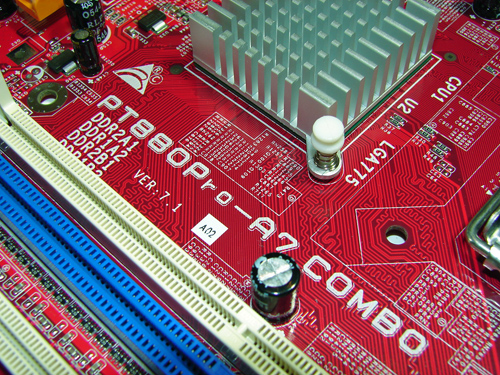
We feel that Biostar made the following errors in the design and execution of the board. The choice of the Realtek 8201CL 10/100Mb/s PCI Ethernet PHY is a mistake when a PCI Gigabit Ethernet controller is available. Although most home network users might not exceed 100Mb/s operations, the lack of Gigabit Ethernet capability in a board today is a mistake.
The use of the Realtek ALC-655 audio codec is an error when VIA's own Envy24PT solution is readily available at this time. Although the ALC-655 is fine for most users purchasing this board, an upgraded audio solution could not hurt.
We believe that Biostar has done a good job in designing a board based upon the VIA PT880 PRO chipset. At this time, we feel like this is a board that was released for a market that is no longer around. The feature set and performance of the board would have been very good when the 925x and 915 chipsets were released almost two years ago. The ability to run AGP graphics and to utilize existing DDR memory technology with a built-in upgrade path to PCI Express graphics and DDR2 would have been a feature set that most people would have seriously considered or purchased at that time. We believe that anyone currently considering an LGA socket 775 CPU is probably looking for better overall system performance via an upgrade to a recent PCI Express graphics card and performance oriented DDR2 memory.
Sometimes, it is best to endure change.
Originally published at https://www.anandtech.com/show/1974 (Wayback Machine).