
Cebit 2006: High end Motherboards and Server News
- Posted in
- Trade Shows
AMD
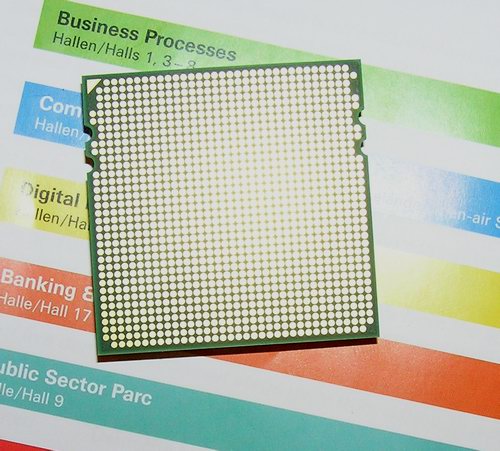
AMD showed the new socket-F Opteron, a CPU with a 1207-pin Organic Land Grid Array (LGA) interface. The socket-F Opteron will support DDR-2 667. The maximum power consumption of these CPUs seems to go up to 95 Watt (Standard) instead of 89 Watt, and 68 instead of 55 Watt for HE low voltage Opterons. On the positive side, the quad core Opterons will not exceed these power requirements. A low voltage (65 nm) quad core Opteron, due in 2007, will consume the same 68 Watt maximum.
AMD also took a stab at Intel's FB-DIMMs strategy. One of the biggest advantages that the Opteron has is the fact that each CPU has its own memory. This allowed a dual Opteron to use 8 DIMMs while the Xeons were limited to 4. Intel's Nocona platform supported DDR-2, which allowed also 8 DIMMs.
Now that AMD moves to Socket-F and DDR-2, the Opteron can use up to 8 DIMMs per CPU. Intel Counters with FB-DIMMs, which uses full duplex serial point-to-point technology.
This technology enables 16 DIMM slots on one board. However AMD points out that the Advanced Memory Buffer (where the serialisation takes place) consumes up to 6 Watt. AMD then claims that this means that Intel systems will consume almost 200 Watt more when equipped with 32 DIMMs of FB-DIMM instead of standard DDR-II.
In a more realistic situation, the memory subsystem of the Intel server with 8 to 16 DIMMs will consume about 24 to 64 Watt more than an Opteron based server and not 100 Watt as AMD's slide seems to indicate.
AMD showed the new socket-F Opteron, a CPU with a 1207-pin Organic Land Grid Array (LGA) interface. The socket-F Opteron will support DDR-2 667. The maximum power consumption of these CPUs seems to go up to 95 Watt (Standard) instead of 89 Watt, and 68 instead of 55 Watt for HE low voltage Opterons. On the positive side, the quad core Opterons will not exceed these power requirements. A low voltage (65 nm) quad core Opteron, due in 2007, will consume the same 68 Watt maximum.
AMD also took a stab at Intel's FB-DIMMs strategy. One of the biggest advantages that the Opteron has is the fact that each CPU has its own memory. This allowed a dual Opteron to use 8 DIMMs while the Xeons were limited to 4. Intel's Nocona platform supported DDR-2, which allowed also 8 DIMMs.
Now that AMD moves to Socket-F and DDR-2, the Opteron can use up to 8 DIMMs per CPU. Intel Counters with FB-DIMMs, which uses full duplex serial point-to-point technology.
This technology enables 16 DIMM slots on one board. However AMD points out that the Advanced Memory Buffer (where the serialisation takes place) consumes up to 6 Watt. AMD then claims that this means that Intel systems will consume almost 200 Watt more when equipped with 32 DIMMs of FB-DIMM instead of standard DDR-II.
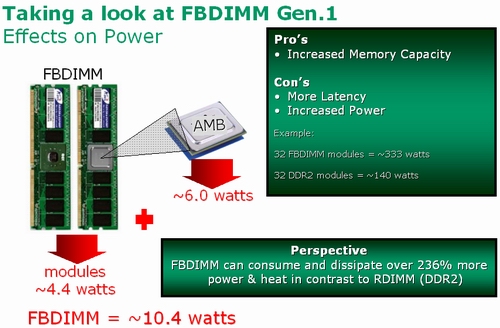
In a more realistic situation, the memory subsystem of the Intel server with 8 to 16 DIMMs will consume about 24 to 64 Watt more than an Opteron based server and not 100 Watt as AMD's slide seems to indicate.
Originally published at https://www.anandtech.com/show/1971 (Wayback Machine).