
Spring IDF 2006: Introducing Intel's new Core processors
- Posted in
- Trade Shows
Single Cycle SSE and Macro-Fusion in Core
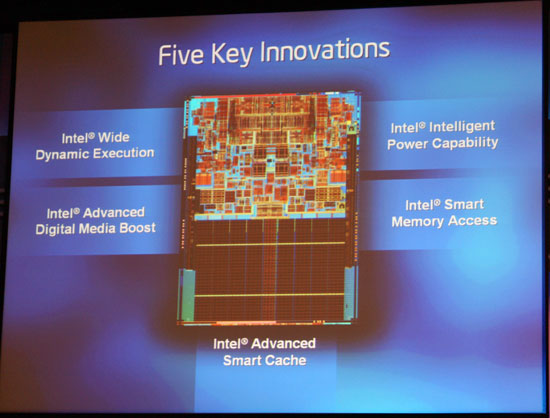
Not spending any time beating around the bush, Justin Rattner immediately jumped into the five key innovations in Intel's new Core micro-architecture.
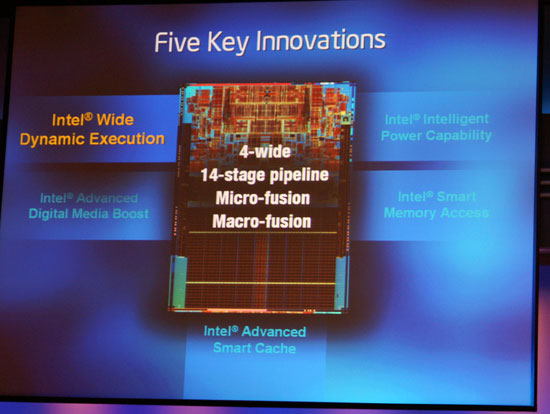
The 4-issue core and 14-stage pipeline were both disclosed at the last IDF and we already knew that the Pentium M's micro-ops fusion would make its way into Conroe, but what's new here is the support for macro fusion. While micro-ops fusion will allow decoded instructions to be sent down the pipe together (as "fused" instructions), macro fusion will allow x86 instructions (before the decode stage) to be fused together and sent down as a single instruction. The example of this that Rattner gave was that Compare and Jump instructions now become a single instruction in the pipeline thanks to Macro-fusion.
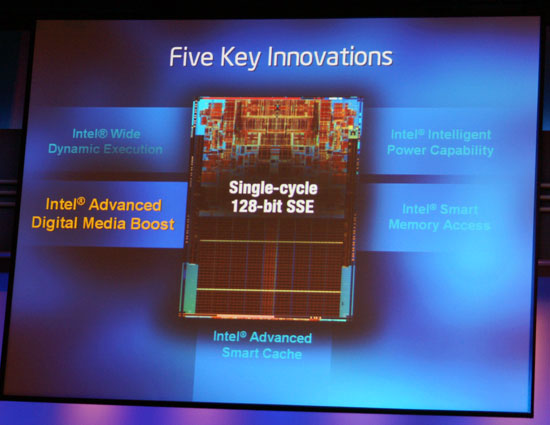
The next major feature of the Core micro-architecture is that now all 128-bit SSE instructions will execute in a single cycle. The single cycle throughput for all SSE instructions should offer some pretty hefty gains in any applications that make extensive use of SSE. We've confirmed that this applies to all SSEn instructions (SSE1/SSE2/SSE3). Updated: Intel clarified the single-cycle SSE item for us. The throughput (not latency) of all SSE instructions is now 1 cycle, whereas in the past it was generally a 2 cycle throughput. The increase in throughput will result in some pretty hefty performance gains in SSE optimized encoding applications.
Originally published at https://www.anandtech.com/show/1961 (Wayback Machine).