
Exclusive: SLI Head-to-Head: Monarch Micro-ATX vs. Shuttle SFF
- Posted in
- Systems
Noise, Heat and Power
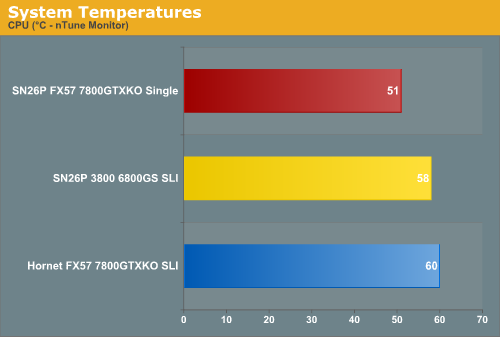
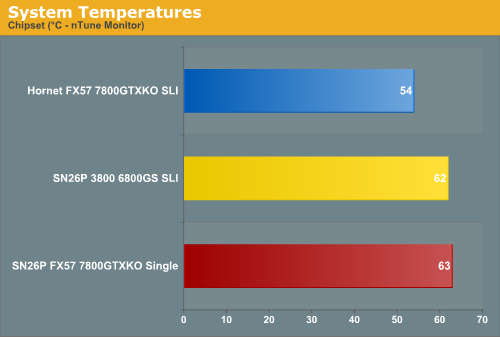
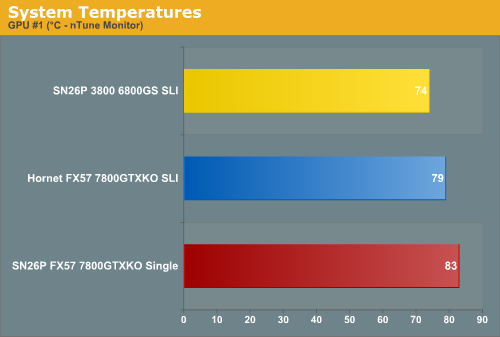
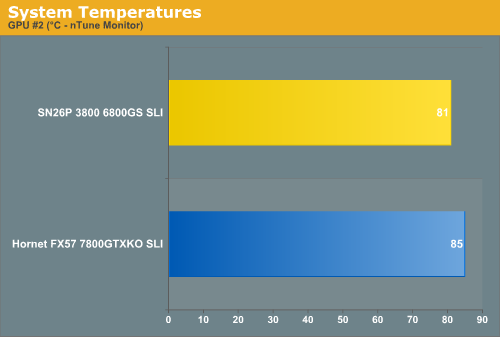
I neglected to get complete results for all the configurations, but simply put, this much computational performance doesn't come in a silent system with a low power draw and heat output. As usual, we measured system power draw at the wall outlet. Noise was measured using an SPL meter at a distance of 12 inches and 4 feet in a room with an ambient noise level of less than 30 dB. (The lower limit on the SPL meter is 30 dB, but that won't matter much for these systems.) For temperatures, we used NVIDIA's nTune Monitor software. CPU load was achieved by running four Futuremark applications (3DMark03, 3DMark05, PCMark04, and PCMark05) in a continual loop for several hours before extracting the maximum temperatures.
Temperatures
First, the Hornet Revenge draws slightly more power for equivalent configurations. That's not too surprising, since it has more fans and a larger motherboard. The power supply may contribute slightly as well, but there's really nothing in the power draw test to raise concern. It is somewhat interesting to note that an old 130 nm Newcastle core appears to draw nearly as much power as the new 90 nm San Diego core, despite the cache and 400 MHz differences. That same comment does not apply to the graphics cards: at idle, the 7800 GTX KO draws about 15W more than a 6800 GS, so two such cards ends up with a 30 W difference. Under load, the 7800 cards draw proportionally more power than the 6800 cards, around 30 to 40 W per card.
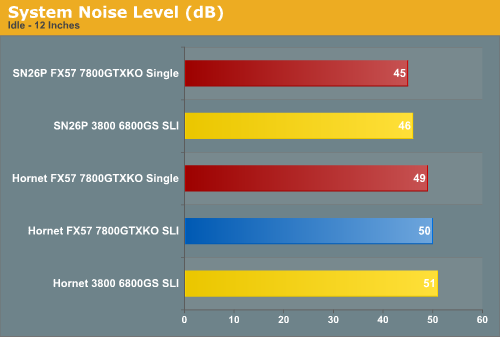
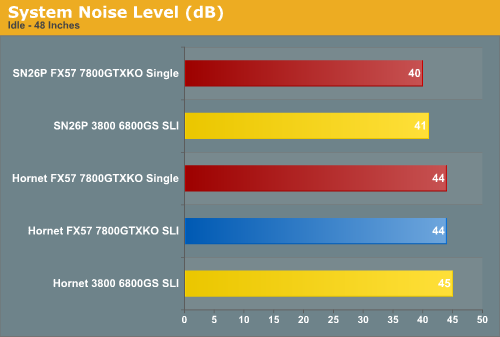
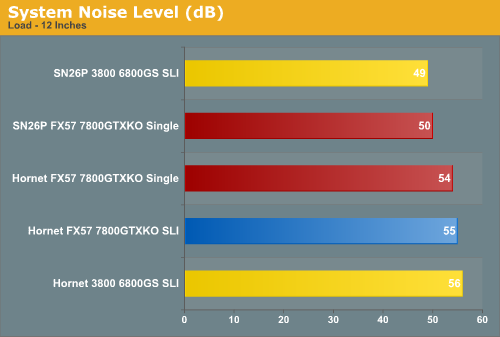
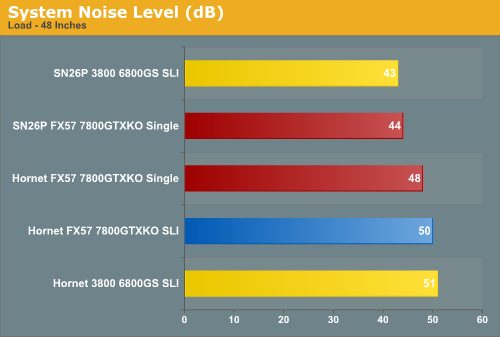
Looking at the noise benchmarks, the difference between graphics cards and CPUs isn't very large. However, the overall system design shows that the Shuttle generates quite a bit less noise. Focusing on the "operator location" measurements at 48 inches, the Revenge is 4 to 6 dB louder, which means roughly twice as loud. Neither one of the systems is particularly quiet, but for high-performance gaming systems, they do fine. Anyone interested in a truly quiet computer is probably worried less about portability and size, and they can look towards water cooling and other alternative cooling configurations. After all, when's the last time that you heard anyone at a LAN party comment about how silent their PC is?
I neglected to get complete results for all the configurations, but simply put, this much computational performance doesn't come in a silent system with a low power draw and heat output. As usual, we measured system power draw at the wall outlet. Noise was measured using an SPL meter at a distance of 12 inches and 4 feet in a room with an ambient noise level of less than 30 dB. (The lower limit on the SPL meter is 30 dB, but that won't matter much for these systems.) For temperatures, we used NVIDIA's nTune Monitor software. CPU load was achieved by running four Futuremark applications (3DMark03, 3DMark05, PCMark04, and PCMark05) in a continual loop for several hours before extracting the maximum temperatures.
Temperatures
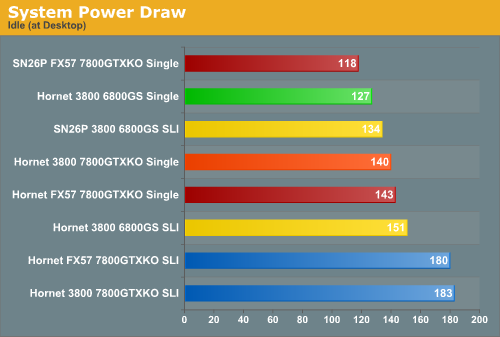
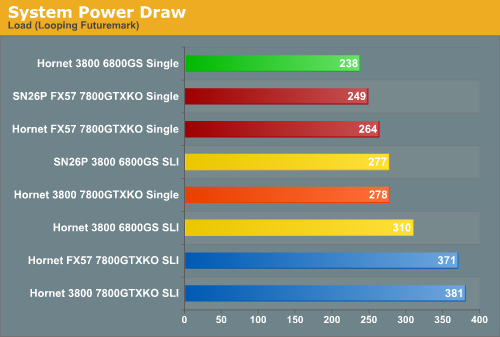
First, the Hornet Revenge draws slightly more power for equivalent configurations. That's not too surprising, since it has more fans and a larger motherboard. The power supply may contribute slightly as well, but there's really nothing in the power draw test to raise concern. It is somewhat interesting to note that an old 130 nm Newcastle core appears to draw nearly as much power as the new 90 nm San Diego core, despite the cache and 400 MHz differences. That same comment does not apply to the graphics cards: at idle, the 7800 GTX KO draws about 15W more than a 6800 GS, so two such cards ends up with a 30 W difference. Under load, the 7800 cards draw proportionally more power than the 6800 cards, around 30 to 40 W per card.
Looking at the noise benchmarks, the difference between graphics cards and CPUs isn't very large. However, the overall system design shows that the Shuttle generates quite a bit less noise. Focusing on the "operator location" measurements at 48 inches, the Revenge is 4 to 6 dB louder, which means roughly twice as loud. Neither one of the systems is particularly quiet, but for high-performance gaming systems, they do fine. Anyone interested in a truly quiet computer is probably worried less about portability and size, and they can look towards water cooling and other alternative cooling configurations. After all, when's the last time that you heard anyone at a LAN party comment about how silent their PC is?
Originally published at https://www.anandtech.com/show/1958 (Wayback Machine).