
Clash of the Titans - TT Tai Chi vs. CM Stacker 830
- Posted in
- Cases/Cooling/PSUs
Benchmark Comparisons
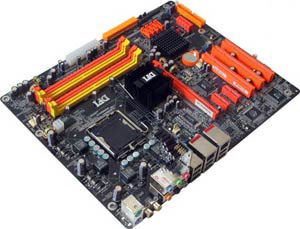
To get as meaningful a comparison as possible between the two cases, we installed the same set of hardware into each one; our new standard ATX test bed. Each system used the default fan configuration that was in the case. Note that our Stacker 830 came with four fans total, but now the product is being released with only the front, rear, and side fan – the top one would have to be added to achieve similar results.
These cases both tout themselves as being the best of the best in terms of thermal capabilities. So, how do they perform? Here's a culmination of the results of averaging the temperatures read over a period of half an hour of various components both at idle and load in our ATX test bed.
As for speculation of performance when these cases are loaded up with additional fans, one could safely expect the temperatures in both cases to scale similarly when adding side fans. The difference here to consider is that the Stacker can hold four 120mm fans, while the Tai Chi can only fit two. Even without a fan in the side at all, the Tai Chi nearly ties the 830 in the motherboard temperature arena, suggesting that it really is doing a better job at passively dissipating heat. This is a testament to the radiator-style design of the side panels, reassuring us that it isn't just a gimmick.
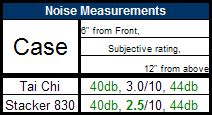
With the finding that the Tai Chi cools just as well as the Stacker 830 with half as many fans, one has to wonder if that means that the Thermaltake fans are making substantially more noise. To see if that's the case, we used our sound pressure level (SPL) meter and rated the system's noise subjectively on a scale from 1 to 10.
To get as meaningful a comparison as possible between the two cases, we installed the same set of hardware into each one; our new standard ATX test bed. Each system used the default fan configuration that was in the case. Note that our Stacker 830 came with four fans total, but now the product is being released with only the front, rear, and side fan – the top one would have to be added to achieve similar results.
| ATX Test Bed | |
| DFI LanParty UT 915P-T12 Pentium 4 530 Prescott 3.0ghz OCZ 512MB DDR2 x 2 Thermaltake Golden Orb II Seagate 120gb SATA Hard Drive Chaintech GeForce 6600GT MSI DVD-CD/R/RW Combo drive MadDog MD-600SCPS PSU |
 |
These cases both tout themselves as being the best of the best in terms of thermal capabilities. So, how do they perform? Here's a culmination of the results of averaging the temperatures read over a period of half an hour of various components both at idle and load in our ATX test bed.
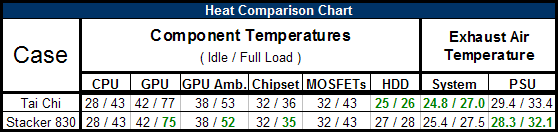
As for speculation of performance when these cases are loaded up with additional fans, one could safely expect the temperatures in both cases to scale similarly when adding side fans. The difference here to consider is that the Stacker can hold four 120mm fans, while the Tai Chi can only fit two. Even without a fan in the side at all, the Tai Chi nearly ties the 830 in the motherboard temperature arena, suggesting that it really is doing a better job at passively dissipating heat. This is a testament to the radiator-style design of the side panels, reassuring us that it isn't just a gimmick.
With the finding that the Tai Chi cools just as well as the Stacker 830 with half as many fans, one has to wonder if that means that the Thermaltake fans are making substantially more noise. To see if that's the case, we used our sound pressure level (SPL) meter and rated the system's noise subjectively on a scale from 1 to 10.
Originally published at https://www.anandtech.com/show/1953 (Wayback Machine).