
Looking Back Pt. 2: X800 & Catalyst Under The Knife
- Posted in
- GPUs
3dMark 2005
As we noted in our previous article, 3dMark isn't something that we normally use in an article due to its nature as a synthetic benchmark instead of being a real game. That being said, it's an excellent diagnostic tool both for its wide customizability and the ability to render specific frames. It's also highly prone to being manipulated (both fairly and unfairly) due to the value that some groups attach to it, so while it has little worth as a good way to compare products, it's a great indicator of just what kind of performance improvements a company can wring out of a video card when given the proper motivation.
Otherwise, there is a very interesting progressive increase in 3dMark performance throughout the entire series of Catalyst drivers, which sits in stark contrast to our game tests.
As we noted in our previous article, 3dMark isn't something that we normally use in an article due to its nature as a synthetic benchmark instead of being a real game. That being said, it's an excellent diagnostic tool both for its wide customizability and the ability to render specific frames. It's also highly prone to being manipulated (both fairly and unfairly) due to the value that some groups attach to it, so while it has little worth as a good way to compare products, it's a great indicator of just what kind of performance improvements a company can wring out of a video card when given the proper motivation.
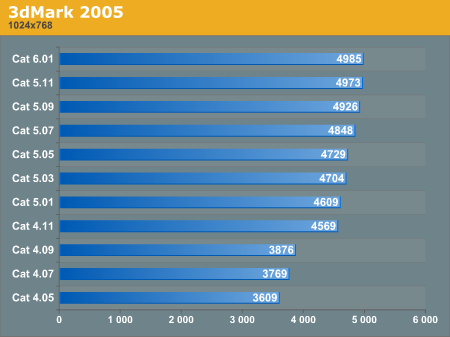
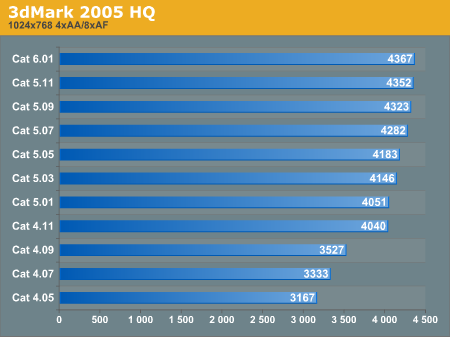
Otherwise, there is a very interesting progressive increase in 3dMark performance throughout the entire series of Catalyst drivers, which sits in stark contrast to our game tests.

Catalyst 4.05 versus 6.01 (mouse over to see 4.05)
Originally published at https://www.anandtech.com/show/1952 (Wayback Machine).