
Crucial Ballistix DDR2: The New DDR2 Standard?
- Posted in
- Memory
Intel 975X Memory Test Configuration
Test Settings
All hard drives were completely formatted with a fresh OS installation. Four partitions were made, with one for the operating system, a small partition containing the paging file, an applications partition, and finally a storage partition. Using standard benchmark practice, all drives were defragmented after installation of programs and before any tests were run. Diskeeper 10 Professional Premier was the defragmentation program of choice.
Memory Module Information:
Crucial DDR2 PC2-6400
DDR2 testing on an Intel based platform proves to be a different beast entirely. Most enthusiasts know well the effects of brute force front side bus clocks, as the memory frequency produces a bigger effect on performance than does latency. It presents a bit of a conundrum as you can use different multipliers and memory ratios, either at a 1:1 ratio or up-clocked via the chipset memory strap. Ideally, a phase changed or water cooled solution might be best for testing, as one could use a 12X multiplier on the 955 EE, ramp the front side bus speeds up to 400 MHz, effectively running at DDR 800 in this manner. By maintaining this same strap during a review of DDR2 products on an Intel based platform, you would be able to see results more comparable to DDR memory testing on an Athlon 64 platform.
A remaining issue with Intel's 955 Extreme Edition processor is that the P4 Netburst architecture is still bottlenecked by its front side bus. Until Intel comes around to an integrated memory controller-type solution favored currently by AMD, it will be hard for them to be competitive on the memory latency front, as current generations of AMD processors have shown in a gaming or multi-tasked environment.
| Processor: | Intel 955 Extreme Edition at 13X Ratio (3.46 GHZ dual core 65nm CPU) |
| RAM: | Crucial Ballistix DDR2 PC2-5300 (2 x 1024 MB) Crucial Ballistix DDR2 PC2-6400 (2 x 1024 MB) |
| Hard Drives: | Maxtor DiamondMax Plus 9 160 GB ATA/133 - 8 MB Cache Seagate 7200.9 ST3500641AS SATA NCQ - 16 MB Cache |
| Video Card: | EVGA 7800 GTX KO 256MB |
| Video Drivers: | NVIDIA ForceWare Release 80/Version: 81.98 |
| Power Supply: | PC Power and Cooling Turbo-Cool 850-SSI |
| Operating System(s): | Windows XP Professional SP2 Windows XP Professional x64 Edition |
| Motherboard: | ASUS P5WD2-Premium |
| BIOS: | AMI version 0302 January 17, 2006 |
Test Settings
All hard drives were completely formatted with a fresh OS installation. Four partitions were made, with one for the operating system, a small partition containing the paging file, an applications partition, and finally a storage partition. Using standard benchmark practice, all drives were defragmented after installation of programs and before any tests were run. Diskeeper 10 Professional Premier was the defragmentation program of choice.
Memory Module Information:
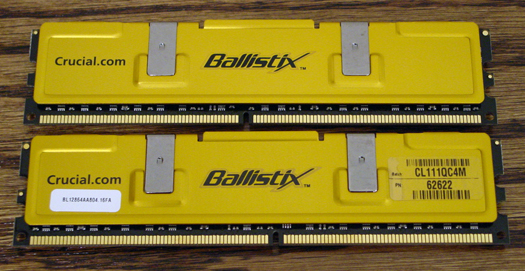
Crucial DDR2 PC2-6400
- Part Number: BL2KIT12864AA804
- Module Size: 2GB kit (1GBx2)
- Package: Ballistix 240-pin DIMM
- Feature: DDR2 PC2-6400
- Configuration: 128Meg x 64
- DIMM Type: UNBUFFERED
- Error Checking: NON-ECC
- Speed: DDR2-800
- Voltage: 2.2V
- Memory Timings: 4-4-4-12
- Specs: DDR2 PC2-6400 (2.2V)
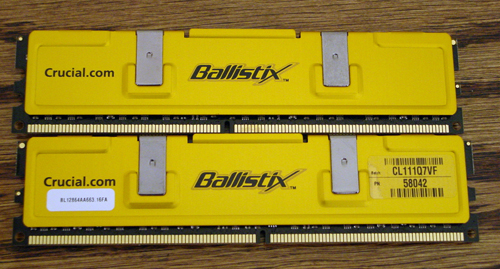
- Part Number: BL2KIT12864AA663
- Module Size: 2GB kit (1GBx2)
- Package: Ballistix 240-pin DIMM
- Feature: DDR2 PC2-5300
- Configuration: 128Meg x 64
- DIMM Type: UNBUFFERED
- Error Checking: NON-ECC
- Speed: DDR2-667
- Voltage: 2.2V
- Memory Timings: 3-3-3-12
- Specs: DDR2 PC2-5300 (2.2V)
DDR2 testing on an Intel based platform proves to be a different beast entirely. Most enthusiasts know well the effects of brute force front side bus clocks, as the memory frequency produces a bigger effect on performance than does latency. It presents a bit of a conundrum as you can use different multipliers and memory ratios, either at a 1:1 ratio or up-clocked via the chipset memory strap. Ideally, a phase changed or water cooled solution might be best for testing, as one could use a 12X multiplier on the 955 EE, ramp the front side bus speeds up to 400 MHz, effectively running at DDR 800 in this manner. By maintaining this same strap during a review of DDR2 products on an Intel based platform, you would be able to see results more comparable to DDR memory testing on an Athlon 64 platform.
A remaining issue with Intel's 955 Extreme Edition processor is that the P4 Netburst architecture is still bottlenecked by its front side bus. Until Intel comes around to an integrated memory controller-type solution favored currently by AMD, it will be hard for them to be competitive on the memory latency front, as current generations of AMD processors have shown in a gaming or multi-tasked environment.
Originally published at https://www.anandtech.com/show/1951 (Wayback Machine).