
X1900 XT/XTX Roundup: A Closer Look at the Performance Leader in Graphics
- Posted in
- GPUs
Overclocking/Power Load/Noise
Overclocking these cards was somewhat difficult, as the usual tool that we use (Powerstrip) didn't support the X1900 yet. Instead, we used a program called ATITool to get our overclocks. Unfortunately, we found that ATITool's listed speeds didn't quite indicate actual performance speeds perfectly, so the clock speeds that we were able to achieve yield slightly lower performance on the card. We were, however, able to get a good idea of the overclocking abilities of these cards with this tool. Here are the clock speeds that we achieved:
Splinter Cell Chaos Theory Performance
The first thing we can point out here is that the Sapphire X1900 XT did in fact achieve clock speeds slightly higher than a stock X1900 XTX. This is an important discovery, as it may give pause to those who would be quick to choose an X1900 XTX over the less expensive XT. The fairly large difference in price between the two cards is enough to justify buying the X1900 XT and attempting to clock it up to XTX speeds. It's true that the PowerColor X1900 XT didn't quite get up to XTX speeds (650/775), which indicates that not everyone will have this kind of success overclocking their X1900 XT. However, as the graphs show, the performance of the PowerColor X1900 XT and the reference X1900 XTX are close enough to each other. So, the fact that the PowerColor has a slightly lower clock is unimportant.
Overall, the overclocks varied quite a bit with the different cards. The XTXs in particular all achieved memory clocks very different from one another, with the GeCube X1900 XTX doing the worst. The Sapphire cards seemed to overclock the best, something that isn't very surprising given our experiences with their cards in the past. The GeCube and PowerColor X1900s achieved the lowest overclocks, with our GeCube being particularly finicky (crashing, artifacts, etc.). Bear in mind, however, that many cards of the exact type can overclock very differently from one another, so this might not be the case for all GeCube X1900 XTXs.
Power Load
To test the power load of the card, we measure the total watt usage of our test computer at the wall outlet, recording the power usage of our system in two different states. The first state is with the card installed and the computer at idle, and the second is during intensive performance tests (looped Splinter Cell benchmarks). This doesn't give us an exact power measurement of the card, but it helps us get an idea of the kind of power the card pulls.
Interestingly, the X1900 XTs and XTXs drew very similar loads. Of the XTXs, the HIS X1900 XTX drew the smallest amount of power under load, which isn't that surprising given its unique HSF. The Sapphire and GeCube XTXs drew nearly the same amount of power under load. We can see that the X1900 XT does pull a slightly lower load than the XTX, but these are both incredibly power-hungry cards.
Noise
Again, we see that the HIS X1900 XTX stands out somewhat as being slightly more quiet than the other cards, likely due to the different HSF. All of these cards are a bit noisier than most, but this isn't very surprising given their enormous power. For reference, the noise level of the room with the system off was 40.6 dbl.
Overclocking these cards was somewhat difficult, as the usual tool that we use (Powerstrip) didn't support the X1900 yet. Instead, we used a program called ATITool to get our overclocks. Unfortunately, we found that ATITool's listed speeds didn't quite indicate actual performance speeds perfectly, so the clock speeds that we were able to achieve yield slightly lower performance on the card. We were, however, able to get a good idea of the overclocking abilities of these cards with this tool. Here are the clock speeds that we achieved:
| Overclock speeds | ||
| Graphics Card | Core (in MHz) | Memory (in MHz) |
| PowerColor X1900 XT | 650.7 | 742.5 |
| Sapphire X1900 XT | 664.2 | 774.0 |
| Sapphire X1900 XTX | 688.5 | 841.5 |
| GeCube X1900 XTX | 679.5 | 801.0 |
| HIS X1900 XTX | 697.5 | 819.0 |
Splinter Cell Chaos Theory Performance
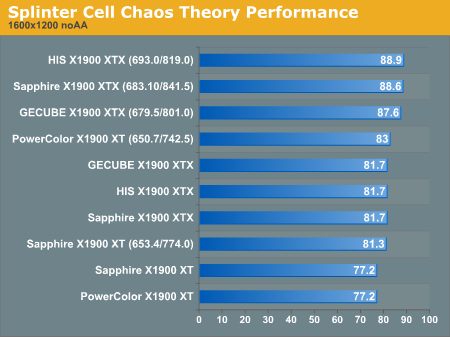
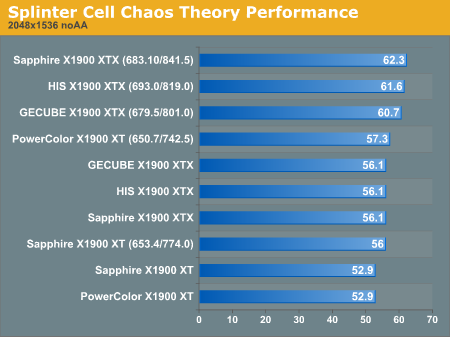
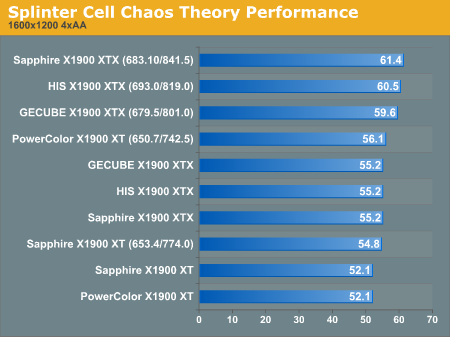
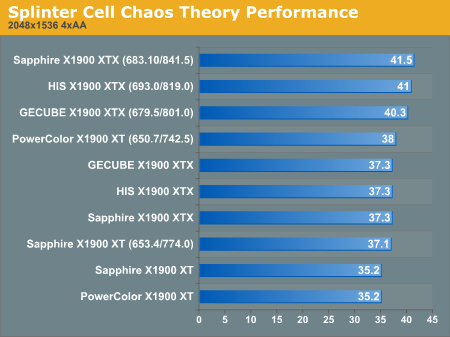
The first thing we can point out here is that the Sapphire X1900 XT did in fact achieve clock speeds slightly higher than a stock X1900 XTX. This is an important discovery, as it may give pause to those who would be quick to choose an X1900 XTX over the less expensive XT. The fairly large difference in price between the two cards is enough to justify buying the X1900 XT and attempting to clock it up to XTX speeds. It's true that the PowerColor X1900 XT didn't quite get up to XTX speeds (650/775), which indicates that not everyone will have this kind of success overclocking their X1900 XT. However, as the graphs show, the performance of the PowerColor X1900 XT and the reference X1900 XTX are close enough to each other. So, the fact that the PowerColor has a slightly lower clock is unimportant.
Overall, the overclocks varied quite a bit with the different cards. The XTXs in particular all achieved memory clocks very different from one another, with the GeCube X1900 XTX doing the worst. The Sapphire cards seemed to overclock the best, something that isn't very surprising given our experiences with their cards in the past. The GeCube and PowerColor X1900s achieved the lowest overclocks, with our GeCube being particularly finicky (crashing, artifacts, etc.). Bear in mind, however, that many cards of the exact type can overclock very differently from one another, so this might not be the case for all GeCube X1900 XTXs.
Power Load
To test the power load of the card, we measure the total watt usage of our test computer at the wall outlet, recording the power usage of our system in two different states. The first state is with the card installed and the computer at idle, and the second is during intensive performance tests (looped Splinter Cell benchmarks). This doesn't give us an exact power measurement of the card, but it helps us get an idea of the kind of power the card pulls.
| Graphics Card | Idle | Load |
| PowerColor X1900 XT | 146 | 315 |
| Sapphire X1900 XT | 148 | 316 |
| Sapphire X1900 XTX | 151 | 336 |
| GeCube X1900 XTX | 154 | 337 |
| HIS X1900 XTX | 152 | 330 |
Interestingly, the X1900 XTs and XTXs drew very similar loads. Of the XTXs, the HIS X1900 XTX drew the smallest amount of power under load, which isn't that surprising given its unique HSF. The Sapphire and GeCube XTXs drew nearly the same amount of power under load. We can see that the X1900 XT does pull a slightly lower load than the XTX, but these are both incredibly power-hungry cards.
Noise
| Graphics Card | dbl level |
| PowerColor X1900 XT | 52.0 |
| Sapphire X1900 XT | 49.6 |
| Sapphire X1900 XTX | 50.2 |
| GeCube X1900 XTX | 51.4 |
| HIS X1900 XTX | 49.5 |
Again, we see that the HIS X1900 XTX stands out somewhat as being slightly more quiet than the other cards, likely due to the different HSF. All of these cards are a bit noisier than most, but this isn't very surprising given their enormous power. For reference, the noise level of the room with the system off was 40.6 dbl.
Originally published at https://www.anandtech.com/show/1946 (Wayback Machine).