
Apple Makes the Switch: iMac G5 vs. iMac Core Duo
- Posted in
- Mac
Architecture and Memory Performance
When Johan did his No More Mysteries article, he found that as a processor, the G5 is quite competitive with modern day x86 CPUs. In fact, he found that it offered floating point performance on par with that of the fastest x86 processor - the Athlon 64/Opteron.
Separately, I looked at Core Duo performance and found that clock-for-clock, it was a pretty solid competitor to AMD's offerings. Intel had effectively created a performance equal to AMD's Athlon 64 at lower clock speeds, without the use of an on-die memory controller.
But now, it's time for judgment day. How does the Core Duo stack up to the G5? Let's start at one of the G5's weakest points - memory speed.
I turned to lmbench and compiled it for both G5 and Intel x86 architectures, and used it to give me some hints to how memory speed has changed with the new platform.
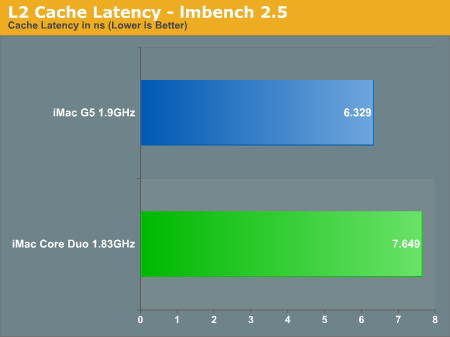
I organized the data in terms of distance from the CPU. So first, we have performance of the on-die L2 cache of these two chips. The Core Duo's L2 cache took 7.649ns to access, which translates into 14 clock cycles, a number that agrees with my ScienceMark results from previous articles.
The 1.83GHz Core Duo features a 64-bit wide 667MHz FSB, offering a similar 5.336GB/s of bandwidth. The FSB connects the chip to a 945 Express MCH with a dual channel DDR2-667 memory controller, providing it with 10.6GB/s of memory bandwidth. However, the Intel based iMac only ships with a single SO-DIMM installed, meaning that it is only operating in single-channel mode - delivering 5.336GB/s of memory bandwidth. I didn't have a DDR2 SO-DIMM on hand to test whether or not installing a second one would actually enable dual channel mode.
The 1.9GHz G5 features a bi-directional 64-bit wide 633MHz FSB, offering a total of 5.06GB/s of bandwidth. The chip connects to a North Bridge that appears to have a dual channel DDR2-533 memory controller, which provides it with 4.264GB/s of memory bandwidth, thanks to only one channel being active. This means that the iMac G5 is slightly memory bandwidth starved.
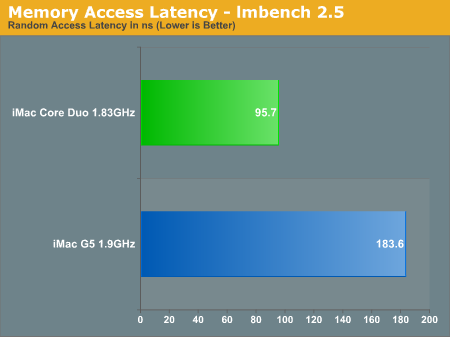
In Johan's article, he uncovered that the G5 is in terrible need of a lower latency memory controller, with memory requests taking almost twice as long as on an Intel platform! Whether it is the G5's FSB or its chipset's memory controller that is at fault is difficult to isolate, but needless to say, the comparison to the Core Duo isn't pretty:
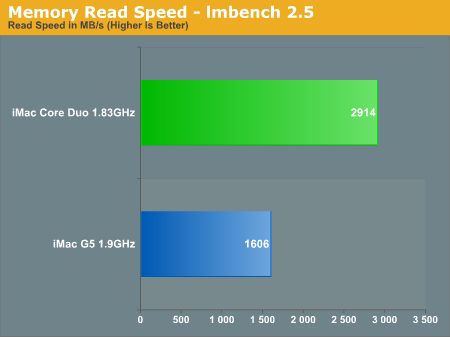
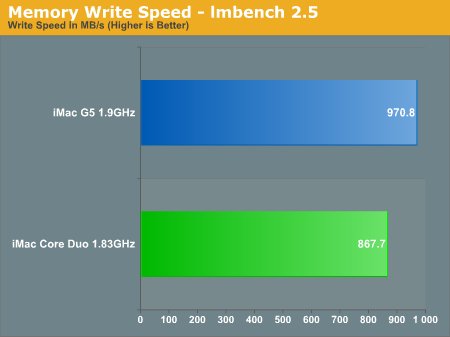
The high latency memory access and slower memory bus is why the G5 suffers tremendously when it comes to memory bandwidth:
When Johan did his No More Mysteries article, he found that as a processor, the G5 is quite competitive with modern day x86 CPUs. In fact, he found that it offered floating point performance on par with that of the fastest x86 processor - the Athlon 64/Opteron.
Separately, I looked at Core Duo performance and found that clock-for-clock, it was a pretty solid competitor to AMD's offerings. Intel had effectively created a performance equal to AMD's Athlon 64 at lower clock speeds, without the use of an on-die memory controller.
But now, it's time for judgment day. How does the Core Duo stack up to the G5? Let's start at one of the G5's weakest points - memory speed.
I turned to lmbench and compiled it for both G5 and Intel x86 architectures, and used it to give me some hints to how memory speed has changed with the new platform.
I organized the data in terms of distance from the CPU. So first, we have performance of the on-die L2 cache of these two chips. The Core Duo's L2 cache took 7.649ns to access, which translates into 14 clock cycles, a number that agrees with my ScienceMark results from previous articles.
The 1.83GHz Core Duo features a 64-bit wide 667MHz FSB, offering a similar 5.336GB/s of bandwidth. The FSB connects the chip to a 945 Express MCH with a dual channel DDR2-667 memory controller, providing it with 10.6GB/s of memory bandwidth. However, the Intel based iMac only ships with a single SO-DIMM installed, meaning that it is only operating in single-channel mode - delivering 5.336GB/s of memory bandwidth. I didn't have a DDR2 SO-DIMM on hand to test whether or not installing a second one would actually enable dual channel mode.
The 1.9GHz G5 features a bi-directional 64-bit wide 633MHz FSB, offering a total of 5.06GB/s of bandwidth. The chip connects to a North Bridge that appears to have a dual channel DDR2-533 memory controller, which provides it with 4.264GB/s of memory bandwidth, thanks to only one channel being active. This means that the iMac G5 is slightly memory bandwidth starved.
In Johan's article, he uncovered that the G5 is in terrible need of a lower latency memory controller, with memory requests taking almost twice as long as on an Intel platform! Whether it is the G5's FSB or its chipset's memory controller that is at fault is difficult to isolate, but needless to say, the comparison to the Core Duo isn't pretty:
The high latency memory access and slower memory bus is why the G5 suffers tremendously when it comes to memory bandwidth:
Originally published at https://www.anandtech.com/show/1936 (Wayback Machine).