
Intel D975XBX: Intel brings their Bad-Axe to Market
- Posted in
- Motherboards
FSB Overclocking Results
We tried two other boards, but we did not have success in increasing the CPU multiplier past 20 or utilizing a combination of the CPU multiplier and the FSB frequency override setting past the reported numbers. Even though this particular CPU has reached 4.4GHz, we could not pass the 4.0GHz mark and maintain stability or complete our test suite. We will be receiving a retail board shortly and will re-examine the overclocking ability of the board with our 840EE, 950D, and 955EE processors.
Memory Stress Testing
Memory stress tests look at the ability of the Intel D975XBX to operate at the officially supported memory frequencies of 667MHz DDR2, at the best performing memory timings that the Corsair CM2X512A-5400UL revision 1.3 will support.
The Intel D975XBX was very stable with 2 DDR2 modules in Dual-Channel at the settings of 3-2-2-8 at 2.1V. We will now install all four available memory slots that are usually more strenuous on the memory subsystem than testing 2 DDR2 modules on a motherboard.
The Intel D975XBX was completely stable with 4 DDR2 modules in Dual-Channel at the settings of 4-2-3-8 and needed the voltage increased to 2.2V. We tried several combinations of memory settings at the CAS Latency of 3, but the board was not stable enough to complete our test suite. This is the first i975x board that we have tested that did not allow a CAS Latency of 3 in our testing with 4 DDR2 modules.
| Front Side Bus Overclocking Testbed | |
| Processor: | Pentium 4 Smithfield LGA 775 840EE Dual Core 3.2GHz |
| CPU Voltage: | 1.5125V (1.4000V default) |
| Memory Settings: | 3-2-2-8 at 667MHz |
| Memory Voltage: | 2.2V |
| MCH Voltage: | 1.60V |
| ICH Voltage: | Default |
| Cooling: | Thermaltake Big Typhoon |
| Power Supply: | OCZ Power Stream 520 |
| Maximum CPU OverClock: | 200fsb x 20 (4000MHz) +25% |
| Maximum FSB OverClock: | 260fsb x 15 (3900MHz) +30% |
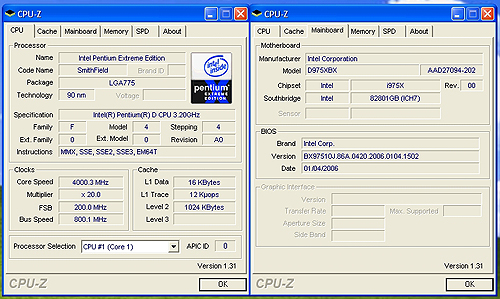
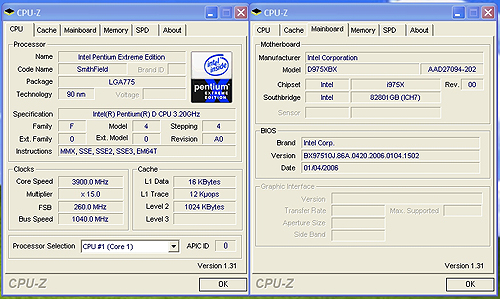
We tried two other boards, but we did not have success in increasing the CPU multiplier past 20 or utilizing a combination of the CPU multiplier and the FSB frequency override setting past the reported numbers. Even though this particular CPU has reached 4.4GHz, we could not pass the 4.0GHz mark and maintain stability or complete our test suite. We will be receiving a retail board shortly and will re-examine the overclocking ability of the board with our 840EE, 950D, and 955EE processors.
Memory Stress Testing
Memory stress tests look at the ability of the Intel D975XBX to operate at the officially supported memory frequencies of 667MHz DDR2, at the best performing memory timings that the Corsair CM2X512A-5400UL revision 1.3 will support.
| Intel D975XBX Stable DDR667 Timings - 2 DIMMs (2/4 slots populated - 1 Dual-Channel Bank) |
|
| Clock Speed: | 200MHz (800FSB) |
| Timing Mode: | 667MHz - Default |
| CAS Latency: | 3 |
| RAS to CAS Delay: | 2 |
| RAS Precharge: | 2 |
| RAS Cycle Time: | 8 |
| Voltage: | 2.1V |
The Intel D975XBX was very stable with 2 DDR2 modules in Dual-Channel at the settings of 3-2-2-8 at 2.1V. We will now install all four available memory slots that are usually more strenuous on the memory subsystem than testing 2 DDR2 modules on a motherboard.
| Intel D975XBX Stable DDR667 Timings - 4 DIMMs (4/4 slots populated - 2 Dual-Channel Banks) |
|
| Clock Speed: | 200MHz (800FSB) |
| Timing Mode: | 667MHz - Default |
| CAS Latency: | 4 |
| RAS to CAS Delay: | 2 |
| RAS Precharge: | 3 |
| RAS Cycle Time: | 8 |
| Voltage: | 2.2V |
The Intel D975XBX was completely stable with 4 DDR2 modules in Dual-Channel at the settings of 4-2-3-8 and needed the voltage increased to 2.2V. We tried several combinations of memory settings at the CAS Latency of 3, but the board was not stable enough to complete our test suite. This is the first i975x board that we have tested that did not allow a CAS Latency of 3 in our testing with 4 DDR2 modules.
Originally published at https://www.anandtech.com/show/1932 (Wayback Machine).