
Intel's Core Duo Launch - Notebook Performance Revealed
- Posted in
- Laptops
Real World Centrino Duo Performance
We’ve already run the full gamut of performance benchmarks on Intel’s Core Duo processor, however those performance tests compared Intel’s latest mobile processor against some of the strongest desktop competitors. What our performance tests here will show is how well the Core Duo competes in the mobile space, or more specifically, how it stacks up to the Pentium M in a notebook.
To assist with our little performance experiment we turned to ASUS, who just happens to know a thing or two about notebooks. You see, ASUS not only has an extensive line of their own notebooks that they manufacture under the ASUS brand, but they also happen to make notebooks for companies like Apple and Dell. So when we asked for two identical notebooks one based on the latest Napa platform and the other based on the previous generation Sonoma platform, ASUS was well equipped to respond.
What they provided us with was two notebooks from their W5 line, which is a line of extremely portable sub-3 pound 12.1” widescreen notebooks. The two models that ASUS provided were the W5F and the W5A.
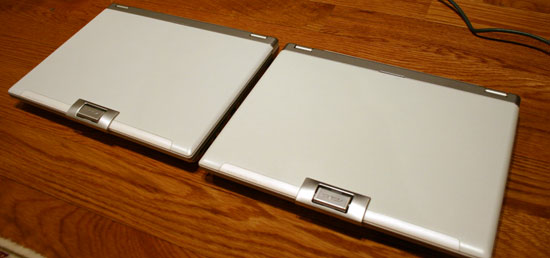
The ASUS W5F and W5A - can you tell the difference?
The beauty of the W5F and W5A is that they are virtually identical, with the only real difference being that the former is based on the Napa platform while the latter is a Sonoma notebook. ASUS even went one step further and shipped us notebooks with processors clocked identically - the W5F featured a Core Duo T2400 (1.83GHz) while the W5A featured a Pentium M 750 (1.83GHz).
What we wanted was an apples to apples comparison of Napa vs. Sonoma, and ASUS gave us the exact tools to do just that.
So without further ado, we bring you a continuation of our performance investigation of Intel’s Core Duo microprocessor - this time, in a notebook.
The Test
Both the ASUS W5F and W5A were configured identically, with 512MB of DDR2-533 memory, 80GB hard drives and both relied on their Intel integrated graphics. The only difference was that the W5F was based on Intel's Napa platform while the W5A was Sonoma based. Both CPUs operated at 1.86GHz, with the Napa platform using a Core Duo processor and the Sonoma platform using a Pentium M processor.
For all tests, each machine was tested with a clean install of Windows and all drivers installed (the latest available as of the publication date), but none of the bundled applications were installed (with the exception of any battery/power management utilities).
All performance tests were conducted with the Power Management settings set to Always On.
All benchmarks were conducted with the display set to the native resolution of the notebook's LCD panel.
Mobile Mark 2005 battery life tests were conducted with the Power Management settings set to Portable/Laptop, but with the screen set to never turn off and with the hard disk set to power down after 5 minutes. All battery life tests were conducted with the displays set to 60 - 70 nits.
Performance testing was done using Business and Multimedia Content Creation Winstone 2004, as well as SYSMark 2004.
Battery life testing was done using Mobile Mark 2005.
Originally published at https://www.anandtech.com/show/1915 (Wayback Machine).