
Intel's Pentium Extreme Edition 955: 65nm, 4 threads and 376M transistors
- Posted in
- CPUs
Multi-core support in Games?
Both Quake 4 and Call of Duty 2 now have SMP support, supposedly offering performance improvements on dual core and/or Hyper Threading enabled processors.
For Call of Duty 2, you simply install the new patch and off you go; SMP support is enabled. To verify, we ran our CoD 2 benchmark and kept a log of the total processor utilization over time. Below is a shot of perfmon with a fresh install of CoD2 (sans SMP patch):
Now, let's look at CoD2 CPU utilization with the SMP patch installed:
We looked at performance at 1024x768 and obviously the higher the resolution, the lesser the impact of a faster CPU (at the same time, the lower the resolution, the greater the impact will be as the game becomes less GPU limited).
To ensure a fair comparison, we tested using the SMP patch and simply disabled SMP manually by setting the r_smp_backend variable to "0". We confirmed that SMP support was actually disabled by running perfmon and measuring CPU utilization.
Surprisingly enough, we actually saw pretty large performance drops in CoD2 with SMP enabled across both AMD and Intel platforms. This is unfortunate, but the withdrawn SMP support of Quake 3 makes it less than shocking. We do expect that things will get better as time goes on.
Quake 4 was a different story; with r_useSMP enabled, we saw some extremely large performance gains with the move to dual core:
The SMP patch either only spawns two threads, or the instruction mix of Quake 4 with the patch does not mix well with Intel's Pentium EE 955. The dual core with Hyper Threading enabled platform didn't do anything at all for performance.
While we're only looking at two games, this is a start for multithreaded game development. You can expect to see a lot of examples where dual-core does absolutely nothing for gaming, but as time goes on, the situation will change.
Both Quake 4 and Call of Duty 2 now have SMP support, supposedly offering performance improvements on dual core and/or Hyper Threading enabled processors.
For Call of Duty 2, you simply install the new patch and off you go; SMP support is enabled. To verify, we ran our CoD 2 benchmark and kept a log of the total processor utilization over time. Below is a shot of perfmon with a fresh install of CoD2 (sans SMP patch):
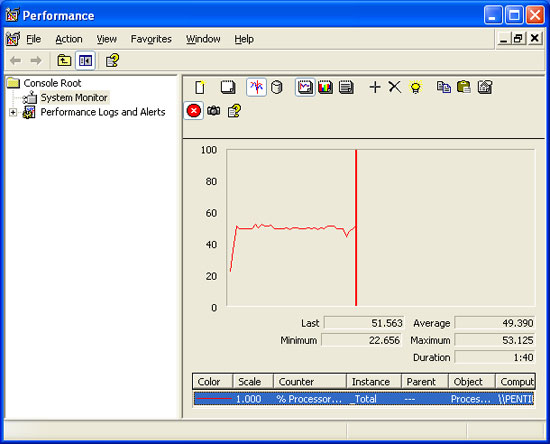
Now, let's look at CoD2 CPU utilization with the SMP patch installed:
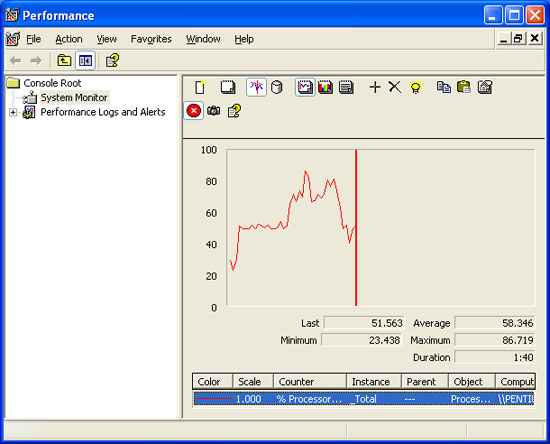
We looked at performance at 1024x768 and obviously the higher the resolution, the lesser the impact of a faster CPU (at the same time, the lower the resolution, the greater the impact will be as the game becomes less GPU limited).
To ensure a fair comparison, we tested using the SMP patch and simply disabled SMP manually by setting the r_smp_backend variable to "0". We confirmed that SMP support was actually disabled by running perfmon and measuring CPU utilization.
| Call of Duty 2 | SMP Disabled | SMP Enabled |
| AMD Athlon 64 FX-57 (2.8GHz) | 80.6 | N/A |
| AMD Athlon 64 X2 4800+ (2.4GHz) | 79.8 | 70.3 |
| AMD Athlon 64 X2 3800+ (2.0GHz) | 78.7 | 68.1 |
| Intel Pentium Extreme Edition 955 (3.46GHz) | 79.8 | 68.4 |
| Intel Pentium Extreme Edition 840 (3.2GHz) | 78.1 | 68 |
| Intel Pentium D 820 (2.8GHz) | 75.6 | 67.1 |
Surprisingly enough, we actually saw pretty large performance drops in CoD2 with SMP enabled across both AMD and Intel platforms. This is unfortunate, but the withdrawn SMP support of Quake 3 makes it less than shocking. We do expect that things will get better as time goes on.
Quake 4 was a different story; with r_useSMP enabled, we saw some extremely large performance gains with the move to dual core:
| Quake 4 | SMP Disabled | SMP Enabled |
| AMD Athlon 64 FX-57 (2.8GHz) | 115.4 | N/A |
| AMD Athlon 64 X2 4800+ (2.4GHz) | 114.9 | 147.4 |
| AMD Athlon 64 X2 3800+ (2.0GHz) | 100.9 | 143.2 |
| Intel Pentium Extreme Edition 955 (3.46GHz) | 98.9 | 142.3 |
| Intel Pentium Extreme Edition 840 (3.2GHz) | 89.0 | 133.6 |
| Intel Pentium D 820 (2.8GHz) | 80.6 | 125.5 |
The SMP patch either only spawns two threads, or the instruction mix of Quake 4 with the patch does not mix well with Intel's Pentium EE 955. The dual core with Hyper Threading enabled platform didn't do anything at all for performance.
While we're only looking at two games, this is a start for multithreaded game development. You can expect to see a lot of examples where dual-core does absolutely nothing for gaming, but as time goes on, the situation will change.
Originally published at https://www.anandtech.com/show/1910 (Wayback Machine).