
Intel's Pentium Extreme Edition 955: 65nm, 4 threads and 376M transistors
- Posted in
- CPUs
Literally Dual Core
One of the major changes with Presler is that unlike Smithfield, the two cores are not a part of the same piece of silicon. Instead, you actually have a single chip with two separate die on it. By splitting the die in two, Intel can reduce total failure rates and even be far more flexible with their manufacturing (since one Presler chip is nothing more than two Cedar Mill cores on a single package).
In order to find out if there was an appreciable increase in core-to-core communication latency, we used a tool called Cache2Cache, which Johan first used in his series on multi-core processors. Johan's description of the utility follows:
Not only did we not find an increase in latency between the two cores on Presler, communication actually occurs faster than on Smithfield. We made sure that it had nothing to do with the faster FSB by clocking the chip at 2.8GHz with an 800MHz FSB and repeated the tests only to find consistent results.
We're not sure why, but core-to-core communication is faster on Presler than on Smithfield. That being said, a difference of less than 9ns just isn't going to be noticeable in the real world - given that we've already seen that the Athlon 64 X2's 100ns latency doesn't really help it scale better when going from one to two cores.
One of the major changes with Presler is that unlike Smithfield, the two cores are not a part of the same piece of silicon. Instead, you actually have a single chip with two separate die on it. By splitting the die in two, Intel can reduce total failure rates and even be far more flexible with their manufacturing (since one Presler chip is nothing more than two Cedar Mill cores on a single package).
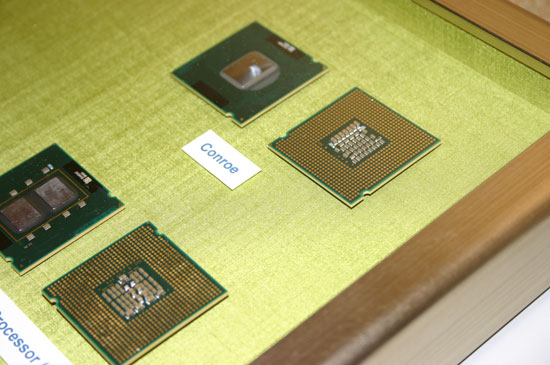
The chip at the bottom of the image is Presler; note the two individual cores.
In order to find out if there was an appreciable increase in core-to-core communication latency, we used a tool called Cache2Cache, which Johan first used in his series on multi-core processors. Johan's description of the utility follows:
"Michael S. started this extremely interesting thread at the Ace's hardware Technical forum. The result was a little program coded by Michael S. himself, which could measure the latency of cache-to-cache data transfer between two cores or CPUs. In his own words: "it is a tool for comparison of the relative merits of different dual-cores."Armed with Cache2Cache, we looked at the added latency seen by Presler over Smithfield:
"Cache2Cache measures the propagation time from a store by one processor to a load by the other processor. The results that we publish are approximately twice the propagation time. For those interested, the source code is available here."
| Cache2Cache Latency in ns (Lower is Better) | |
| AMD Athlon 64 X2 4800+ | 101 |
| Intel Smithfield 2.8GHz | 253.1 |
| Intel Presler 2.8GHz | 244.2 |
Not only did we not find an increase in latency between the two cores on Presler, communication actually occurs faster than on Smithfield. We made sure that it had nothing to do with the faster FSB by clocking the chip at 2.8GHz with an 800MHz FSB and repeated the tests only to find consistent results.
We're not sure why, but core-to-core communication is faster on Presler than on Smithfield. That being said, a difference of less than 9ns just isn't going to be noticeable in the real world - given that we've already seen that the Athlon 64 X2's 100ns latency doesn't really help it scale better when going from one to two cores.
Originally published at https://www.anandtech.com/show/1910 (Wayback Machine).