
Investigations into Athlon X2 Overclocking
- Posted in
- CPUs
Encoding Performance
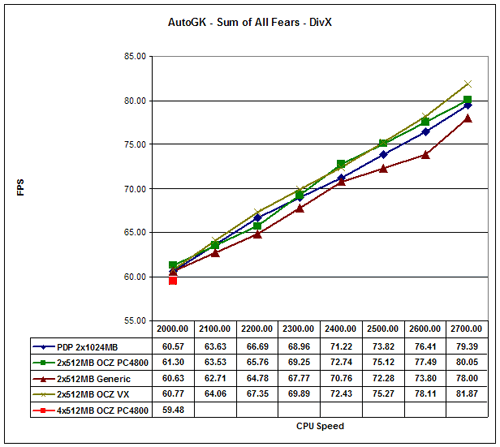
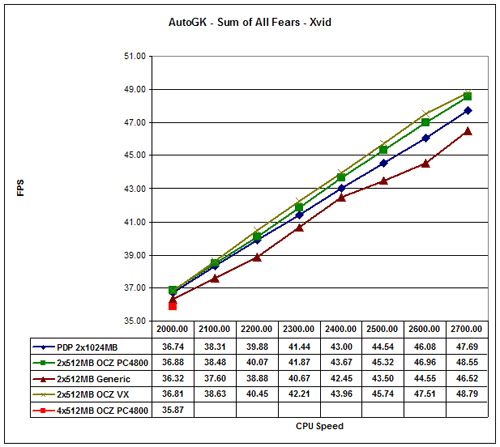
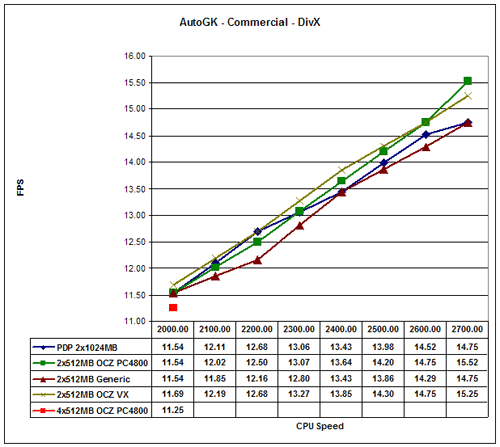
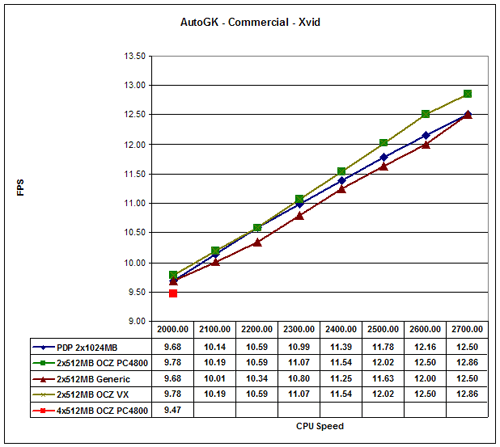
For our encoding performance tests, we use AutoGK 1.96 with both the DivX and Xvid codecs. (A newer version of AutoGK is now available, but performance and scores didn't change noticeably, and so, we will continue using the older version.) We encode chapter 9 from The Sum of All Fears without audio to 75% quality. This results in a file size about 1/3 as large as the original (not counting the audio size). As a more common encoding task, we also encode a TV commercial from 30 MB down to 5 MB, including audio encoding. This results in three encoding passes: the compression test, a first pass, and the final pass. We take the total number of frames in the video (900) and divide it by the time taken, reporting the resulting frames per second. In all AutoGK benchmarks, higher scores will be better.
The performance difference between the slowest and fastest setup is around 35% for every encoding task, scaling linearly with processor speed. AutoGK runs a lot more of the computations within the CPU and doesn't depend much on user input, and it also benefits from multiple processor cores. Compared to the Venice chip, the second core increases DivX performance by about 50% and Xvid performance by about 30%. Comparing the different RAM types, the largest gap is about 4%; so while there is a difference, it's not huge. As we said, clock speed is king for encoding.
For our encoding performance tests, we use AutoGK 1.96 with both the DivX and Xvid codecs. (A newer version of AutoGK is now available, but performance and scores didn't change noticeably, and so, we will continue using the older version.) We encode chapter 9 from The Sum of All Fears without audio to 75% quality. This results in a file size about 1/3 as large as the original (not counting the audio size). As a more common encoding task, we also encode a TV commercial from 30 MB down to 5 MB, including audio encoding. This results in three encoding passes: the compression test, a first pass, and the final pass. We take the total number of frames in the video (900) and divide it by the time taken, reporting the resulting frames per second. In all AutoGK benchmarks, higher scores will be better.
The performance difference between the slowest and fastest setup is around 35% for every encoding task, scaling linearly with processor speed. AutoGK runs a lot more of the computations within the CPU and doesn't depend much on user input, and it also benefits from multiple processor cores. Compared to the Venice chip, the second core increases DivX performance by about 50% and Xvid performance by about 30%. Comparing the different RAM types, the largest gap is about 4%; so while there is a difference, it's not huge. As we said, clock speed is king for encoding.
Originally published at https://www.anandtech.com/show/1902 (Wayback Machine).