
Intel Core Duo (Yonah) Performance Preview - Part II
- Posted in
- CPUs
Overall System Performance with Winstone 2004
Business Winstone 2004
Business Winstone 2004 tests the following applications in various usage scenarios:
The FP/SSE enhancements to Core Duo have no chance to shine in your everyday run-of-the-mill business applications like Word and Outlook, not to mention that the workload is not heavily multithreaded, so there's no benefit from a dual core processor. So from a performance standpoint, all we see from the Core Duo is a similarly clocked processor to the Pentium M 760, but with a higher latency L2 cache, which explains the performance deficit.
The Athlon 64 X2 running at 2.0GHz with a 1MB L2 per core manages to slightly outperform the Core duo T2500, however the performance margin is negligible.
Multimedia Content Creation Winstone 2004
Multimedia Content Creation Winstone 2004 tests the following applications in various usage scenarios:
Not all of the Core Duo's advantage over the Pentium M is due to its dual core nature, but it does account for some of it.
But as we saw in our original article, at 2.0GHz, the Core Duo T2500 just isn't able to offer performance comparable to the Athlon 64 X2 at the same speed. It is worth noting that L2 cache size doesn't really make a difference here to the X2 at all, just clock speed. Thanks to the Athlon 64's on-die memory controller, the architecture is inherently less sensitive to cache size than more conventional designs that rely on an external memory controller.
Business Winstone 2004
Business Winstone 2004 tests the following applications in various usage scenarios:
. Microsoft Access 2002
. Microsoft Excel 2002
. Microsoft FrontPage 2002
. Microsoft Outlook 2002
. Microsoft PowerPoint 2002
. Microsoft Project 2002
. Microsoft Word 2002
. Norton AntiVirus Professional Edition 2003
. WinZip 8.1
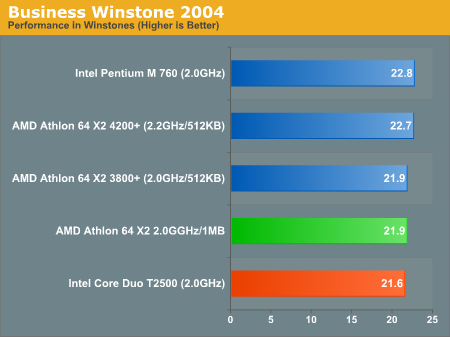
The FP/SSE enhancements to Core Duo have no chance to shine in your everyday run-of-the-mill business applications like Word and Outlook, not to mention that the workload is not heavily multithreaded, so there's no benefit from a dual core processor. So from a performance standpoint, all we see from the Core Duo is a similarly clocked processor to the Pentium M 760, but with a higher latency L2 cache, which explains the performance deficit.
The Athlon 64 X2 running at 2.0GHz with a 1MB L2 per core manages to slightly outperform the Core duo T2500, however the performance margin is negligible.
Multimedia Content Creation Winstone 2004
Multimedia Content Creation Winstone 2004 tests the following applications in various usage scenarios:
. Adobe® Photoshop® 7.0.1All chips were tested with Lightwave set to spawn 4 threads.
. Adobe® Premiere® 6.50
. Macromedia® Director MX 9.0
. Macromedia® Dreamweaver MX 6.1
. Microsoft® Windows MediaTM Encoder 9 Version 9.00.00.2980
. NewTek's LightWave® 3D 7.5b
. SteinbergTM WaveLabTM 4.0f
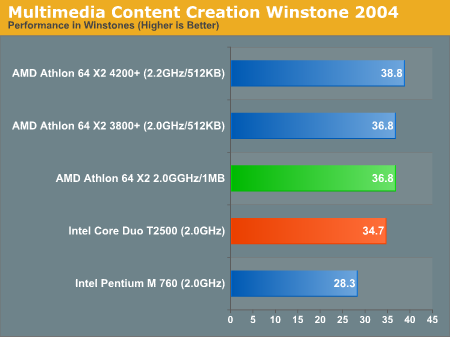
Not all of the Core Duo's advantage over the Pentium M is due to its dual core nature, but it does account for some of it.
But as we saw in our original article, at 2.0GHz, the Core Duo T2500 just isn't able to offer performance comparable to the Athlon 64 X2 at the same speed. It is worth noting that L2 cache size doesn't really make a difference here to the X2 at all, just clock speed. Thanks to the Athlon 64's on-die memory controller, the architecture is inherently less sensitive to cache size than more conventional designs that rely on an external memory controller.
Originally published at https://www.anandtech.com/show/1900 (Wayback Machine).