
Intel Core Duo (Yonah) Performance Preview - Part II
- Posted in
- CPUs
It's called the Core Duo
When Yonah first started appearing on roadmaps, we knew it as Jonah, which then starting being written as Yonah. Eventually, Intel confirmed its existence and we had always assumed that it would continue to use the name Pentium M. However, given the great importance of the launch of Intel's first dual-core, low power, notebook processor, it shouldn't be much of a surprise that Intel has a new name in store for it. As you've probably already heard, Yonah will receive the marketing name "Core" with the words "Duo" or "Solo" following it depending on whether it is the dual or single core version. The name Centrino will still be there, but instead of referring to the processor as a Pentium M, it'll be called a Core Duo or a Core Solo. The Centrino platform itself will be referred to as Centrino Duo when paired with a Core Duo processor. We have to admit, we kind of like the new name.
Not so pleasant, however, are the new processor numbers that go along with the new processor names. Gone are Intel's simple three-digit numbers and they have since been replaced with a four-digit number preceded by a letter. The letter indicates the thermal envelope of the processor, while the following four digits denote the performance level of the CPU. If you think that this sounds oddly similar to AMD's Turion processor nomenclature, don't worry; you'd be completely right (of course, the Turion only uses two numbers, while Core Duo uses four). Maybe, one of these days, Intel will get around to copying some more important elements of AMD's history, such as an on-die memory controller or at least a serial bus interface.
As an example of the numbers in use, the 2.0GHz processor that we previewed in the first article will be sold under the name "Intel Core Duo T2500". For your reference, the T2600 will run at 2.16GHz (compared to the 2.0GHz T2500). The Core Solo processors will feature a "1" after the "T" denoting a single core; for example, the Intel Core Solo T1300 will run at 1.66GHz.
Intel's Core Duo and Solo processors both support a 667MHz FSB, which is enabled by the 945 chipset that Intel is pairing with them. The move to a 667MHz FSB is necessary, thanks to the increased bandwidth demands of a dual core processor.
As we mentioned in the first article, the Core Duo (and Solo) processors are not pin-compatible with the older Pentium M, even though they physically have the same number of pins.
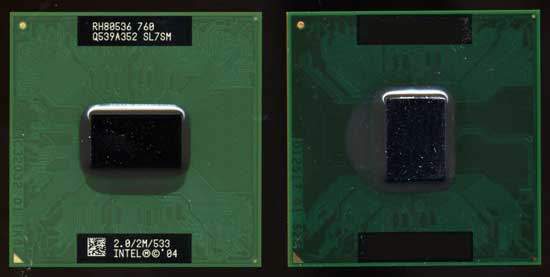
Dothan (Pentium M) on the left, Yonah (Core Duo) on the Right
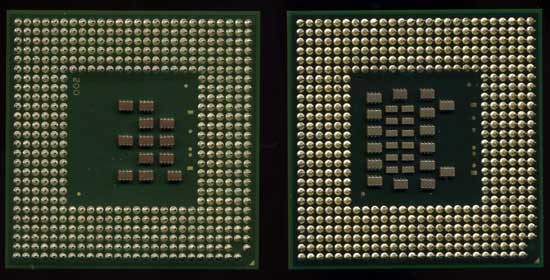
Dothan (Pentium M) on the left, Yonah (Core Duo) on the Right
Originally published at https://www.anandtech.com/show/1900 (Wayback Machine).