
ASRock Industrial NUC BOX-1360P/D5 Review: Raptor Lake-P on the Leading Edge
Miscellaneous Aspects and Concluding Remarks
Networking and storage are aspects that may be of vital importance in specific PC use-cases. The ASRock NUC BOX-1360P/D5 comes with the Wi-Fi 6E AX210 WLAN card that also include Bluetooth 5.3 support. On the wired front, we have a couple of 2.5 Gbps ports backed by the Intel I226-LM and I2260V controllers. The system only supports vPro Essentials - so the full extent of remote management over a dedicated LAN port that can be obtained with vPro for Enterprise is sadly absent.
On the storage side, some applications require wide-temperature range and/or high endurance SSDs. The ASRock Industrial NUC BOX-1360P/D5 supports PCIe 4.0 x4 NVMe SSDs (and we used one in our configuration). However, cooling those within the space constraints imposed by the form-factor of the NUC is very challenging, as we saw in the SSD temperature graph in the previous section. In the absence of an effective thermal solution, it might be a better option to stick with a PCIe 3.0 x4 NVMe SSD for this unit. From a benchmarking perspective, we provide results from the WPCstorage test of SPECworkstation 3.1. This benchmark replays access traces from various programs used in different verticals and compares the score against the one obtained with a 2017 SanDisk 512GB SATA SSD in the SPECworkstation 3.1 reference system
| SPECworkstation 3.1.0 - WPCstorage SPEC Ratio Scores | |||
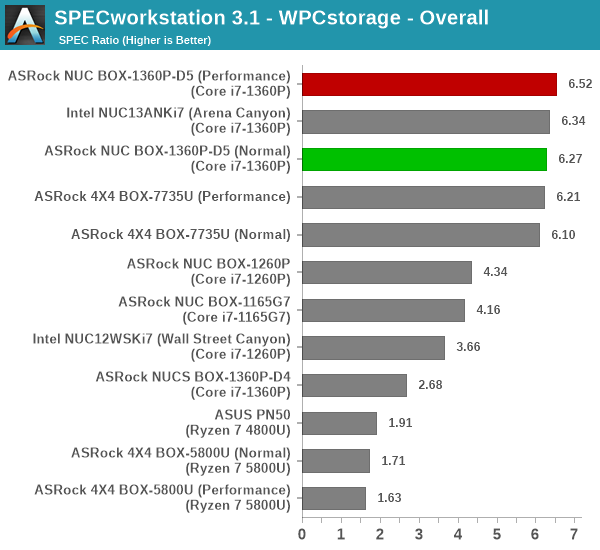
The graphs above present results for different verticals, as grouped by SPECworkstation 3.1. The storage workload consists of 60 subtests. Access traces from CFD solvers and programs such as Catia, Creo, and Solidworks come under 'Product Development'. Storage access traces from the NAMD and LAMMPS molecular dynamics simulator are under the 'Life Sciences' category. 'General Operations' includes access traces from 7-Zip and Mozilla programs. The 'Energy' category replays traces from the energy-02 SPECviewperf workload. The 'Media and Entertainment' vertical includes Handbrake, Maya, and 3dsmax. Given that the comparison is between a wide range of SSDs in the systems - including both Gen 3 and Gen 4 / DRAM-equipped and DRAMless NVMe, the relative numbers for most workloads are not surprising. The Samsung SSD 980 PRO was a high-end flagship model, and the NUC BOX-1360P/D5 is able to bring out its performance capabilities (despite the SSD overheating concern, which is an orthogonal issue)
Closing Thoughts
ASRock Industrial has one of the most comprehensive Raptor Lake UCFF PC lineups in the market today. The company has a wide variety of options to choose from this year - in addition to the NUC(S) BOX-13xx/D4 and the NUC BOX-13xx/D5 reviewed here, the AMD-based 4X4 BOX-7735U is also a very credible contender. In fact, the AMD system fares much better than the Intel one over a number of different benchmarks, thanks to the presence of eight high-performance cores (compared to the 4P + 8E configuration of the Core i7-1360P). Even on the I/O front, the presence of two USB4 ports (compared to 1x USB 4 / Thunderbolt 4, and 1x USB 3.2 Gen 2x2) is also an advantage for the AMD system. It is frugal in terms of peak power consumption while delivering largely similar performance numbers when averaged across multiple workloads.
DDR5 support does give the edge in many of the workloads for the NUC BOX-1360P/D5 over the NUCS BOX-1360P/D4. However, many AMD mini-PCs with DDR5-5200 and DDR5-5600 support have already started appearing in the market. Under such circumstances, the DDR5-4800 support in the NUC BOX-1360P/D5 appears a bit dated. That said, the inclusion of USB 3.2 Gen 2x2 support in the Type-C ports is a very welcome update over the NUC BOX-1200 and the NUCS BOX-13xx/D4 series.

ASRock Industrial is no stranger to UCFF PCs, and that shows in the robust build and performance profile of the NUC BOX-1360P/D5. The system is an excellent Intel option in the mini-PC space, and the feature set and performance profile have been optimized under the constraints imposed by the form-factor. On the pricing front, the company has decided to introduce the NUC BOX-1360P/D5 at $670. The NUC BOX-1340P/D5 with similar features (based on the Core i5-1340P instead of the Core i7-1360P) is available for $540.
The only areas of concern that we had from our evaluation are the absence of a proper thermal solution for the SSD and the inability of the thermal solution to sustain a 40W PL1 indefinitely while maintaining a safe temperature for the processor package. The form-factor adopted by the system is usually meant for 28W TDP systems, and is hence not a big surprise. Despite these minor quibbles, we have to say that ASRock Industrial's NUC BOX-1360P/D5 presents consumers with a credible alternative to the DDR4-only Arena Canyon NUC in the mainstream class.
Originally published at https://www.anandtech.com/show/18955/asrock-industrial-nuc-box1360pd5-review-raptor-lakep-on-the-leading-edge (Wayback Machine).