
Looking Back: ATI's Catalyst Drivers Exposed
- Posted in
- GPUs
3dMark 2003
3dMark is not a benchmark that we routinely bring you here at AnandTech, as our editorial policy is to bring you benchmarks from real-world games and engines, and not synthetic metrics. That said, it would be inappropriate to leave out 3dMark in this case due to the significant cheating incidents with it. And, as a flashy, system draining benchmark backed by a unique database for comparisons, it's still an important title in the eyes of many consumers, OEMs, and the GPU makers looking for bragging rights.
With 3dMark, its importance in this regression is not so much the performance improvements as a sign of what happened with the card - the improvements were most certainly exaggerated due to in part by the synthetic nature of the benchmark - but rather a possibility of what can happen when ATI dedicates its resources to a game/benchmark that it considers most important. We should note that ATI has admitted to "cheating" on 3dMark 2003; however, these were what we consider honest shader-replacement optimizations (same mathematical output) that ATI voluntarily removed, though they were apparently re-introduced at some point. We used the latest version of 3dMark 2003, so this "cheat" was not activated in the older drivers.
For these benchmarks, 3dMark was run at its default resolution of 1024x768.
Overall then, 3dMark is much like Halo, a benchmark that received a slow, but steady improvement, without any fixes.
3dMark is not a benchmark that we routinely bring you here at AnandTech, as our editorial policy is to bring you benchmarks from real-world games and engines, and not synthetic metrics. That said, it would be inappropriate to leave out 3dMark in this case due to the significant cheating incidents with it. And, as a flashy, system draining benchmark backed by a unique database for comparisons, it's still an important title in the eyes of many consumers, OEMs, and the GPU makers looking for bragging rights.
With 3dMark, its importance in this regression is not so much the performance improvements as a sign of what happened with the card - the improvements were most certainly exaggerated due to in part by the synthetic nature of the benchmark - but rather a possibility of what can happen when ATI dedicates its resources to a game/benchmark that it considers most important. We should note that ATI has admitted to "cheating" on 3dMark 2003; however, these were what we consider honest shader-replacement optimizations (same mathematical output) that ATI voluntarily removed, though they were apparently re-introduced at some point. We used the latest version of 3dMark 2003, so this "cheat" was not activated in the older drivers.
For these benchmarks, 3dMark was run at its default resolution of 1024x768.
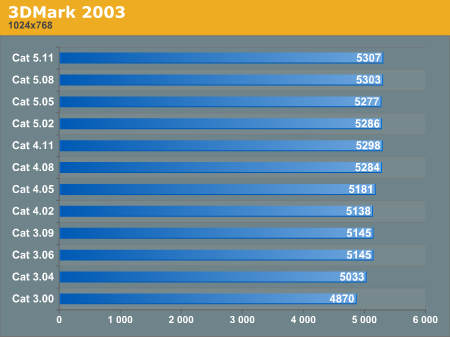
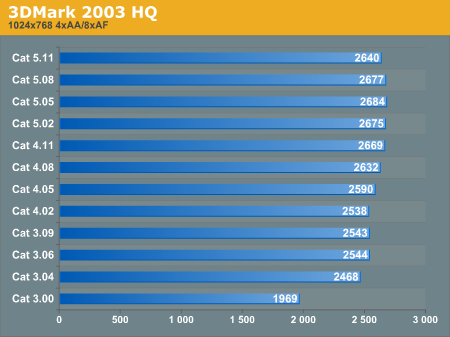

Catalyst 5.11 versus 3.00 (mouse over to see 3.00)
Overall then, 3dMark is much like Halo, a benchmark that received a slow, but steady improvement, without any fixes.
Originally published at https://www.anandtech.com/show/1892 (Wayback Machine).