
Asus P5WDG2-WS: Intel 975X goes to Work
- Posted in
- Motherboards
CPU & FSB Overclocking Results
Memory Stress Testing
Memory stress tests look at the ability of the Asus P5WDG2-WS to operate at the officially supported memory frequencies of 667MHz DDR2, at the best performing memory timings that the Corsair CM2X512A-5400UL revision 1.3 will support.
The Asus P5WDG2-WS was completely stable with 2 DDR2 modules in Dual-Channel at the settings of 3-2-2-8 at 2.1V.
We will now install all four available memory slots that are usually more strenuous on the memory subsystem than testing 2 DDR2 modules on a motherboard.
The Asus P5WDG2-WS was completely stable with 4 DDR2 modules in Dual-Channel at the settings of 3-3-3-8 and only needed the voltage increased to 2.15V. This is a very good accomplishment and continues to show off Asus's engineering capability.
| Front Side Bus Overclocking Testbed | |
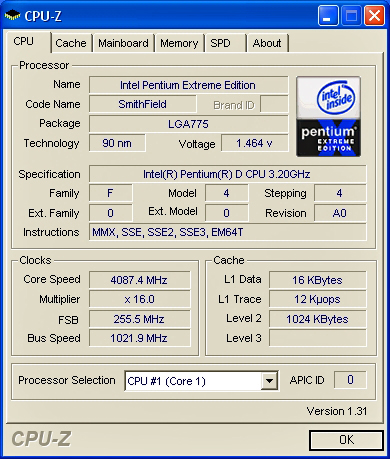
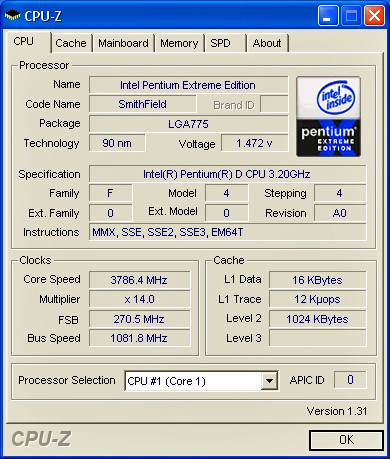
| Processor: | Pentium 4 Prescott LGA 775 840EE Dual Core 3.2GHz |
| CPU Voltage: | 1.4750V (1.4000V default) |
| Memory Settings: | 3-2-2-8 at 680MHz, 3-3-3-8 at 720MHz |
| Memory Voltage: | 2.1V |
| NorthBridge Voltage: | 1.50V |
| SouthBridge Voltage: | 1.05V |
| Cooling: | Intel 840EE Heat Sink |
| Power Supply: | OCZ Power Stream 520 |
| Video Card: | 1 x XFX 7800GTX OC (PCI Express) |
| Maximum CPU OverClock: | 255fsb x 16 (4087MHz) +27% |
| Maximum FSB OverClock: | 270fsb x 14 (3786MHz) +35% |
Memory Stress Testing
Memory stress tests look at the ability of the Asus P5WDG2-WS to operate at the officially supported memory frequencies of 667MHz DDR2, at the best performing memory timings that the Corsair CM2X512A-5400UL revision 1.3 will support.
| Asus P5WDG2-WS Stable DDR667 Timings - 2 DIMMs (2/4 slots populated - 1 Dual-Channel Bank) |
|
| Clock Speed: | 200MHz (800FSB) |
| Timing Mode: | 667MHz - Default |
| CAS Latency: | 3 |
| RAS to CAS Delay: | 2 |
| RAS Precharge: | 2 |
| RAS Cycle Time: | 8 |
| Voltage: | 2.1V |
The Asus P5WDG2-WS was completely stable with 2 DDR2 modules in Dual-Channel at the settings of 3-2-2-8 at 2.1V.
We will now install all four available memory slots that are usually more strenuous on the memory subsystem than testing 2 DDR2 modules on a motherboard.
| Asus P5WDG2-WS Stable DDR667 Timings - 4 DIMMs (4/4 slots populated - 2 Dual-Channel Banks) |
|
| Clock Speed: | 200MHz (800FSB) |
| Timing Mode: | 667MHz - Default |
| CAS Latency: | 3 |
| RAS to CAS Delay: | 3 |
| RAS Precharge: | 3 |
| RAS Cycle Time: | 8 |
| Voltage: | 2.15V |
The Asus P5WDG2-WS was completely stable with 4 DDR2 modules in Dual-Channel at the settings of 3-3-3-8 and only needed the voltage increased to 2.15V. This is a very good accomplishment and continues to show off Asus's engineering capability.
Originally published at https://www.anandtech.com/show/1884 (Wayback Machine).