
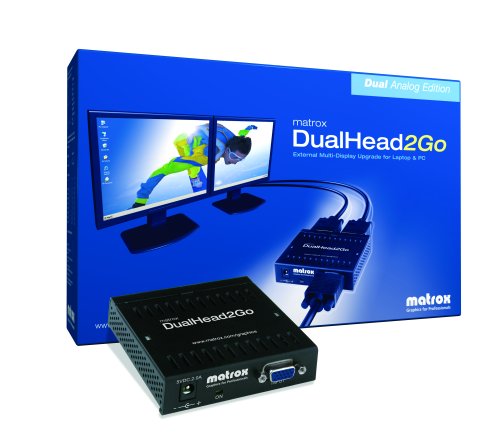
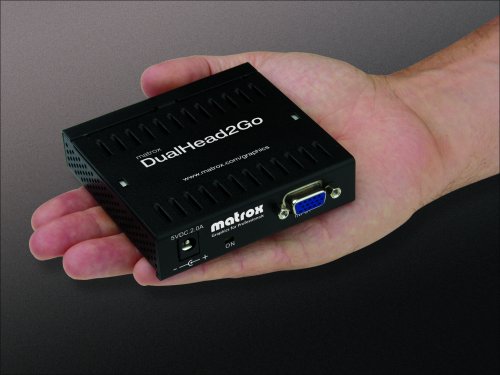
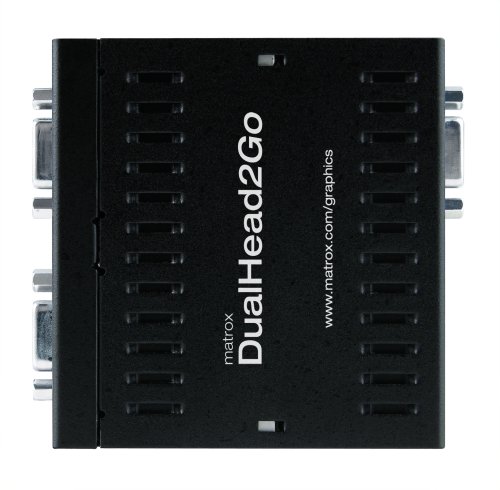
The DualHead2Go: External Multi-Display Upgrade from Matrox.
- Posted in
- Displays
The DualHead2Go
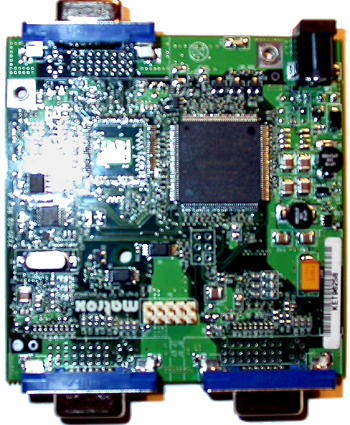
The Cyclone EP1C chips used are what drive the capabilities of the DualHead2Go. As there are no custom Matrox ASICs on the board, we can conclude that the one or both of the FPGAs handle taking the output of the AD9888, splitting the image into two (or clone the image depending on the resolution and PowerDesk settings), and then sending the resulting data along to the Chrontel CH7301C-T display controllers. These devices also likely manage the rest of the board and use the DDC (Display Data Channel) to report the DualHead2Go's EDID (extended display identification data) to the display device.
The CH7301C is a single link DVI transmitter, which supports analog output over three 10-bit DACs for analog RGB displays. This suggests that a digital version of the DualHead2Go wouldn't be that difficult to implement. This part of the design could also be reused if Matrox were to develop a version of the DualHead2Go that supports up to 3200x1200 (or two 1600x1200 displays). Of course, a device such as this would require a dual-link DVI input and a beefier digitizer than the AD9888. The FPGAs may also need an upgrade for a higher resolution version (it would entail more I/O and might require something larger), but the functionality of the device should be easily extendable, so added design time would be minimal.
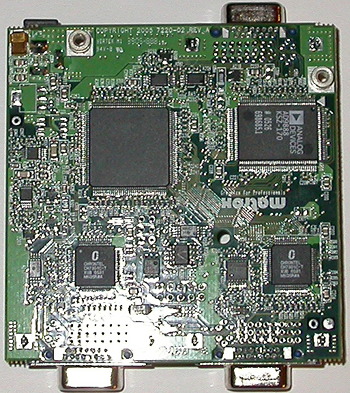
The Cyclone EP1C chips used are what drive the capabilities of the DualHead2Go. As there are no custom Matrox ASICs on the board, we can conclude that the one or both of the FPGAs handle taking the output of the AD9888, splitting the image into two (or clone the image depending on the resolution and PowerDesk settings), and then sending the resulting data along to the Chrontel CH7301C-T display controllers. These devices also likely manage the rest of the board and use the DDC (Display Data Channel) to report the DualHead2Go's EDID (extended display identification data) to the display device.
The CH7301C is a single link DVI transmitter, which supports analog output over three 10-bit DACs for analog RGB displays. This suggests that a digital version of the DualHead2Go wouldn't be that difficult to implement. This part of the design could also be reused if Matrox were to develop a version of the DualHead2Go that supports up to 3200x1200 (or two 1600x1200 displays). Of course, a device such as this would require a dual-link DVI input and a beefier digitizer than the AD9888. The FPGAs may also need an upgrade for a higher resolution version (it would entail more I/O and might require something larger), but the functionality of the device should be easily extendable, so added design time would be minimal.
Originally published at https://www.anandtech.com/show/1875 (Wayback Machine).