
OWC Envoy Pro Mini Review: SSD in a Thumb Drive Exceeds Expectations
Miscellaneous Aspects and Concluding Remarks
The performance of the storage bridges / drives in various real-world access traces as well as synthetic workloads was brought out in the preceding sections. We also looked at the performance consistency for these cases. Power users may also be interested in performance consistency under worst-case conditions, as well as drive power consumption. The latter is also important when used with battery powered devices such as notebooks and smartphones. Pricing is also an important aspect. We analyze each of these in detail below.
Worst-Case Performance Consistency
Flash-based storage devices tend to slow down in unpredictable ways when subject to a large number of small-sized random writes. Many benchmarks use that scheme to pre-condition devices prior to the actual testing in order to get a worst-case representative number. Fortunately, such workloads are uncommon for direct-attached storage devices, where workloads are largely sequential in nature. Use of SLC caching as well as firmware caps to prevent overheating may cause drop in write speeds when a flash-based DAS device is subject to sustained sequential writes.
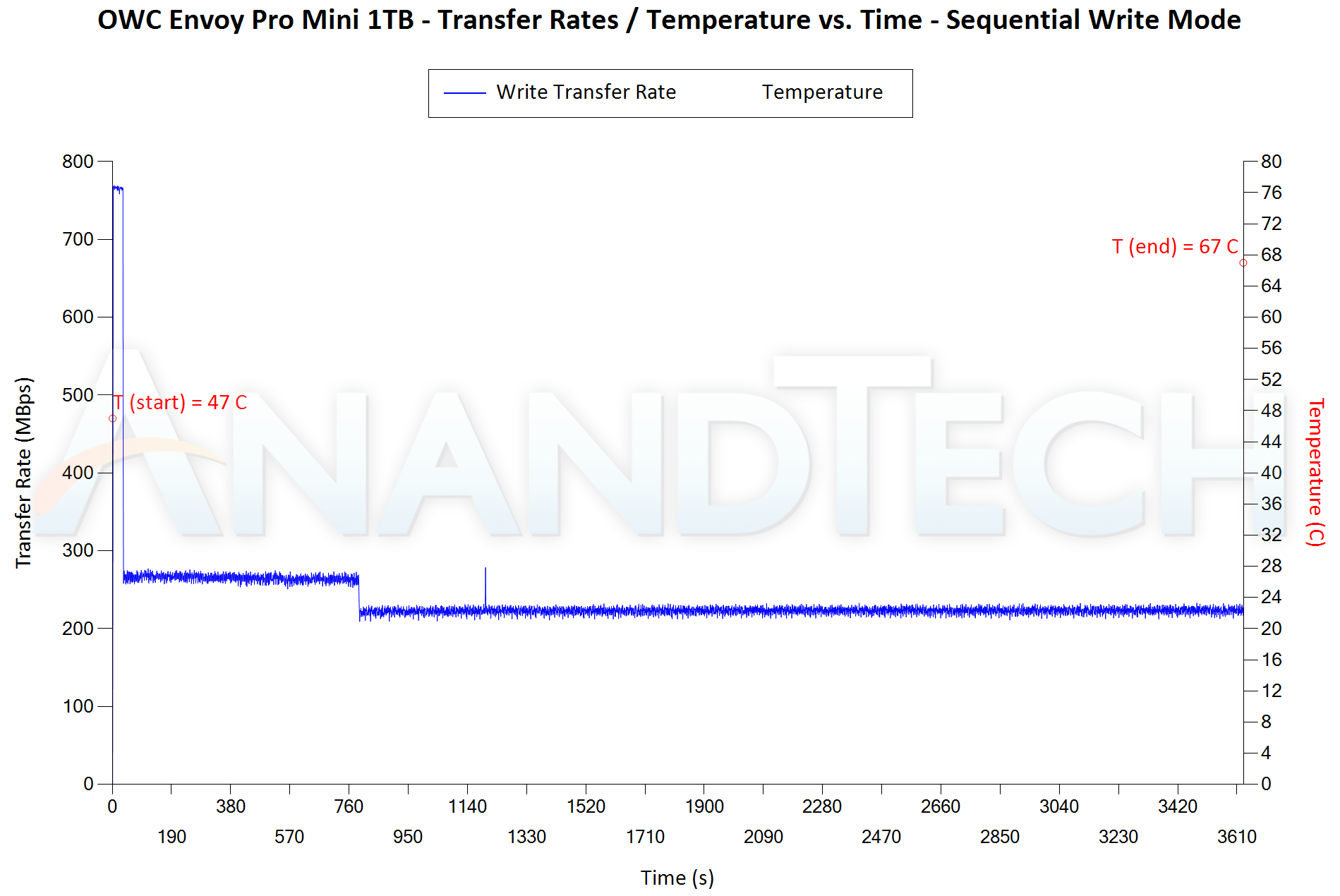
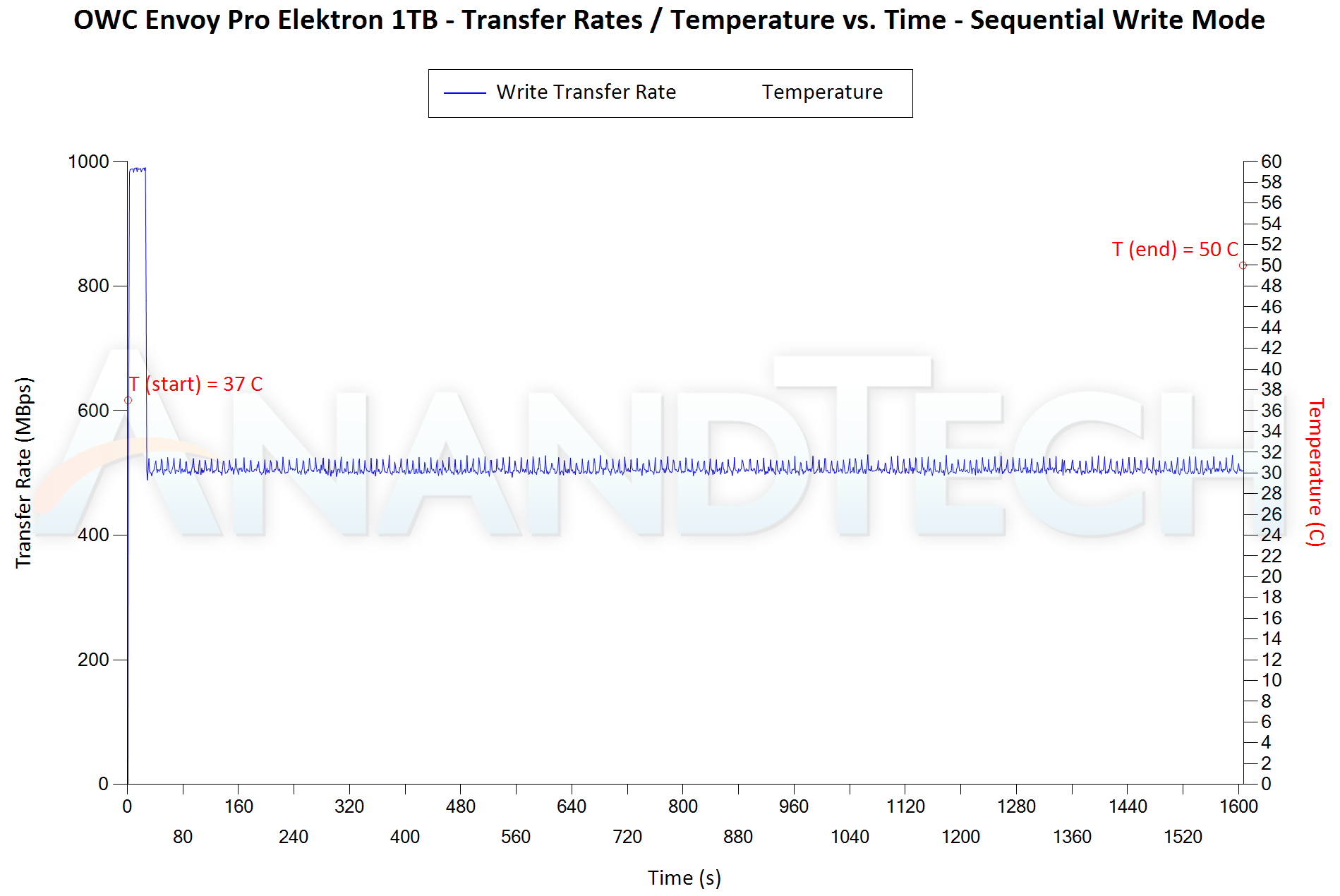
Our Sequential Writes Performance Consistency Test configures the device as a raw physical disk (after deleting configured volumes). A fio workload is set up to write sequential data to the raw drive with a block size of 128K and iodepth of 32 to cover 90% of the drive capacity. The internal temperature is recorded at either end of the workload, while the instantaneous write data rate and cumulative total write data amount are recorded at 1-second intervals.
| Sequential Writes to 90% Capacity - Performance Consistency | |
| TOP: | BOTTOM: |
 |
|
 |
|
The SLC cliff for the OWC Envoy Pro Mini is around 24GB, after which write speeds drop down from 760 MBps to 270 MBps. Around 220GB, we get another small cliff where the writes go down to 220 MBps. The temperature of the internals at the end is around 67C (though we saw temperatures of around 78C in the DAS suite performance consistency section). Guaranteed write speeds for sequential accesses of more than 200 MBps is impressive for a thumb drive, and a comparison against the two DataTraveler Max SKUs in the above show that the Envoy Pro Mini is indeed praiseworthy in this aspect.
Power Consumption
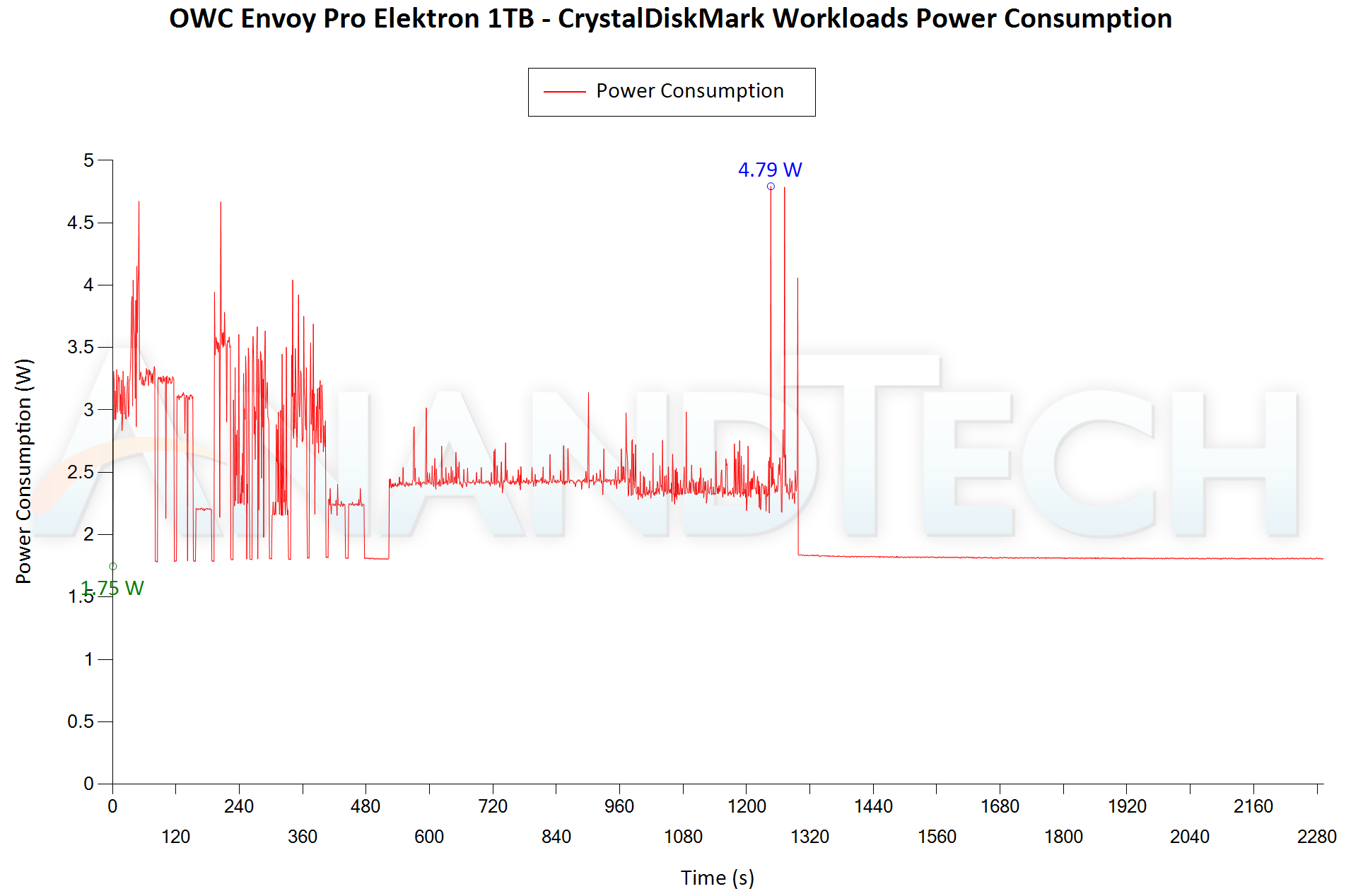
Bus-powered devices can configure themselves to operate within the power delivery constraints of the host port. While Thunderbolt ports are guaranteed to supply up to 15W for client devices, USB 2.0 ports are guaranteed to deliver only 4.5W (900mA @ 5V). In this context, it is interesting to have a fine-grained look at the power consumption profile of the various external drives. Using the Plugable USBC-TKEY, the bus power consumption of the drives was tracked while processing the CrystalDiskMark workloads (separated by 5s intervals). The graphs below plot the instantaneous bus power consumption against time, while singling out the maximum and minimum power consumption numbers.
| CrystalDiskMark Workloads - Power Consumption | |
| TOP: | BOTTOM: |
 |
|
 |
|
A peak of just 1.83W is impressive for the Envoy Pro Mini, and the drive can pretty much turn itself off and idle at close to 0W after around 20 minutes of traffic absence. We do see garbage collection kick in automatically after extended idling (causing the power numbers to spike), and that helps keep the drive in good fettle over the long run. In comparison, the DataTraveler Max SKUs peak at 2.31 W (Type-A) and 3.05 W (Type-C). It must be noted here that we tested the power consumption numbers with the Type-C adapter active.
Final Words
The OWC Envoy Pro Mini has been available for purchase for a couple of quarters now. The street prices are $78 (250 GB), $90 (500 GB), and $130 (1 TB). A comparison of the DataTraveler Max prices at the corresponding capacity points shows that OWC places a premium on the enclosure design - the gap is around $40 for the 250 GB version, and it progressively becomes smaller to just $24 for the 1 TB version. For the premium, the end user gets a highly durable and attractive enclosure that is compatible with a wide variety of computing devices (thanks to its dual interface support). The internal flash device also performs more consistently for stressful workloads.

The Envoy Pro Mini was compared against a host of other 1 TB external flash drives in the preceding sections. However, the key comparison is within its own niche, where it goes up against the Kingston DataTraveler Max. For short bursts, the DataTraveler Max comes out on top in almost all types of workloads. However, under extended use conditions, the Envoy Pro Mini delivers higher absolute performance numbers. This puts more stress on the thermal design, and the Envoy Pro Mini manages to handle it. Despite the higher temperatures during the course of use, the drive does not throttle.
On the internal configuration front, the Envoy Pro Mini delivered a nice surprise. When the Phison U17 was launched in early 2021 after having been teased at the 2019 Computex, its claimed performance numbers were rather anemic. Understandably, this native UFD controller was relegated to the mid-range and entry-level offerings. With NAND layer counts and performance numbers ramping up at a steady pace, it is likely that the U17 has seen some minor updates to support the latest NAND generations - OWC is probably using the new NAND to deliver performance numbers that surpass Phison's initial claims easily. Similar to previous Phison designs from OWC, the SLC cache is rather small. We would like to see SLC cache sizes in the 10% range (rather than the 2.4% adopted for the 1 TB model) as long as other performance metrics (particularly in the extended stress scenario) are not negatively affected.
OWC deserves plaudits for bucking the usual trend of vendors trying to slap on the the highest possible performance numbers in the product packaging. In our opinion, the slightly lower peak performance numbers are more than made up for by the performance consistency under extended use, as well as optimized power consumption numbers (particularly when used with battery-operated devices). Overall, the Envoy Pro Mini has come out as a credible challenger to the pole position enjoyed by the Kingston DataTraveler Max series in the 'SSD in a thumb drive' market segment.
Originally published at https://www.anandtech.com/show/18748/owc-envoy-pro-mini-review-ssd-in-a-thumb-drive-exceeds-expectations (Wayback Machine).