
Supermicro SYS-E302-12E Fanless Industrial PC Review: Elkhart Lake for IoT Applications
GPU Performance: Synthetic Benchmarks
GPUs in industrial PCs are an afterthought, unless the system is being actively used for GPU-intensive tasks (such as in gaming kiosks / arcades, or AI inferencing). The SYS-E302-12E is not meant for such type of workloads. However, digital signage applications require some basic capabilities that are fulfilled by the Intel HD Graphics for 10th Gen Intel processors in the Atom x6425E.
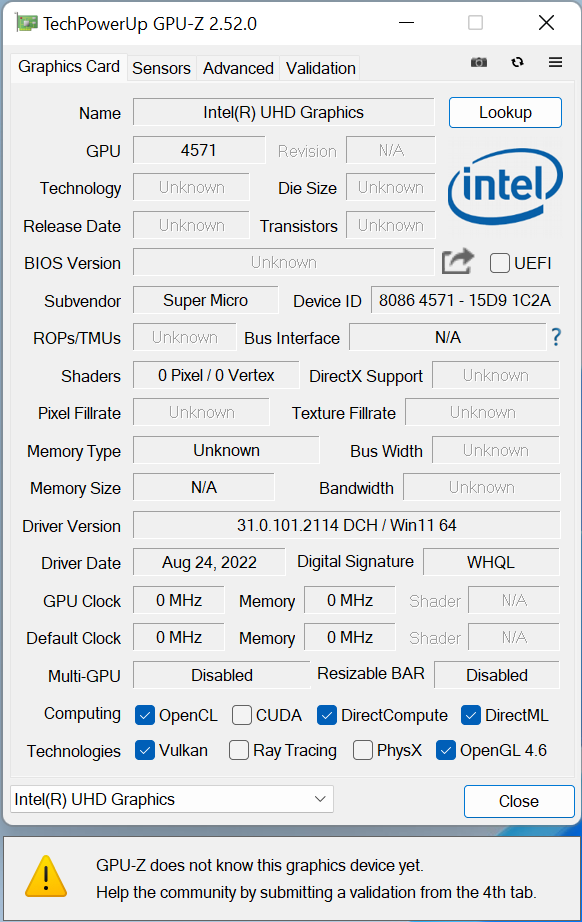
Since the SoC is not widely available yet, GPU-Z doesn't have the details in the database. However, publicly available specifications indicate that this iGPU has 32EUs operating at 500 MHz, with the option to boost to 750 MHz.
GFXBench
The DirectX 12-based GFXBench tests from Kishonti are cross-platform, and available all the way down to smartphones. As such, they are not very taxing for discrete GPUs and modern integrated GPUs. We processed the offscreen versions of the 'Aztec Ruins' benchmark.
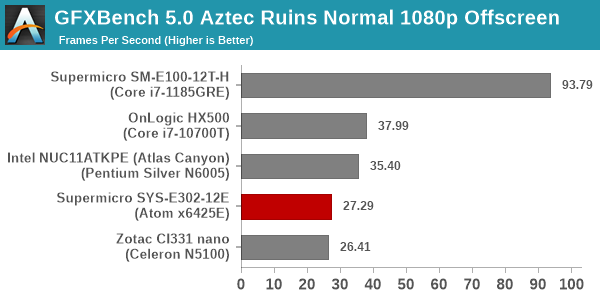
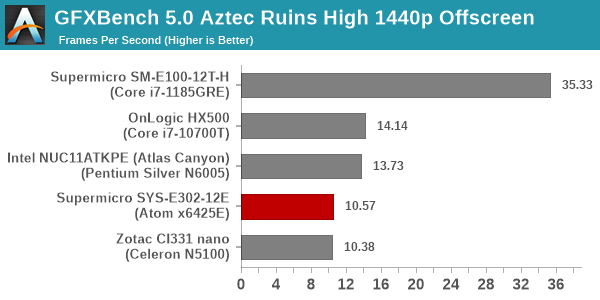
Despite the gulf in the power budgets, the faster RAM in the CI331 nano means that the SYS-E302-12E and the ZBOX perform pretty much identically in the GFXBench workloads.
UL 3DMark
Four different workload sets were processed in 3DMark - Fire Strike, Time Spy, Night Raid, and Wild Life.
3DMark Fire Strike
The Fire Strike benchmark has three workloads. The base version is meant for high-performance gaming PCs. It uses DirectX 11 (feature level 11) to render frames at 1920 x 1080. The Extreme version targets 1440p gaming requirements, while the Ultra version targets 4K gaming system, and renders at 3840 x 2160. The graph below presents the overall score for the Fire Strike Extreme and Fire Strike Ultra benchmark across all the systems that are being compared.
| UL 3DMark - Fire Strike Workloads | |||
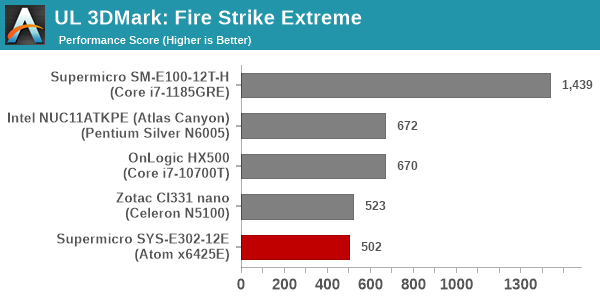
The slower RAM in the SYS-E302-12E pushes it below the CI331 nano in the Fire Strike workload. The other numbers are along expected lines based on the available power budgets.
3DMark Time Spy
The Time Spy workload has two levels with different complexities. Both use DirectX 12 (feature level 11). However, the plain version targets high-performance gaming PCs with a 2560 x 1440 render resolution, while the Extreme version renders at 3840 x 2160 resolution. The graphs below present both numbers for all the systems that are being compared in this review.
| UL 3DMark - Time Spy Workloads | |||
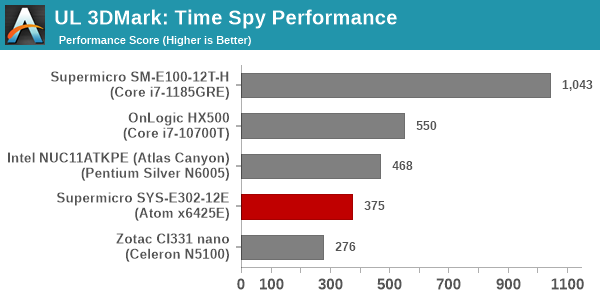
Time Spy appears to be unaffected by the slower RAM, with the clock speed / power budget advantage of the SYS-E302-12E helping it perform signficantly better than the ZBOX.
3DMark Wild Life
The Wild Life workload was initially introduced as a cross-platform GPU benchmark in 2020. It renders at a 2560 x 1440 resolution using Vulkan 1.1 APIs on Windows. It is a relatively short-running test, reflective of mobile GPU usage. In mid-2021, UL released the Wild Life Extreme workload that was a more demanding version that renders at 3840 x 2160 and runs for a much longer duration reflective of typical desktop gaming usage.
| UL 3DMark - Wild Life Workloads | |||
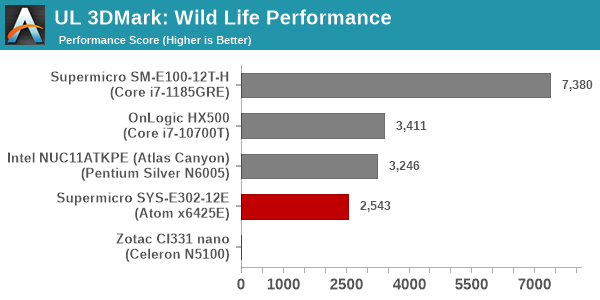
The CI331 nano was unable to complete the Wild Life Performance workload, but we see that the SYS-E302-12E was able to deliver much better performance in the Extreme case.
3DMark Night Raid
The Night Raid workload is a DirectX 12 benchmark test. It is less demanding than Time Spy, and is optimized for integrated graphics. The graph below presents the overall score in this workload for different system configurations.
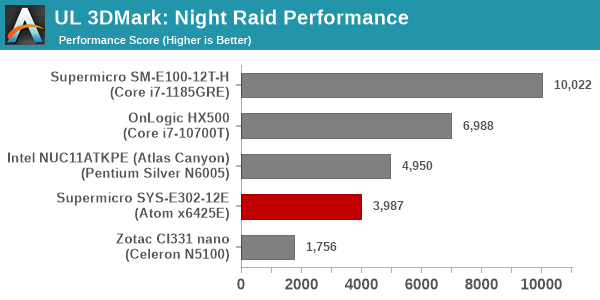
The power budget and iGPU clock speeds help the Atom x6425E outperform the Celeron N5100 by a significant margin, but the actively cooled Pentium Silver N6005 delivers even higher performance.
Originally published at https://www.anandtech.com/show/18744/supermicro-syse30212e-fanless-industrial-pc-review-elkhart-lake-for-iot-applications (Wayback Machine).