
The Intel Core i3-13100F Review: Finding Value in Intel's Cheapest Core Chip
- Posted in
- CPUs
- Intel
- Core i3
- Desktop
- Golden Cove
- Core i3-12300
- 13th Gen Core
- Raptor Lake
- Raptor Lake-S
- Core i3-13100F
CPU Benchmark Performance: Simulation
Simulation and Science have a lot of overlap in the benchmarking world. The benchmarks that fall under Science have a distinct use for the data they output – in our Simulation section, these act more like synthetics but at some level are still trying to simulate a given environment.
In the encrypt/decrypt scenario, how data is transferred and by what mechanism is pertinent to on-the-fly encryption of sensitive data - a process by which more modern devices are leaning to for software security.
We are using DDR5-4800 memory on the Intel Core i3-13100F as per the JEDEC specifications. Other recent chips, such as Intel's 13th/12th Gen Core series and Ryzen 7000 processors, are also tested at the rated JEDEC specifications. We tested the aforementioned platforms with the following settings:
- DDR5-5600B CL46 - Intel 13th Gen
- DDR5-5200 CL44 - Ryzen 7000
- DDR5-4800 (B) CL40 - Intel 12th Gen
- DDR5-4800 (B) CL40 - Intel 13th Gen Core i3 series
All other CPUs such as Ryzen 5000 and 3000 were tested at the relevant JEDEC settings as per the processor's individual memory support with DDR4.
Simulation
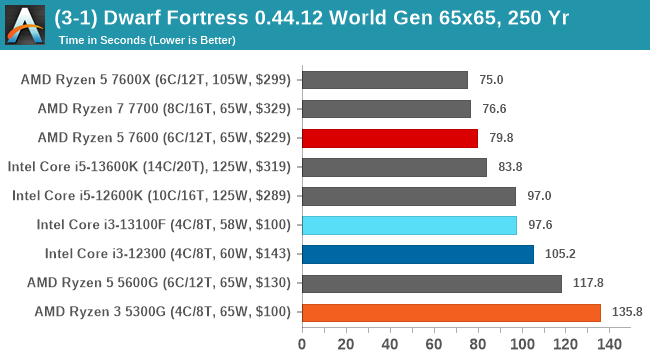
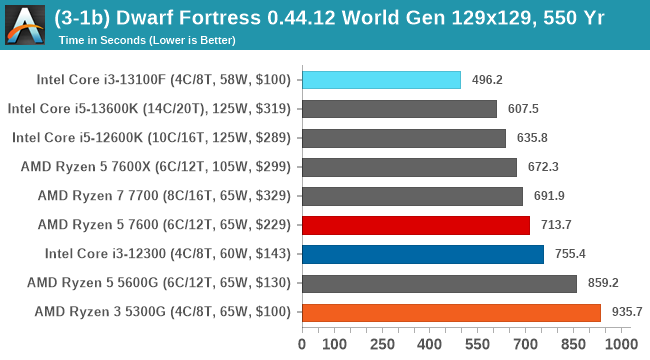
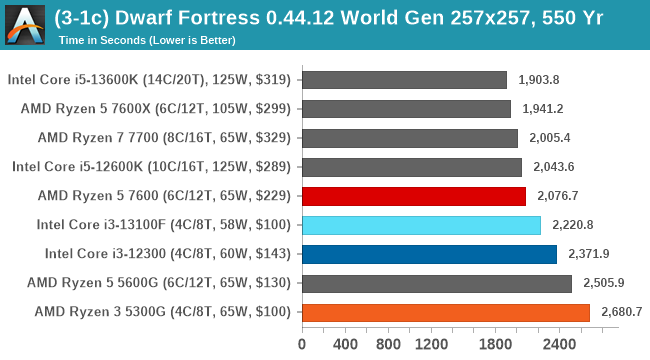
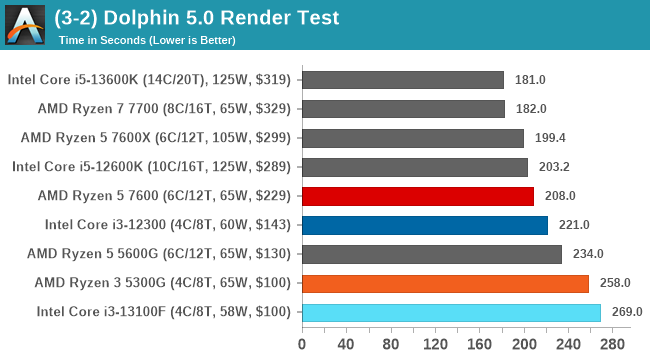
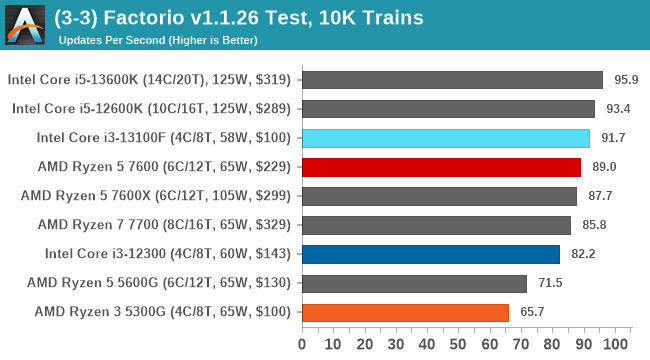
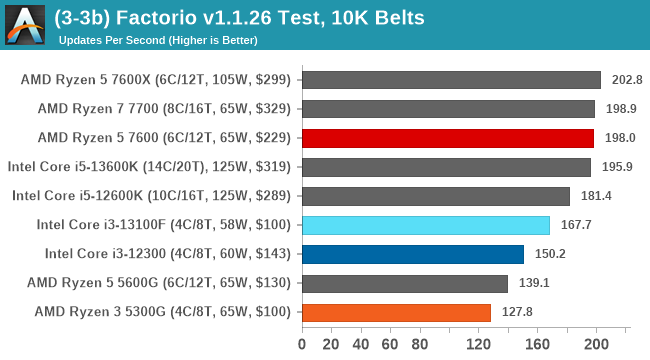
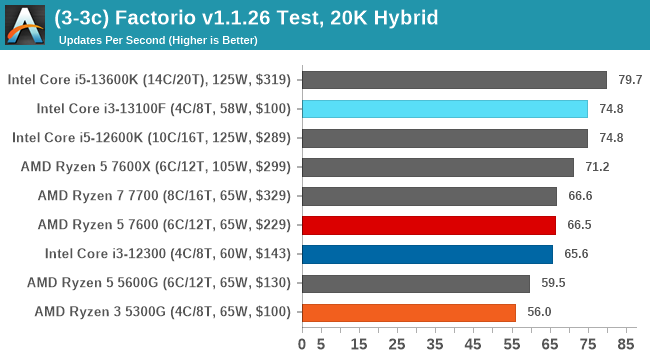
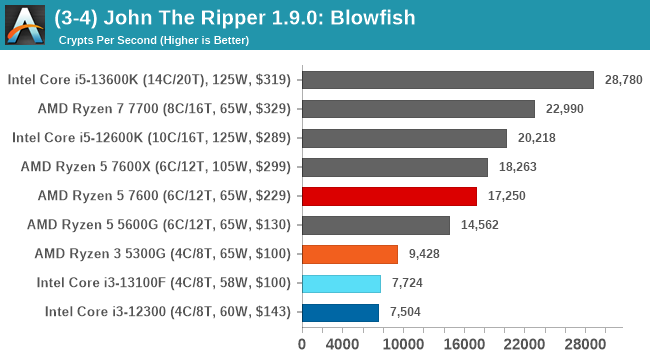
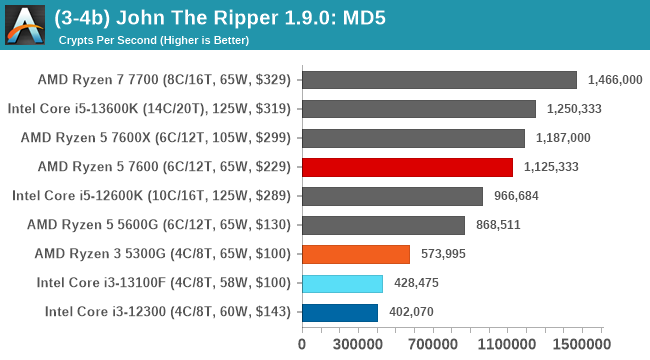
In our simulation-based tests, the Core i3-13100F lacks the grunt of the other chips simply because it only has four cores. The Core i3-13100F did, however, perform much better than expected in some of our Dwarf Fortress and Factorio benchmarks. It should be noted that it's apparent that in simulations, chips with a higher core count, higher IPC performance, and faster turbo clock speeds typically benefit users better that are doing compute heavy workloads.
Originally published at https://www.anandtech.com/show/18740/the-intel-core-i3-13100f-review-finding-value-in-intels-cheapest-chip (Wayback Machine).