
Intel NUC 12 Pro Wall Street Canyon Kits Review: Alder Lake in UCFF Avatar
- Posted in
- Systems
- Intel
- Fanless
- NUC
- Passive Cooling
- UCFF
- Mini-PC
- Alder Lake-P
- NUC12
- Wall Street Canyon
- Bleu Jour
Miscellaneous Aspects and Concluding Remarks
Networking and storage are aspects that may be of vital importance in specific PC use-cases. The NUC 12 Pro kits come with the Wi-Fi 6E AX211 WLAN cards that also include Bluetooth 5.2 support. On the wired front, the vPro model has the I225-LM Ethernet controller, while the regular model has the I225-V controller with 2.5 Gbps support. Dual LAN options would be nice to have in the vPro SKU in order to enable a dedicated management network interface. Unfortunately, the NUC12WSKv7 has only one wired LAN interface.
On the storage side, the NUC 12 Pro kits do have support for PCIe 4.0 x4 NVMe SSDs. However, cooling those within the space constraints imposed by the form-factor of the mainstream NUCs is very challenging. Even Intel's review sample came only with the Kingston KC2500 PCIe 3.0 x4 NVMe SSD. From a benchmarking perspective, we provide results from the WPCstorage test of SPECworkstation 3.1. This benchmark replays access traces from various programs used in different verticals and compares the score against the one obtained with a 2017 SanDisk 512GB SATA SSD in the SPECworkstation 3.1 reference system.
| SPECworkstation 3.1.0 - WPCstorage SPEC Ratio Scores | |||
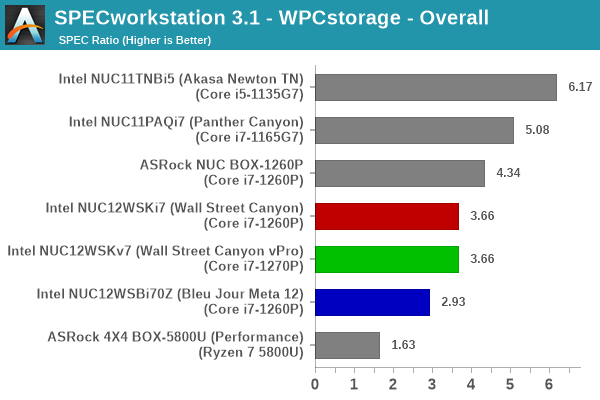
The graphs above present results for different verticals, as grouped by SPECworkstation 3.1. The storage workload consists of 60 subtests. Access traces from CFD solvers and programs such as Catia, Creo, and Soidworks come under 'Product Development'. Storage access traces from the NAMD and LAMMPS molecular dynamics simulator are under the 'Life Sciences' category. 'General Operations' includes access traces from 7-Zip and Mozilla programs. The 'Energy' category replays traces from the energy-02 SPECviewperf workload. The 'Media and Entertainment' vertical includes Handbrake, Maya, and 3dsmax. It is no surprise to see the SSD score being the same in both the actively-cooled NUC 12 Pro kits. The Bleu Jour Meta 12 suffers from extreme thermal throttling, with the SSD temperature going as high as 80 C. So, it is no surprise to see the score for the SSD getting pulled low in that system.
Closing Thoughts
The introduction of hybrid processors to the UCFF line is a major marker in the history of the Intel NUCs. It is only fitting that the ten-year journey of the mainstream NUCs is punctuated by this event. The ultra-compact form-factor has evolved significantly over that time frame, and we find the systems being put to use in a wide range of deployments.
At the end of our review process for the three NUC 12 Pro Wall Street Canyon kits, we have good insights into the key knobs that control system performance. The PL1 and PL2 values are important for delivering the performance improvements expected when going from one generation to the next. At the same time, these numbers also impact the design of fanless systems. OEMs designing such industrial PCs need to pay extra attention to the tuning of the BIOS parameters to keep the temperatures in check.

Between the NUC12WSKi7 and NUC12WSKv7, it appears that the slightly higher turbo clocks in the latter do not deliver any tangible performance benefits. However, the vPro capabilities of the processor may be a must for specific deployments. Unless AMT is absolutely essential, the NUC12WSKi7 is as good a system as the NUC12WSKv7. Intel's new case design that was previewed in our NUC12WSKv7 sample is eye-catching and subjectively better than the current plain chassis. It might be worthwhile to investigate whether the case design for UCFF systems can also help improve the thermal profile.
I/O options in the NUC 12 Pro kits are excellent, given the form-factor of the system. The presence of two Thunderbolt 4 ports make up for the absence of a SDXC card slot and offers extensive expansion options. At the same time, the Lite SKU that removes the Thunderbolt 4 ports is also an attractive lower-priced option for industrial deployments that don't have a need for such high-speed I/O. The Bleu Jour Meta 12's use of the Lite board manages to convey that point.
Our performance evaluation showed that the NUC 12 Pro kits deliver tangible improvements over their Tiger Lake counterparts. Compared to the ASRock Industrial NUC BOX-1260P, the two actively-cooled kits have a much better power consumption and performance profile. Our doubts regarding the performance per watt metric for Alder Lake-P were laid to rest after our detailed investigation into the Wall Street Canyon NUC kits.

On the fanless front, the Bleu Jour Meta 12 is an interesting product that can only improve with more attention to BIOS tuning. The design itself could also do with some improvements in terms of SSD cooling support (the regular NUC 12 Pro kits have a better passive thermal solution for the storage subsystem compared to the Meta 12). Hopefully, the performance and temperature profile of the Meta 12 can change for the better before the product hits the market.
Supply chain issues have resulted in the Wall Street Canyon NUCs being offered in a wide range of prices. The official suggested price for the NUC12WSKi7 is $970 (inclusive of a 500GB NVMe SSD and 16GB of DDR4-3200 DRAM). However, equivalent configurations are being sold with a premium. End users are better off purchasing a barebones version for $660 and adding their own SSD and RAM. The NUC12WSKv7 has a recommended price of around $750 for the barebones version, but the only listing we could find has it for sale at $827. Fanless Alder Lake-P machines are yet to come to the market, though Akasa has announced a few DIY cases for the Wall Street Canyon NUCs. It remains to be seen whether Bleu Jour can eventually bring the Meta 12 to the market.
Originally published at https://www.anandtech.com/show/18729/intel-nuc-12-pro-wall-street-canyon-kits-review-alder-lake-in-ucff-avatar (Wayback Machine).