
Seagate 7200.9 500GB: Mouthwatering Benchmarks
- Posted in
- Storage
Final Words
With 3.0Gb/sec peak transfer rates and a 16MB cache, we expected the 500GB 7200.9 to blow away all of the other drives that we have reviewed. HDTach reported an extremely high, 248MB/sec burst speed, which was surprising after seeing the Windows Read Speed Test report a burst speed of 143MB/sec.
Seagate's 500GB 7200.9 performed exceptionally well in the game level loading tests, especially with Doom 3 and C&C;: Generals. Half-Life 2 wasn't so forgiving, but two out of three games isn't bad. It also performed well in the File Zip operations as well as the Multitasking scenario where we zip a file within the drive while we import 400MB worth of emails in an Outlook account.
The 500GB 7200.9 does not perform better than some of the older 3.0Gb/sec drives that we had looked at a few months back, but its capacity may be enough to give Hitachi's 500GB offering some competition. We actually do have Hitachi's 500GB unit on hand and will be following up this review with a look at that drive as well as Western Digital's new 400GB Caviar. Right now, the 500GB Barracuda is a bit on the pricey side for the performance that it gives in our test suite, but it is a known fact that the higher transfer rates are attained more with multi-drive RAID.
If you're looking for capacity, the 500GB 7200.9 might be right for you, but with current prices, it may be more cost-effective to get your hands on a couple of 400GB units. For those who are speed hungry and don't mind giving up the disk space for it, you're better off working with a 10K RPM Raptor for now.
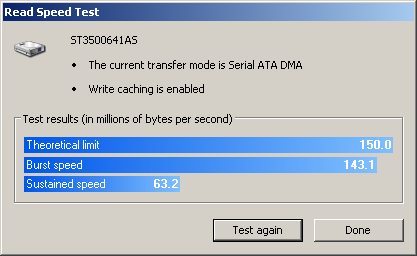
With 3.0Gb/sec peak transfer rates and a 16MB cache, we expected the 500GB 7200.9 to blow away all of the other drives that we have reviewed. HDTach reported an extremely high, 248MB/sec burst speed, which was surprising after seeing the Windows Read Speed Test report a burst speed of 143MB/sec.
Hold mouse over image.
Seagate's 500GB 7200.9 performed exceptionally well in the game level loading tests, especially with Doom 3 and C&C;: Generals. Half-Life 2 wasn't so forgiving, but two out of three games isn't bad. It also performed well in the File Zip operations as well as the Multitasking scenario where we zip a file within the drive while we import 400MB worth of emails in an Outlook account.
The 500GB 7200.9 does not perform better than some of the older 3.0Gb/sec drives that we had looked at a few months back, but its capacity may be enough to give Hitachi's 500GB offering some competition. We actually do have Hitachi's 500GB unit on hand and will be following up this review with a look at that drive as well as Western Digital's new 400GB Caviar. Right now, the 500GB Barracuda is a bit on the pricey side for the performance that it gives in our test suite, but it is a known fact that the higher transfer rates are attained more with multi-drive RAID.
If you're looking for capacity, the 500GB 7200.9 might be right for you, but with current prices, it may be more cost-effective to get your hands on a couple of 400GB units. For those who are speed hungry and don't mind giving up the disk space for it, you're better off working with a 10K RPM Raptor for now.
Originally published at https://www.anandtech.com/show/1833 (Wayback Machine).