
Seagate 120GB External Storage
- Posted in
- Storage
WinBench 99
We have extended our WinBench 99 portion of our benchmarks to include not only the Disk Transfer Rate tests, but also a handful of other disk performance related tests, including Disk Access Time, CPU Utilization, Disk Playback/Bus, Disk Playback/HE, and Disk Playback/Removable Media. As we present our results, we will explain how each test is relevant in our methodology.
Disk Transfer Rate
In the past, we have just given the beginning and ending transfer rates, which doesn’t really show the performance of the entire disk because there is so much more in between on which we don’t report. Our new method includes a graph:
Disk Access Time
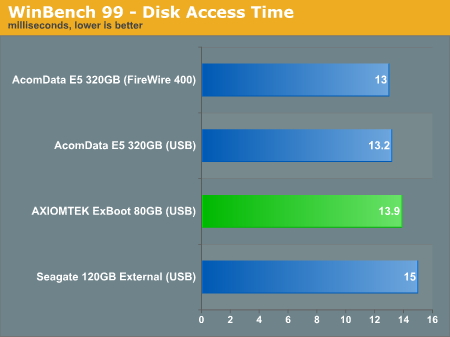
According to WinBench 99, the disk access time on the Seagate is 15ms, which is 1.8ms slower than the Western Digital carrying AcomData. We may be seeing a trend here as the larger 320GB Western Digital based E5 is performing much quicker in the synthetic tests so far.
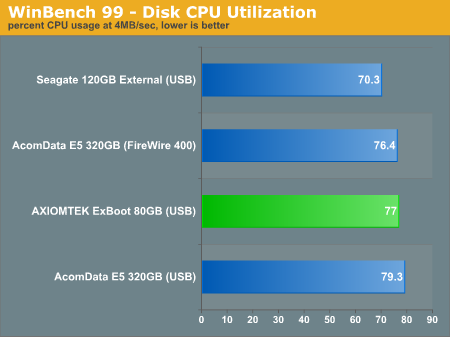
When testing the AcomData E5, we saw that CPU consumption was about 79.3% while transferring data over the USB interface. The Seagate drive took up less of the CPU’s time as it only consumed an average of 70.3% over its one and only USB interface.
We have extended our WinBench 99 portion of our benchmarks to include not only the Disk Transfer Rate tests, but also a handful of other disk performance related tests, including Disk Access Time, CPU Utilization, Disk Playback/Bus, Disk Playback/HE, and Disk Playback/Removable Media. As we present our results, we will explain how each test is relevant in our methodology.
Disk Transfer Rate
In the past, we have just given the beginning and ending transfer rates, which doesn’t really show the performance of the entire disk because there is so much more in between on which we don’t report. Our new method includes a graph:

Click to enlarge.
Disk Access Time
According to WinBench 99, the disk access time on the Seagate is 15ms, which is 1.8ms slower than the Western Digital carrying AcomData. We may be seeing a trend here as the larger 320GB Western Digital based E5 is performing much quicker in the synthetic tests so far.
When testing the AcomData E5, we saw that CPU consumption was about 79.3% while transferring data over the USB interface. The Seagate drive took up less of the CPU’s time as it only consumed an average of 70.3% over its one and only USB interface.
Originally published at https://www.anandtech.com/show/1802 (Wayback Machine).