
Intel Motherboards: Can a Diamond beat a Royal Flush?
- Posted in
- Motherboards
Ethernet Performance
As a refresher, the new motherboard test suite includes LAN performance measurements. Both of these boards utilize PCI Express controllers with the only difference being the supplier of the core logic.
The Windows 2000 Driver Development Kit (DDK) includes a useful LAN testing utility called NTttcp. We used the NTttcp tool to test Ethernet throughput and the CPU utilization of the various Ethernet Controllers used on the nForce4 Ultra motherboards.
We set up one machine as the server; in this case, an Intel box with an Intel CSA Gigabit LAN connection. Intel CSA has a reputation for providing fast throughput and this seemed a reasonable choice to serve our Gigabit LAN clients.
At the server side, we used the following Command Line as suggested by the VIA whitepaper on LAN testing:
All Ethernet tests were performed with standard frames and the NVIDIA Active Armor suite disabled. Gigabit Ethernet supports Jumbo frames as well and will theoretically provide a further reduction in CPU overhead. We have seen test results that show the combination of Active Armor and Jumbo Frames have reduced CPU utilization below 10%, which is very respectable performance for on-chip gigabit LAN.
As a refresher, the new motherboard test suite includes LAN performance measurements. Both of these boards utilize PCI Express controllers with the only difference being the supplier of the core logic.
The Windows 2000 Driver Development Kit (DDK) includes a useful LAN testing utility called NTttcp. We used the NTttcp tool to test Ethernet throughput and the CPU utilization of the various Ethernet Controllers used on the nForce4 Ultra motherboards.
We set up one machine as the server; in this case, an Intel box with an Intel CSA Gigabit LAN connection. Intel CSA has a reputation for providing fast throughput and this seemed a reasonable choice to serve our Gigabit LAN clients.
At the server side, we used the following Command Line as suggested by the VIA whitepaper on LAN testing:
Ntttcps - m 4,0, -a 4 - l 256000 - n 30000On the client side (the motherboard under test), we used the following Command Line:
Ntttcpr - m 4,0, -a 4 - l 256000 - n 30000At the conclusion of the test, we captured the throughput and CPU utilization figures from the client screen.
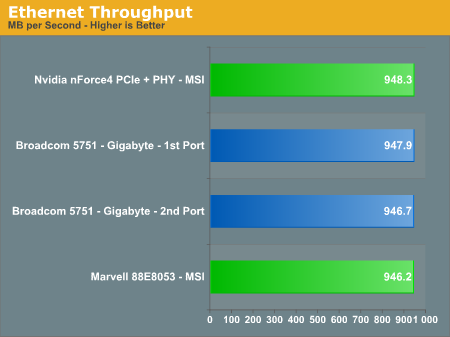
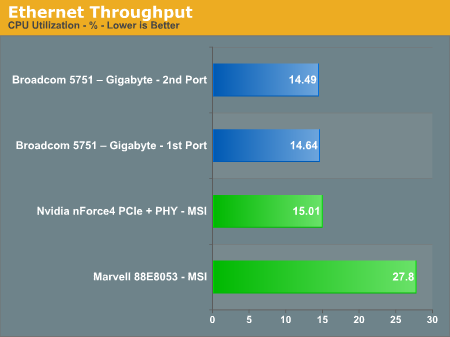
All Ethernet tests were performed with standard frames and the NVIDIA Active Armor suite disabled. Gigabit Ethernet supports Jumbo frames as well and will theoretically provide a further reduction in CPU overhead. We have seen test results that show the combination of Active Armor and Jumbo Frames have reduced CPU utilization below 10%, which is very respectable performance for on-chip gigabit LAN.
Originally published at https://www.anandtech.com/show/1796 (Wayback Machine).