
Mid-Tower Mega Roundup
- Posted in
- Cases/Cooling/PSUs
Benchmark Comparisons
To get as meaningful a comparison as possible between the different cases, we installed the same set of hardware into each one, our standard ATX test bed.
We have compiled the results of all the head and noise testing into a master chart. Cases with variable-speed fans were tested first on their highest setting and then on their lowest setting to get the two different audio measurements. The "Exhaust" column refers to the temperature of the air coming out of the unit's main rear exhaust vents, where if there were more than one fan, the highest temperature was used.
So, are you really getting what you pay for with these units? It certainly seems that this is the case with the P-180 and PC-V1000, as they both pull away with the best temp/noise numbers, but for nearly half the cost, the X-Cruiser puts up great temperatures as well, thanks to its CPU shroud, albeit at the cost of a bit more noise.
Interestingly, the F3323 also looks like an amazing deal from this chart, but those numbers must be taken with a grain of salt as we used a particularly high-performance fan, which although doesn't show up as a loud unit on our dBa meter, does make a rather audible metallic-sounding whine. If the type of noise isn't much of a problem, perhaps the greatest lesson to take away from this entire review is: all that a case really needs to cool rather well is one, high performance fan. For most users, however, the use of several quieter fans would be more ideal, and this is where a design such as the P-180 really comes out with a major advantage.
One other interesting point to elaborate on is the difference in dBa ratings taken from different sides of the cases. For most users, the top and front measurements should be the main ones to focus on. Notice how the V1000 is only quieter than the Antec cases when their fans are set to full-blast. This is probably due to the blower and 120mm running at their stock voltages. With the use of a fan controller, this noise could be controlled much better. In addition, it does look like using the air deflector inhibits the power supply's ability to exhaust air easily, as it has the highest PSU air temps.
To get as meaningful a comparison as possible between the different cases, we installed the same set of hardware into each one, our standard ATX test bed.
| ATX Test Bed | |
| Chaintech VNF3-250 AMD Athlon 64 3200+ OCZ PC3200 512MB DDR x 2 Zalman CNPS7000 Copper Western Digital IDE Hard Drive Sapphire 9800XT AGP8x |
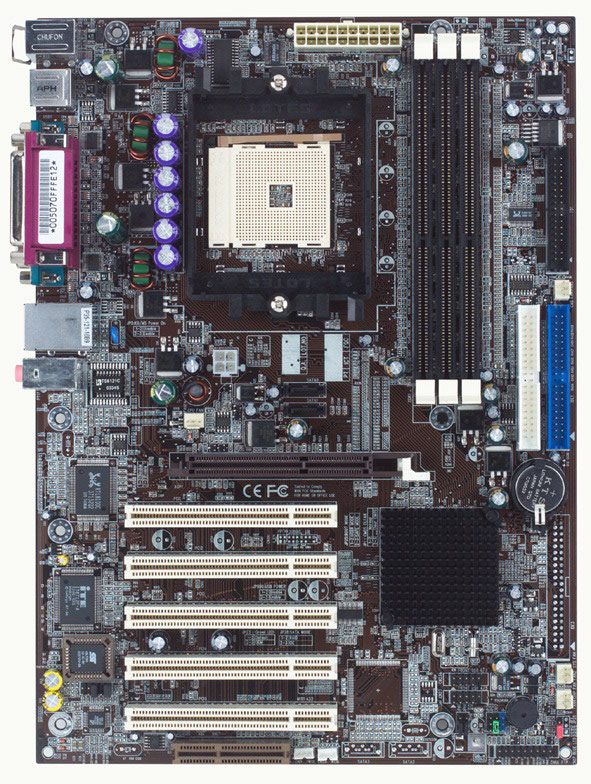 Click to enlarge. |
We have compiled the results of all the head and noise testing into a master chart. Cases with variable-speed fans were tested first on their highest setting and then on their lowest setting to get the two different audio measurements. The "Exhaust" column refers to the temperature of the air coming out of the unit's main rear exhaust vents, where if there were more than one fan, the highest temperature was used.
| Heat and Noise Comparison Chart | ||||||||
| Case | Component Temperatures (idle/full load) | Air Temperatures | dBa Measurements | |||||
| CPU | GPU | N. Bridge | PSU | Exhaust | Front | Rear | Top | |
| X-Cruiser | 45 / 54 | 64 / 71 | 34 | 33 | 31 | 42 | 55 | 58 |
| F3323 | 42 / 53 | 63 / 69 | 31 | 32 | 28 | 40 | 42 | 41 |
| Trio | 44 / 54 | 67 / 72 | 36 | 36 | 29 | 41 | 42 | 41 |
| Sonata II (low) | 45 / 59 | 67 / 72 | 34 | 34 | 30 | 41 | 40 | 39 |
| Sonata II (high) | 43 / 57 | 66 / 71 | 33 | 34 | 29 | 54 | 62 | 57 |
| Centurion | 48 / 59 | 67 / 73 | 36 | 35 | 34 | 40 | 42 | 40 |
| P-180 (low) | 47 / 58 | 66 / 71 | 34 | 33 | 32 | 38 | 39 | 39 |
| P-180 (high) | 44 / 55 | 64 / 69 | 31 | 29 | 28 | 60 | 62 | 61 |
| Eclipse | 43 / 56 | 64 / 70 | 31 | 34 | 32 | 40 | 41 | 40 |
| PC-V1000 | 42 / 55 | 64 / 72 | 38 | 36 | 32 | 44 | 58 | 40 |
So, are you really getting what you pay for with these units? It certainly seems that this is the case with the P-180 and PC-V1000, as they both pull away with the best temp/noise numbers, but for nearly half the cost, the X-Cruiser puts up great temperatures as well, thanks to its CPU shroud, albeit at the cost of a bit more noise.
Interestingly, the F3323 also looks like an amazing deal from this chart, but those numbers must be taken with a grain of salt as we used a particularly high-performance fan, which although doesn't show up as a loud unit on our dBa meter, does make a rather audible metallic-sounding whine. If the type of noise isn't much of a problem, perhaps the greatest lesson to take away from this entire review is: all that a case really needs to cool rather well is one, high performance fan. For most users, however, the use of several quieter fans would be more ideal, and this is where a design such as the P-180 really comes out with a major advantage.
One other interesting point to elaborate on is the difference in dBa ratings taken from different sides of the cases. For most users, the top and front measurements should be the main ones to focus on. Notice how the V1000 is only quieter than the Antec cases when their fans are set to full-blast. This is probably due to the blower and 120mm running at their stock voltages. With the use of a fan controller, this noise could be controlled much better. In addition, it does look like using the air deflector inhibits the power supply's ability to exhaust air easily, as it has the highest PSU air temps.
Originally published at https://www.anandtech.com/show/1783 (Wayback Machine).