
X-Fi and the Elite Pro: SoundBlaster's Return to Greatness
- Posted in
- Smartphones
- Mobile
X-Fi Processing Elements: Exploring the SRC
Sample rate conversion is one of the causes of poor audio reproduction in current sound cards. So, why make such a big deal out of sample rate conversion on the X-Fi? This time, Creative has implemented an SRC that generates very low noise and distortion, and the Audio Ring allows data that doesn't require sample rate conversion to bypass the step altogether. For the conversion of a 997Hz signal from 44.1kHz to 48kHz, the SRC demonstrated -136dB THD+N and +/- 0.00025dB pass-band ripple. Creative says that this is 300 times the quality of the SRC step in previous generation SoundBlaster products. These excellent results allow data to be passed multiple times through the SRC without any significant distortion of the data, making the SRC a key part in effects processing.Pitch shifting can now easily be done on the SRC. Multitasking the sample rate conversion hardware for effects further allows creative to justify the efforts that they put into its development. One thing that Creative says can be dynamically applied to sound in realtime through the SRC is the Doppler effect. This could allow game designers, for instance, to apply a Doppler effect to all moving sound in a scene relatively easily. Sound synthesis can also use the SRC to change the pitch of a sound easily. The SRC also fits into 3D audio processing.
In pro audio applications, the SRC can be used to avoid the necessity of an external clock for syncing audio signals. Synchronized audio is still possible on X-Fi, but audio from multiple sources can be mixed with very good results using the SRC. As we have said before though, applications that do not require sample rate conversion will be able to bypass the SRC all together.
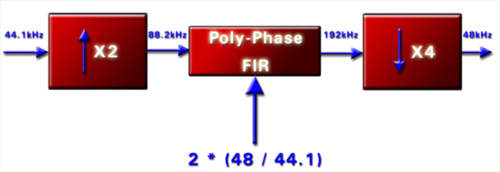
In order to create such a high quality SRC, Creative created a three-step hybrid filter. First, the sample rate is linearly increased by a factor of 2 using fairly simple math - no complex filters are needed for this step. The next stop along the way to sample rate conversion is a poly-phase FIR filter that up-samples its input to 2*(desired_sample_rate / original_sample_rate). This gives us data with a sample rate that is 4 times the desired sample rate. The final step is to reduce the sample rate by a factor of four (which is also an easy computation). Aside from increasing the quality of the sample rate conversion, increasing the sample rate to 4x the desired final rate also serves as an effective anti-imaging filter. The highest frequency that can be represented in sampled digital audio is half the sample rate (as per Nyquist). Imaging is a "ghost" of the audio signal in the range between the sample rate and half the sample rate. Assisting with anti-imaging is a by-product of the X-Fi SRC.
Originally published at https://www.anandtech.com/show/1776 (Wayback Machine).