
The MSI Titan GT77 Review: Desktop-Class Core i9-12900HX Tested
Battery Life
Performance-focused notebooks rarely achieve excellent battery life, although the benchmark has been raised in the last couple of years. A device like the MSI Titan GT77 is designed to be plugged into power for most of the time though, and the component choices reflect that. With a massive RTX 3080L Ti processor, four sticks of DDR5-4000, three M.2 SSDs, and a 360 Hz display, the idle power draw of this system is significant. The display does at least switch to 60 Hz automatically when you unplug the laptop from AC power. This notebook also supports both hybrid graphics (NVIDIA Optimus) as well as discrete only, and for the battery testing the notebook was configured in hybrid mode.
To combat the high power draw, MSI has fit in a 99 Wh battery, which is bumping into the largest viable battery in a laptop computer since you can not take a battery larger than 100 Wh on to a commercial flight.
For all of our battery life measurements, the display is set to 200 nits which on this device was 59%.
Web Battery Life
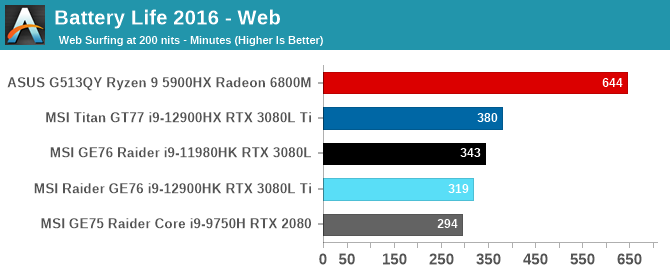
At 380 minutes of runtime, the Titan GT77 was able to surpass the Raider GE76 we tested a few months ago. It is still a long way from the all-AMD ASUS G513QY. AMD has really done an excellent job power-gating their graphics.
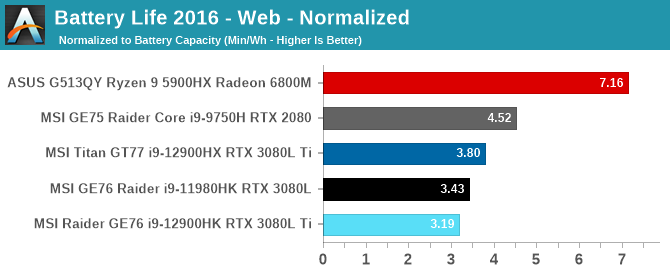
Looking at the normalized results, which removes the battery size from the equation, the power efficiency of this over the Raider GE76 is pretty good. It is surprising since this notebook has quad-channel memory, compared to just dual-channel in the Alder Lake HX powered Raider GE76.
Movie Playback
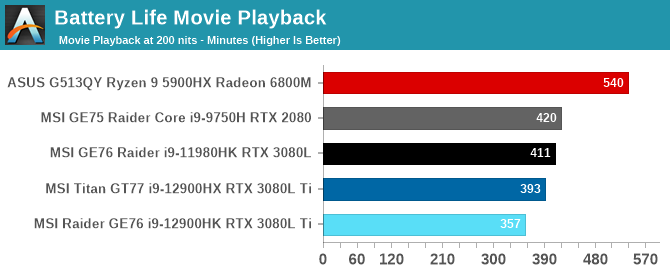
Movie playback is offloaded to fixed function decode in the iGPU, so it is generally one of the tasks that uses the least amount of energy. That is the case here as well, although the base power draw of the rest of the system does mask it somewhat.
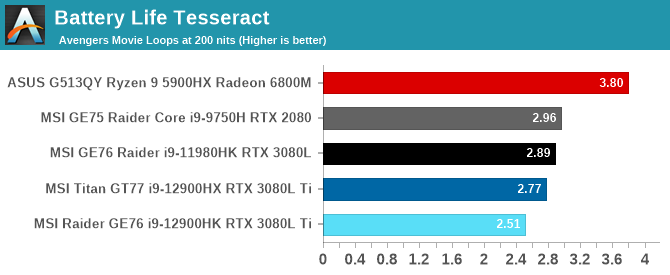
Our Tesseract score divides the movie playback runtime by the length of The Avengers, and the Titan GT77 can almost get through three viewings of that movie before shutting down.
Battery Charge Time
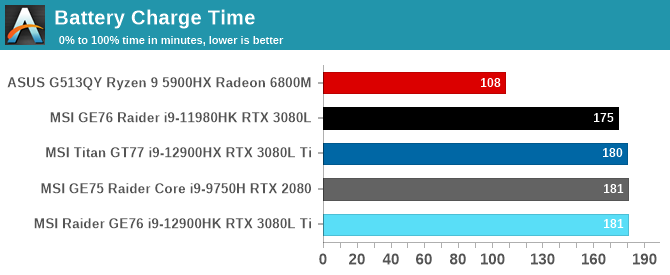
The Titan GT77 ships with a 250-Watt AC Adapter, but it has a very large 99 Wh battery to fill. Laptops meant for on the go often offer fast-charging options, but this desktop-replacement system does not, so the charge time is a very average three hours.
Storage Performance
The review unit that was provided shipped with three Samsung PM9A1 drives with each being 1 TB in size. The PM9A1 is a very quick PCIe 4.0 SSD from previous testing.
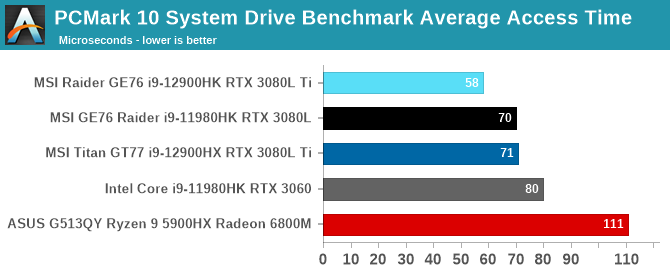
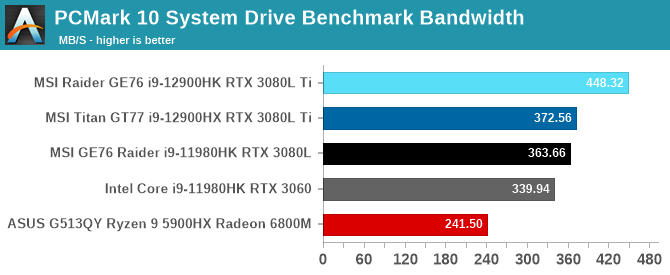
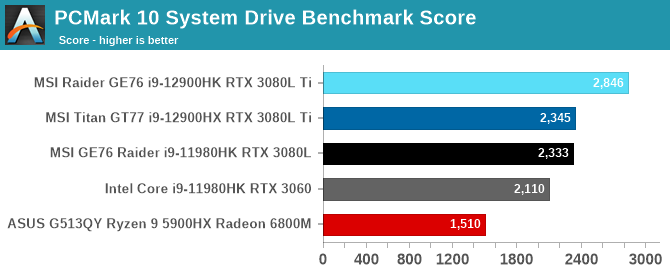
The results are not quite as strong as the Raider GE76 unit, which shipped with three 2 TB PM9A1 drives. In the world of storage, larger drives offer increased parallelization and, at least when looking at the same model, are generally faster, so the 2 TB outperforming the 1 TB is not unexpected. The PCIe 4.0 drive still performed very well though with the smaller capacity.
Wireless
MSI equips the Titan GT77 with Killer’s AX1675i wireless networking solution, which is a Wi-Fi 6E solution based off the Intel Typhoon Peak lineup which includes both this Killer and the Intel AX210. For those that prefer hardwired networking, the Killer E3100G adapter is a 2.5 Gbps solution with an Ethernet jack found on the right side of the device.
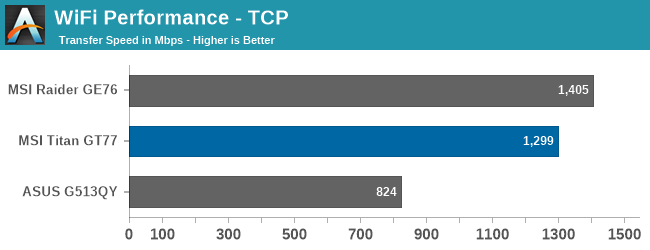
Our test bed for Wi-Fi is the ASUS ROG Rapture GT-AX11000 which is Wi-Fi 6, but not 6E, so it does not support the 6 GHz range. Performance on 5 GHz for the Killer AX1675i was excellent though. Intel’s Wi-Fi offerings are the best in the PC space, with very stable drivers and excellent performance.
Originally published at https://www.anandtech.com/show/17549/the-msi-titan-gt77-review-desktopclass-core-i912900hx-tested (Wayback Machine).