
SFF Roundup, Socket 939 Systems
- Posted in
- Systems
Noise Benchmarks
We used an SPL meter with a sensitivity of down to 30 dB in A-weighted mode to measure noise levels. While it may not be the most realistic placement for the meter, measurements were taken at a distance of 12 inches from the rear of the case. This was necessary to get meaningful differences from the systems in idle mode, though we admit it's not entirely accurate - especially with the fans frequently located at the rear of the case. We also measured from the front-right area of the computer at a range of 48 inches, roughly where we would expect most people to sit in relation to their case. A few of the units were quiet enough that the sensitivity of our SPL device came into play at the larger distance, and while none dropped below 30 dB, accuracy becomes suspect the closer we get to 30 dB. Noise tests were also taken with and without an X800Pro installed; integrated graphics were used if available, or a fanless MX440 or 6600 card was used for the other systems.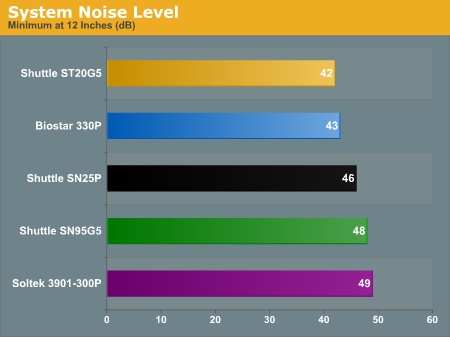
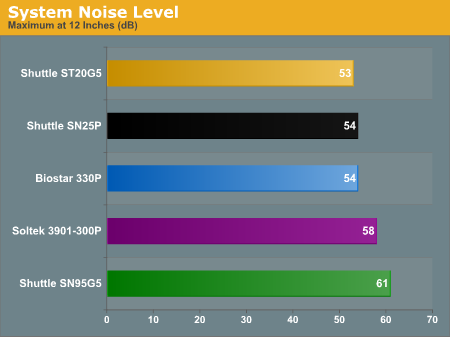
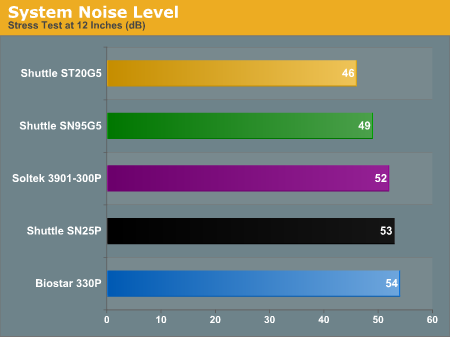
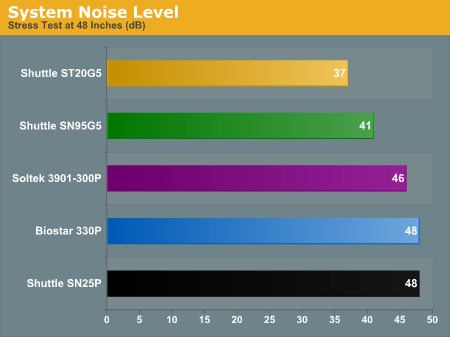
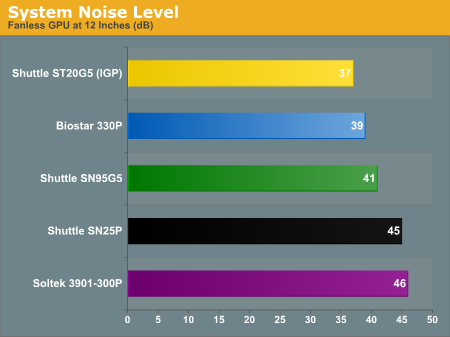
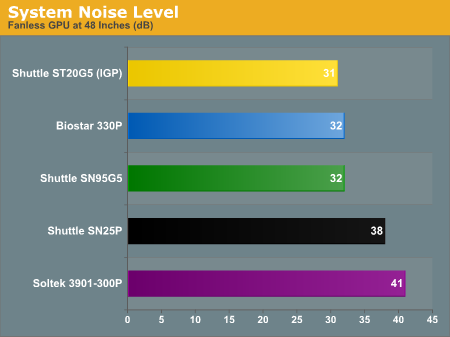
The items to which we'd pay the most attention are the idle (minimum) noise levels and the stress test noise levels. If you plan on using a quiet GPU, look at those results as well. All of these systems are very quiet in typical use - even the Soltek is quieter than most desktop ATX cases that have two or more 80mm fans installed. The stress tests make the 330P and SN25P look worse than what they really are, as the peak noise level that we measured at one specific point in the stress test isn't a continual irritant. Most of the time, they run at around 48 to 50 dB and it would only spike up to 53/54 dB periodically (once every couple of minutes). Overall, the G5 units prove the maturity of the design, as they come out as the quietest systems in the stress test and fanless GPU tests.
Originally published at https://www.anandtech.com/show/1754 (Wayback Machine).