
Kingston DataTraveler Max UFD Series Review: New Type-A Thumb Drive Retains NVMe Performance
Miscellaneous Aspects and Concluding Remarks
The performance of the UFDs and PSSDs in various real-world access traces as well as synthetic workloads was brought out in the preceding sections. We also looked at the performance consistency for these cases. Power users may also be interested in performance consistency under worst-case conditions, as well as UFD power consumption. The latter is also important when used with battery powered devices such as notebooks and smartphones. Pricing is also an important aspect. We analyze each of these in detail below.
Worst-Case Performance Consistency
Flash-based storage devices tend to slow down in unpredictable ways when subject to a large number of small-sized random writes. Many benchmarks use that scheme to pre-condition devices prior to the actual testing in order to get a worst-case representative number. Fortunately, such workloads are uncommon for direct-attached storage devices, where workloads are largely sequential in nature. Use of SLC caching as well as firmware caps to prevent overheating may cause drop in write speeds when a flash-based DAS device is subject to sustained sequential writes.
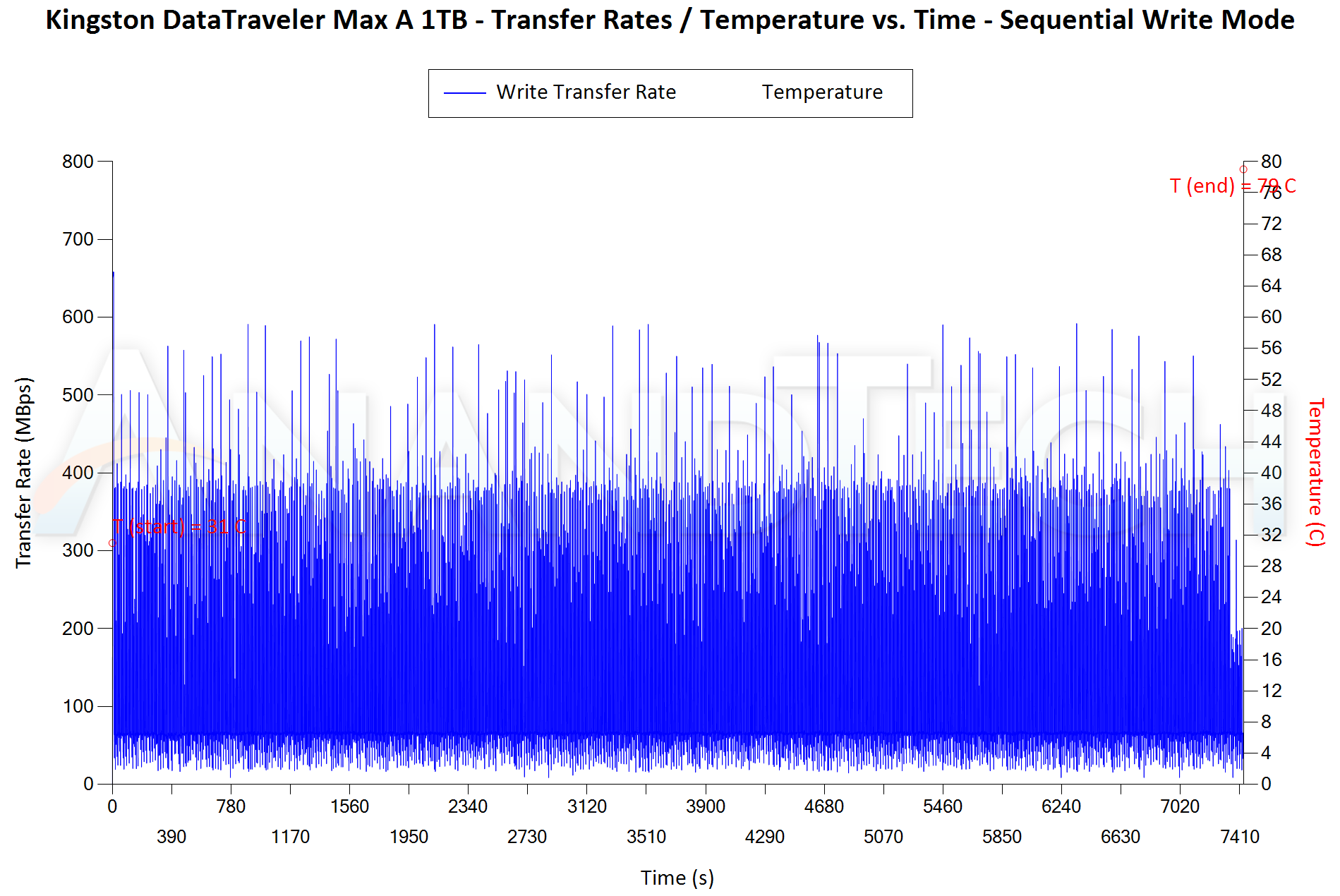
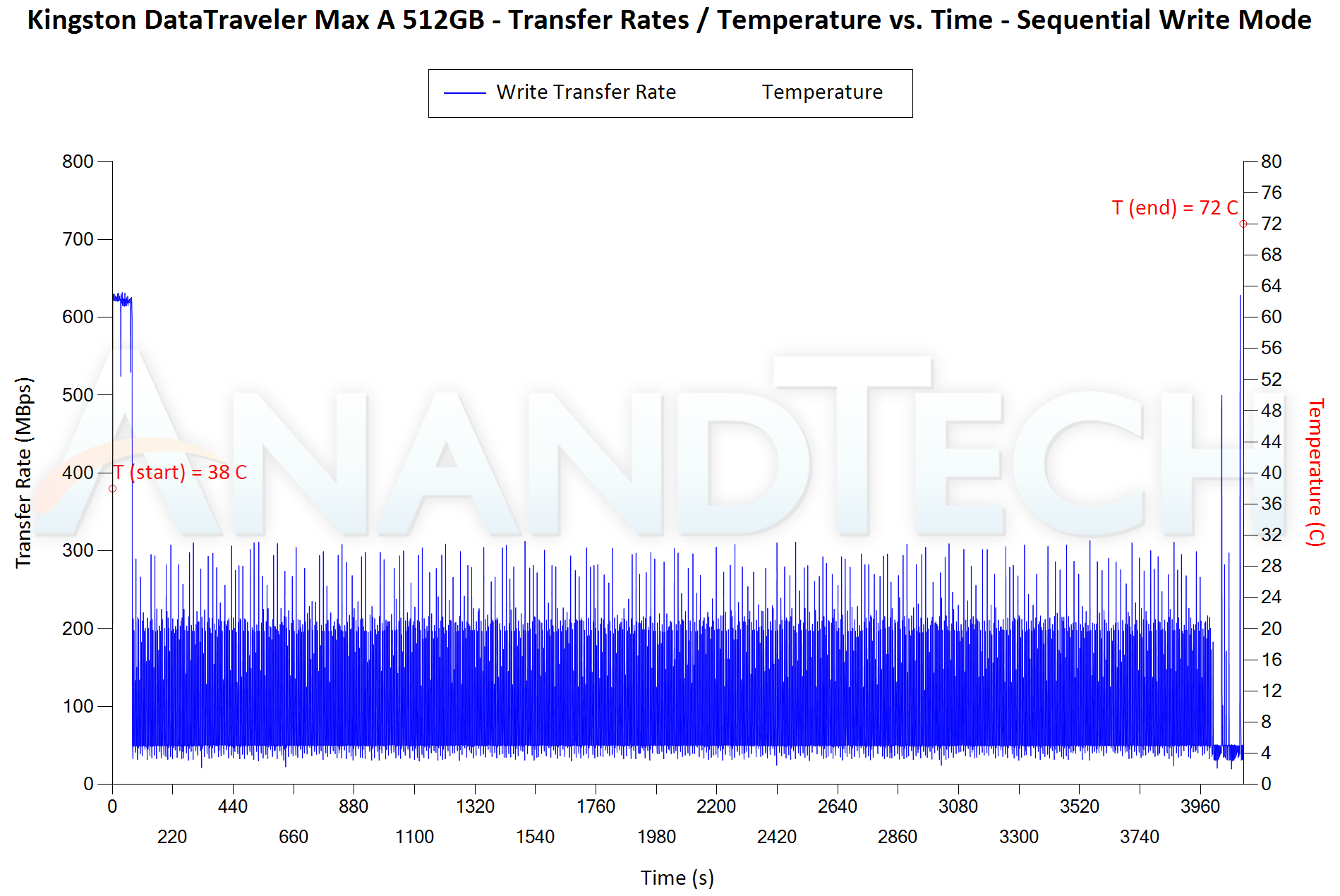
Our Sequential Writes Performance Consistency Test configures the device as a raw physical disk (after deleting configured volumes). A fio workload is set up to write sequential data to the raw drive with a block size of 128K and iodepth of 32 to cover 90% of the drive capacity. The internal temperature is recorded at either end of the workload, while the instantaneous write data rate and cumulative total write data amount are recorded at 1-second intervals.
| Sequential Writes to 90% Capacity - Performance Consistency | |
| TOP: | BOTTOM: |
 |
|
 |
|
The main comparison of interest is the DTMAXA/1TB against the Type-C DT Max 1TB SKU. While the Type-C version had up to 95GB of SLC cache, allowing it to consume that amount of data at 900 MBps+, the Type-A version is limited by the process queue depth / firmware to around 650 MBps. The sustained write also soon drops down into the 50 MBps range for both the Type-C and Type-A UFDs. However, there are many 400 MBps+ peaks in this scenario for the Type-A version. Nett effect is that even though the Type-C wins the quick initial write medal, the Type-A version finishes the workload significantly faster than the Type-C one (7410s vs. 10260s).
Power Consumption
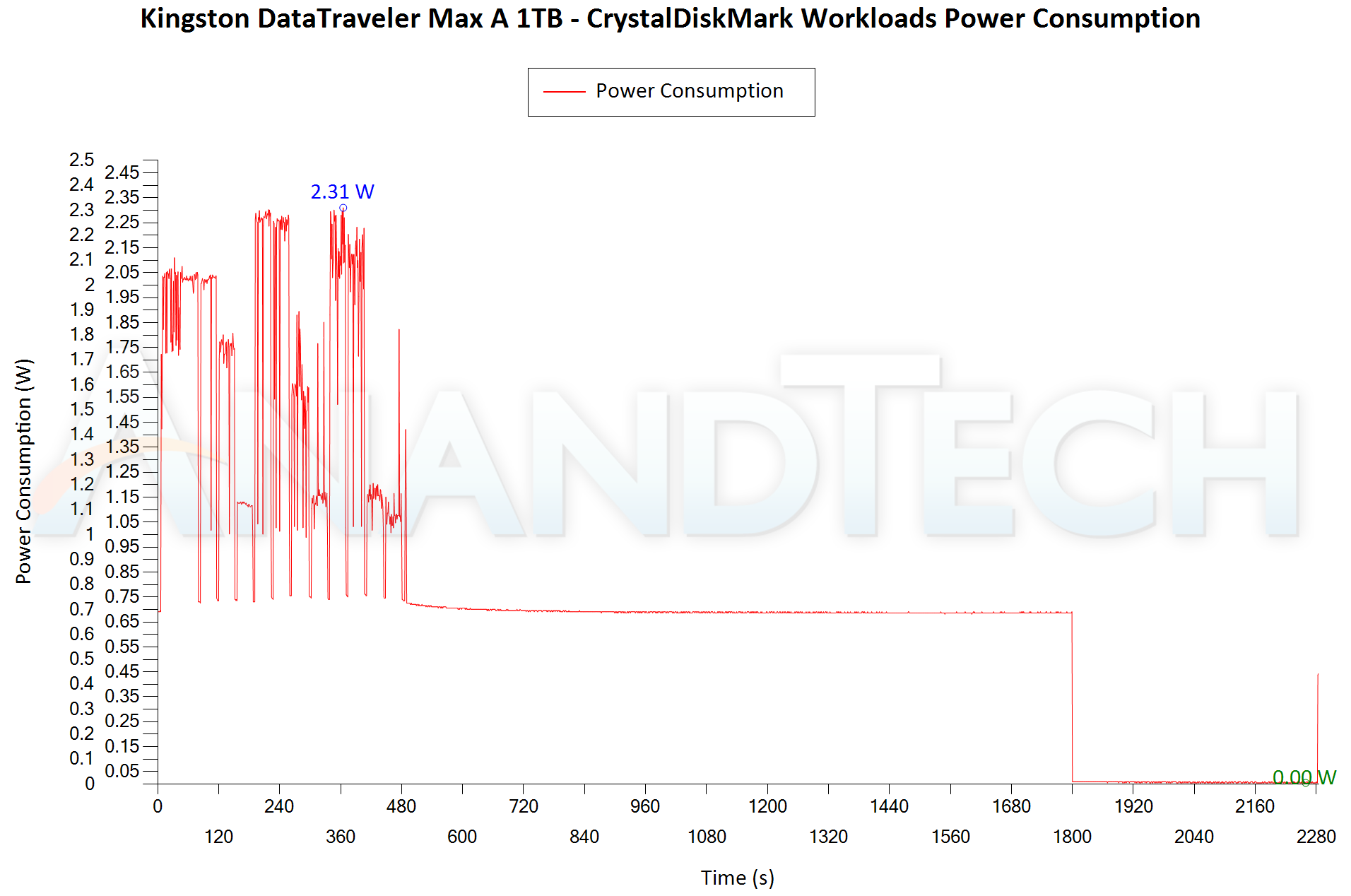
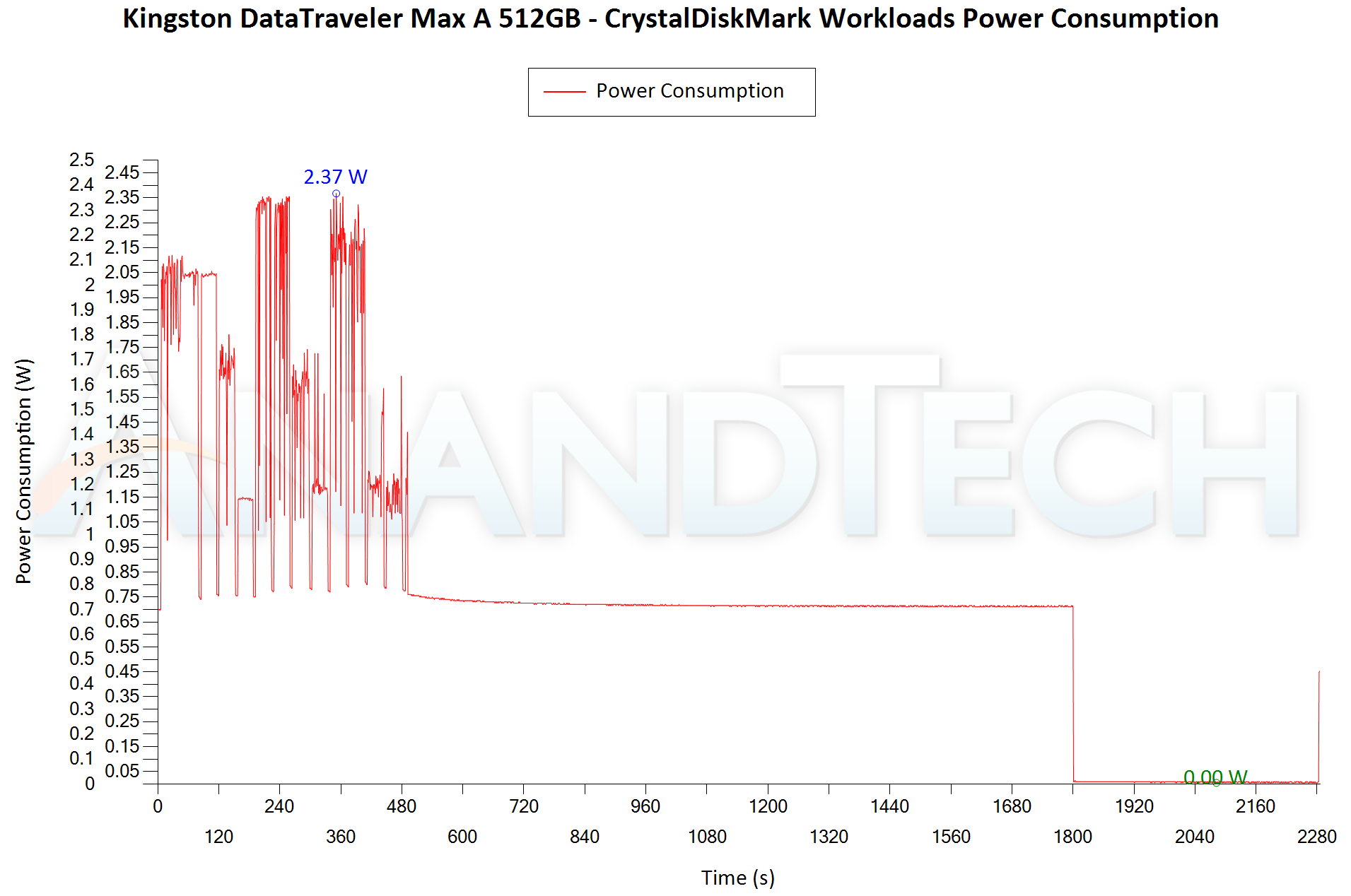
Bus-powered devices can configure themselves to operate within the power delivery constraints of the host port. While Thunderbolt ports are guaranteed to supply up to 15W for client devices, USB 2.0 ports are guaranteed to deliver only 4.5W (900mA @ 5V). In this context, it is interesting to have a fine-grained look at the power consumption profile of the various external drives. Using the Plugable USBC-TKEY and a Type-C male to Type-A female adapter, the bus power consumption of the drives was tracked while processing the CrystalDiskMark workloads (separated by 5s intervals). The graphs below plot the instantaneous bus power consumption against time, while singling out the maximum and minimum power consumption numbers.
| CrystalDiskMark Workloads - Power Consumption | |
| TOP: | BOTTOM: |
 |
|
 |
|
The Type-A version idles at around 0.7W (but does possess deep-sleep characteristics). The peak power is 2.31W, compared to the idling / peak of 0.8W / 3.05W for the Type-C version.
Final Words
The Kingston DTMAXA SKUs are available for purchase today. The official prices are $180 for the 1TB, $106 for the 512GB, and $63 for the 256GB SKU. At these prices, the main competition is the OWC Envoy Pro Mini, priced at $179, $109, and $79 for the three corresponding capacities. The OWC product is made of aluminum, and sports both Type-A and Type-C connectors in the same SKU with a bit of ingenious industrial design. Dimensions are similar (slightly shorter length, but thicker), but the weight is almost doubled (one might argue that it lends it extra solidity). One of my complaints about the DT Max Type-C UFD after using it on and off is that it is too flimsy. The new DTMAXA is not fragile to that extent, but users would do well to handle the UFD with care (something that appears to be a bit less of a concern with the OWC Envoy Pro Mini). The performance numbers claimed by OWC are the same as that of the DT Max series. Given these aspects, to price the drives similarly would not make much sense. Thankfully, the street pricing seems to be a bit more sane, with CDW making the three SKUs available for $137, $80, and $47 respectively. At these prices, there is not much competition, and the DataTraveler Max series becomes much more easier to recommend.
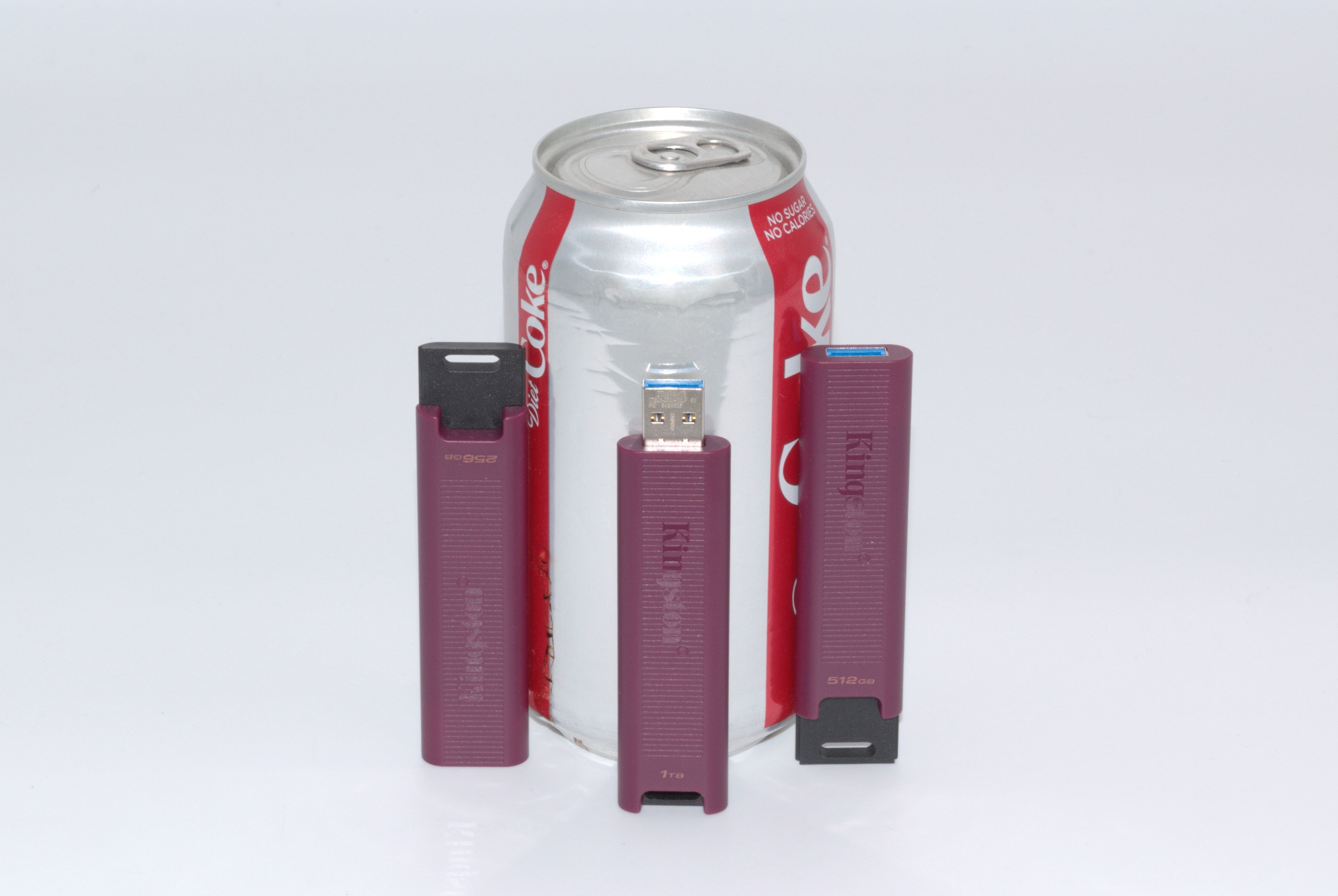
The Kingston DataTraveler Max has enjoyed pole position in this market segment, with no competitor in sight for a few quarters now. As the situation is about to change, Kingston's introduction of the Type-A SKUs will help in expanding the appeal of this high-performance product line. Though Kingston's claim of the new Type-A drives having the same performance as last year's Type-C drives (and thereby retaining the NVMe performance moniker) is not entirely false, last year's Type-C version still delivers better real-world performance. The new behavior also makes the lack of a thermal solution less of an issue.
While the 512GB and 1TB SKUs perform as well as any portable SSD, the lowest capacity SKU (256GB) is fit for sparing use only - if the plan is to subject it to heavy workloads, the lower-priced Samsung MUF-256DA is a better bet despite its USB 3.2 Gen 1 interface (it can sustain 100 MBps under extreme load, compared to around 50 MBps for the DTMAXA/256GB).
The new DTMAXA series does fill in the market gap for a Type-A flash drive that can saturate the interface, similar to a portable SSD. With Type-C and Type-A USB ports set to co-exist in the market for many years to come, a dual-connector (Type-C + Type-A) version could be more appealing to power users dealing with multiple PCs simultaneously. We hope Kingston builds upon this platform and creates rugged UFDs as well to appeal to a broader audience.
Originally published at https://www.anandtech.com/show/17486/kingston-dtmax-ufd-series-review (Wayback Machine).