
Jasper Lake Fanless Showdown: ECS LIVA Z3 and ZOTAC ZBOX CI331 nano UCFF PCs Review
Networking and Storage Aspects
Networking and storage are aspects that may be of vital importance in specific PC use-cases. On the networking front, the ZOTAC ZBOX CI331 nano manages to edge out the ECS LIVA Z3 on both the wired and wireless fronts. Both of them use the Realtek RTL8168/8111 controller to enable the gigabit LAN port. The ZBOX integrates two of them to provide dual LAN capabilities. This opens up a wider variety of use-cases for the system. On the wireless front, the ZBOX wins out by integrating the more modern Wireless-AC 9462 (compared to the Wireless-AC 3165 in the LIVA Z3). Though both solutions are 1x1 Wi-Fi 5 (802.ac) with a theoretical maximum data transmission rate of 433 Mbps, the ZBOX implementation includes Wave 2 features and antenna diversity (allowing the adapter to dynamically choose one of two antennae for a more robust connection). The ZBOX WALN card also includes Bluetooth 5.1 support (compared to the Bluetooth 4.2 support in the LIVA Z3's Wireless-AC 3165). BT 5.1 comes with increased range and doubles the transmit speed over BT 4.2.
On the storage side, the advantage lies with the ECS LIVA Z3 / JSLM-MINI. This platform devotes two PCIe Gen 3 lanes to the M.2 2280 slot, while the ZBOX restricts itself to a single SATA slot. From a benchmarking perspective, we provide results from the WPCstorage test of SPECworkstation 3.1. This benchmark replays access traces from various programs used in different verticals and compares the score against the one obtained with a 2017 SanDisk 512GB SATA SSD in the SPECworkstation 3.1 reference system.
| SPECworkstation 3.1.0 - WPCstorage SPEC Ratio Scores | |||
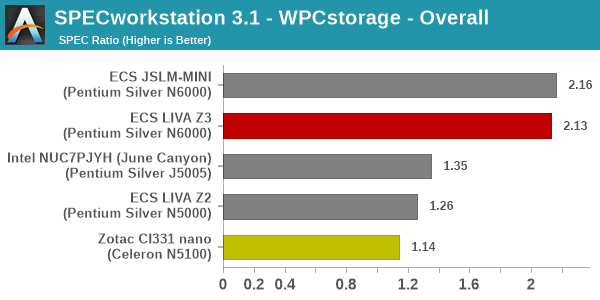
The graphs above present results for different verticals, as grouped by SPECworkstation 3.1. The storage workload consists of 60 subtests. Access traces from CFD solvers and programs such as Catia, Creo, and Soidworks come under 'Product Development'. Storage access traces from the NAMD and LAMMPS molecular dynamics simulator are under the 'Life Sciences' category. 'General Operations' includes access traces from 7-Zip and Mozilla programs. The 'Energy' category replays traces from the energy-02 SPECviewperf workload. The 'Media and Entertainment' vertical includes Handbrake, Maya, and 3dsmax. The 'General Operations' and 'Media and Entertainment' verticals are most relevant for the ECS LIVA Z3 / JSLM-MINI and the ZOTAC ZBOX CI331 nano.
The JSLM-MINI / ECS LIVA Z3 with its PCIe 3.0 x2 NVMe drive gets a significant lead over the SATA SSD in the ZBOX - almost double the performance for real-world workloads. Getting the best out of the storage subsystem also requires the CPU to keep up. Thermal throttling of the CPU is an issue in some of the workloads for the LIVA Z3, though the eventual scores for the LIVA Z3 and JSLM-MINI do end up quite close to each other.
The ECS LIVA Z3 / JSLM-MINI also includes a 128GB eMMC drive (one manufactured by Biwin Technologies in our review sample). We processed a quick CrystalDiskMark test to evaluate the performance of the eMMC drive.

The eMMC drive gives performance similar to a high-end 3.5" HDD for sequential workloads. The random accesses are faster than a HDD's. Obviously, the numbers can't match the capabilities of a PCIe 3.0 x2 NVMe SSD in the same system.
Originally published at https://www.anandtech.com/show/17481/ecs-liva-z3-and-zotac-zbox-ci331-nano-jasper-lake-minipcs-review-lessons-in-fanless-system-design (Wayback Machine).