
Samsung Portable SSD T7 Shield Review: Flagship PSSD Gets IP65 Avatar
Miscellaneous Aspects and Concluding Remarks
The performance of the storage bridges / drives in various real-world access traces as well as synthetic workloads was brought out in the preceding section. We also looked at the performance consistency for these cases. Power users may also be interested in performance consistency under worst-case conditions, as well as drive power consumption. The latter is also important when used with battery powered devices such as notebooks and smartphones. Pricing is also an important aspect. We analyze each of these in detail below.
Worst-Case Performance Consistency
Flash-based storage devices tend to slow down in unpredictable ways when subject to a large number of small-sized random writes. Many benchmarks use that scheme to pre-condition devices prior to the actual testing in order to get a worst-case representative number. Fortunately, such workloads are uncommon for direct-attached storage devices, where workloads are largely sequential in nature. Use of SLC caching as well as firmware caps to prevent overheating may cause drop in write speeds when a flash-based DAS device is subject to sustained sequential writes.
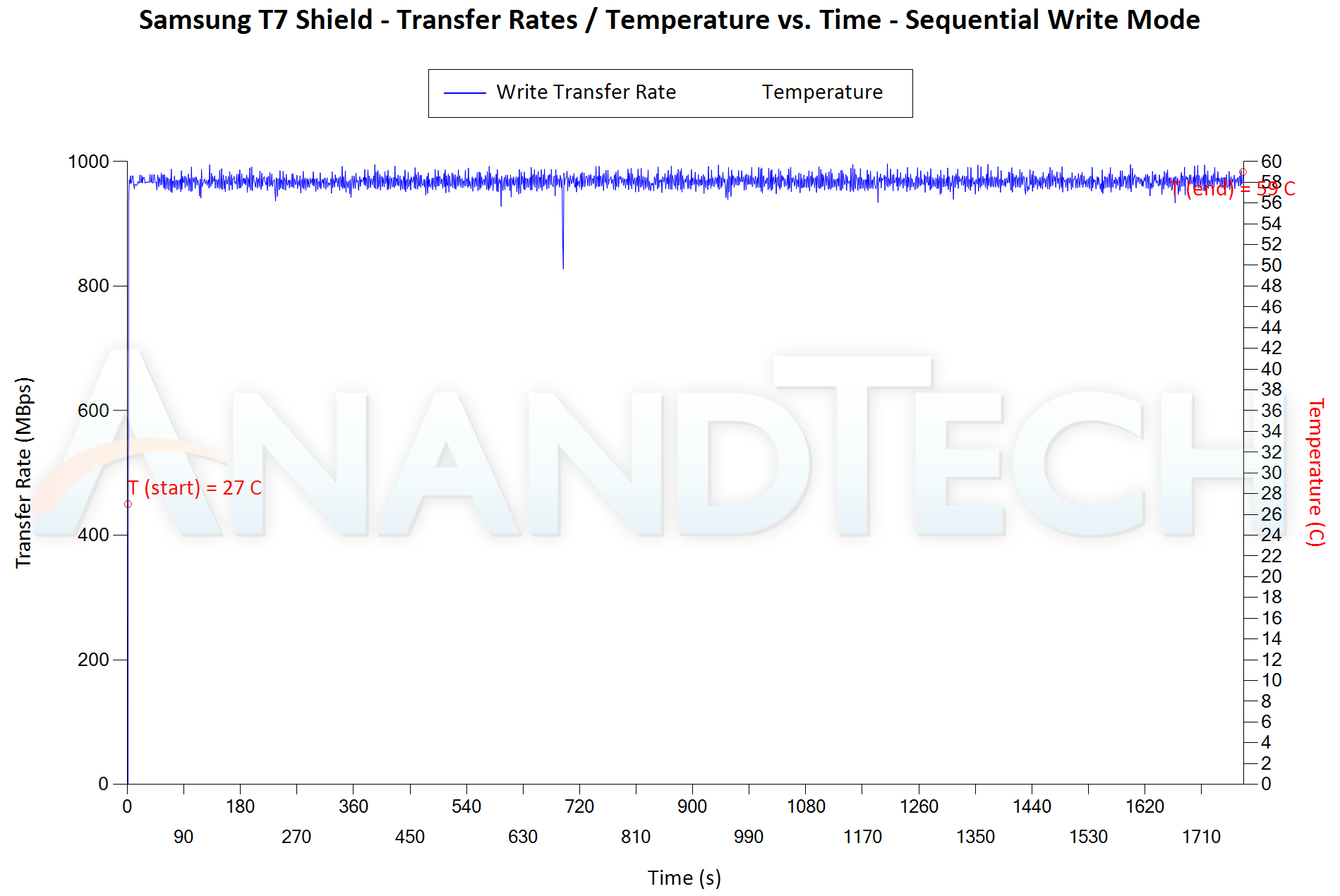
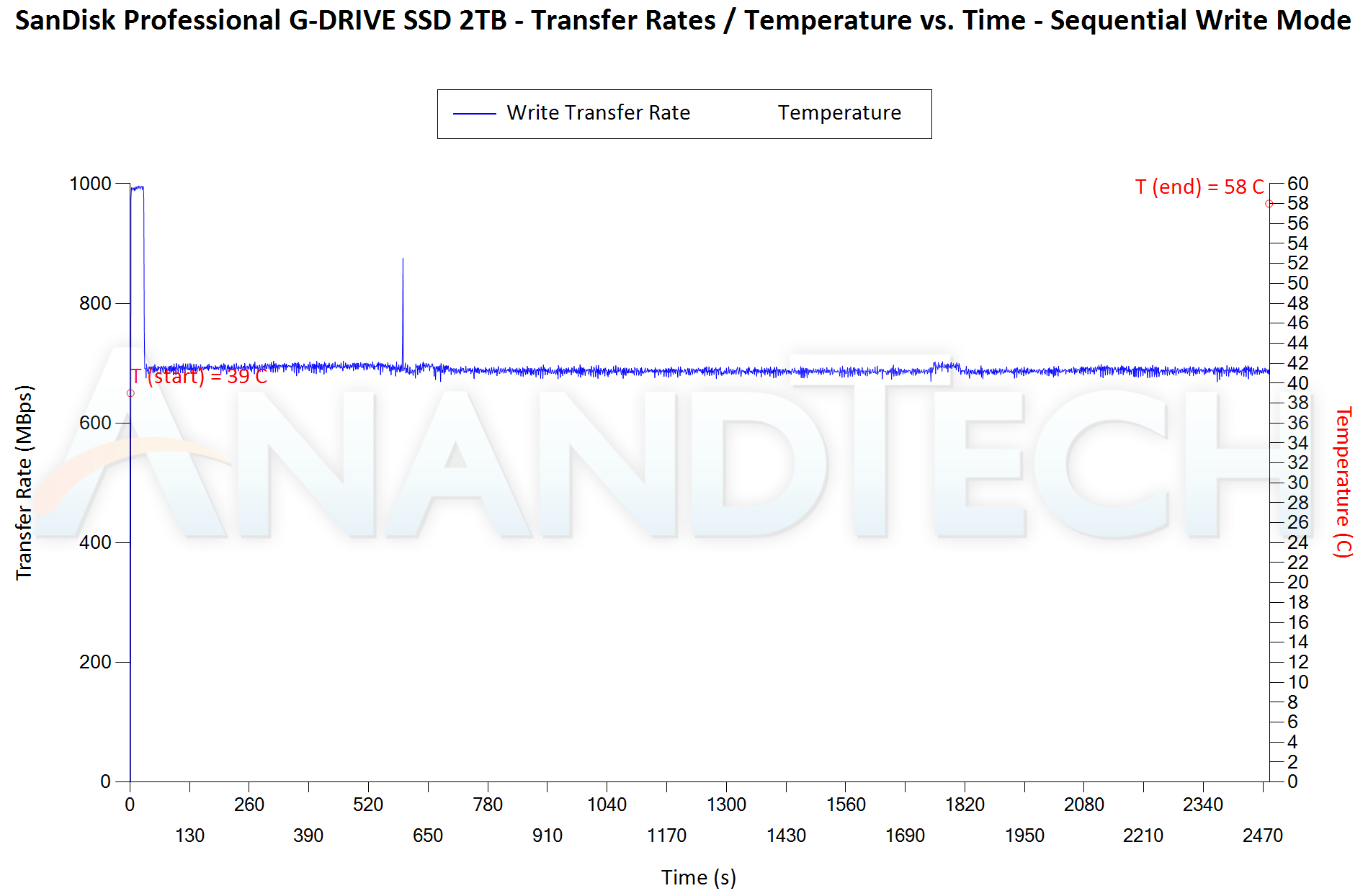
Our Sequential Writes Performance Consistency Test configures the device as a raw physical disk (after deleting configured volumes). A fio workload is set up to write sequential data to the raw drive with a block size of 128K and iodepth of 32 to cover 90% of the drive capacity. The internal temperature is recorded at either end of the workload, while the instantaneous write data rate and cumulative total write data amount are recorded at 1-second intervals.
| Sequential Writes to 90% Capacity - Performance Consistency | |
| TOP: | BOTTOM: |
 |
|
 |
|
The Samsung Portable SSD T7 Shield is the only drive in the considered set to not have a SLC cache cliff during this worst-case sequential drive fill test. Despite the peak speeds right through, the internal temperature at the end was only 59C - very similar to what the SanDisk Professional G-DRIVE ended up, but with a SLC cache cliff reducing its performance to around 700 MBps for most of the testing duration.
Power Consumption
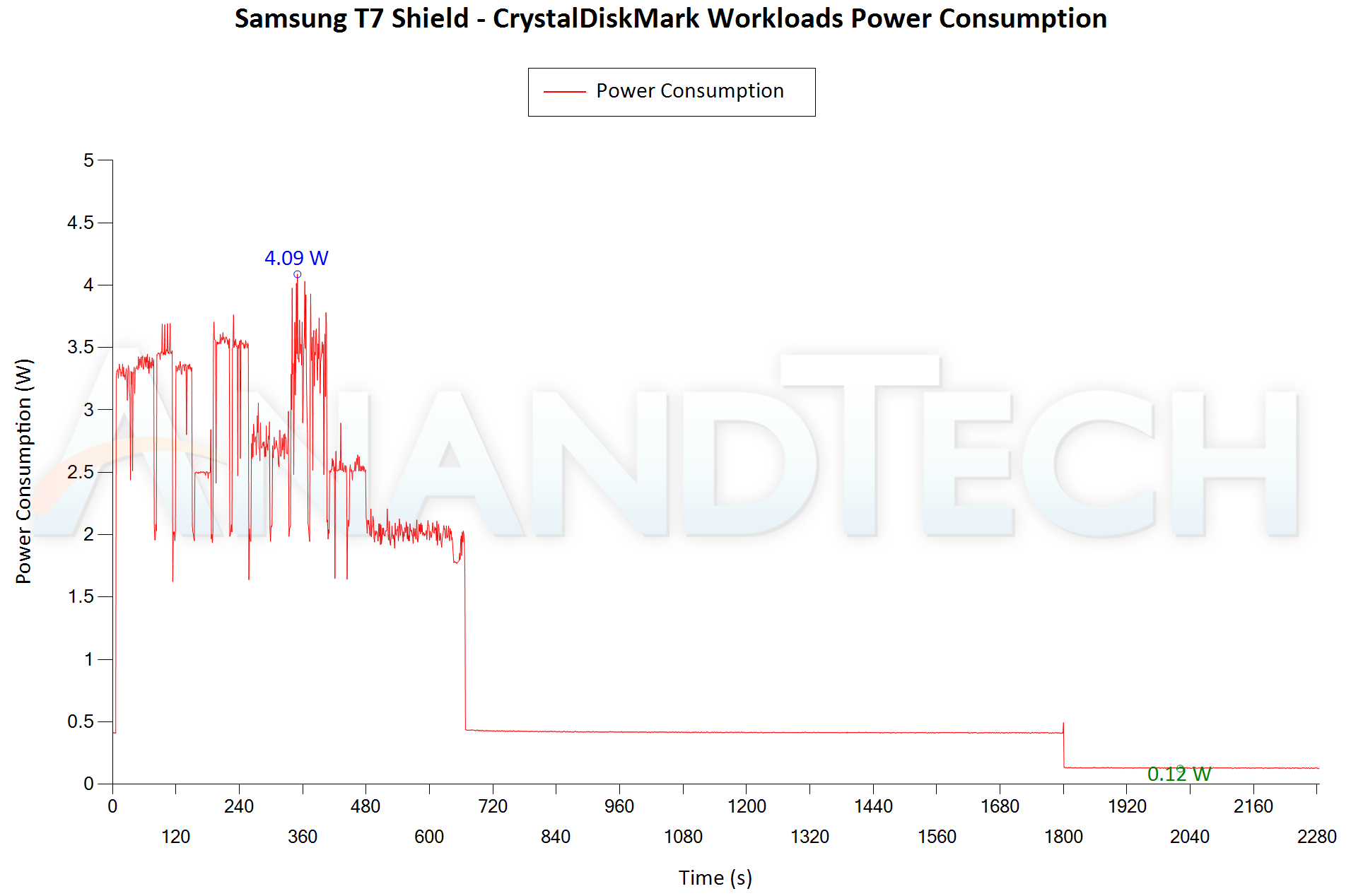
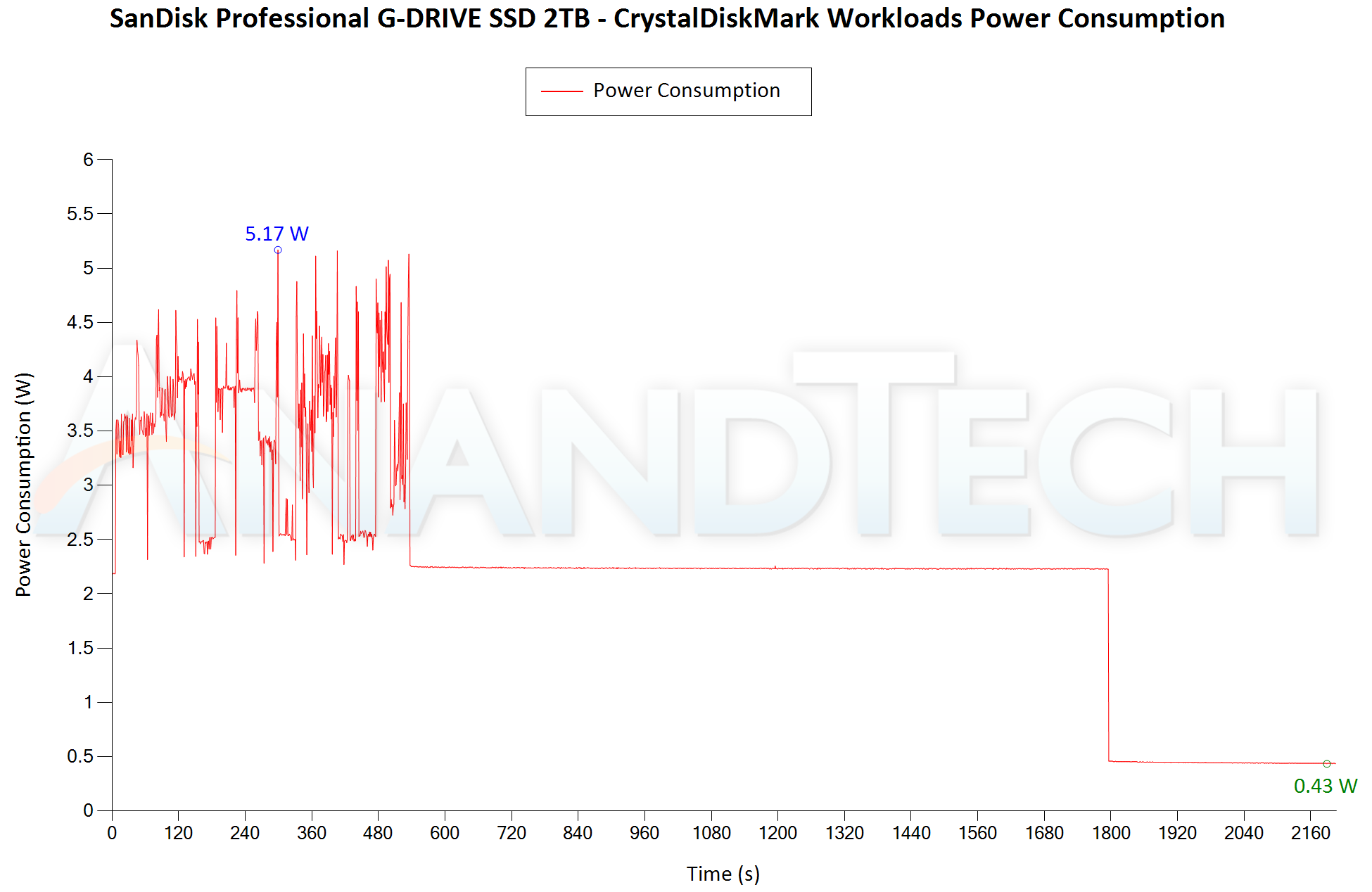
Bus-powered devices can configure themselves to operate within the power delivery constraints of the host port. While Thunderbolt ports are guaranteed to supply up to 15W for client devices, USB 2.0 ports are guaranteed to deliver only 4.5W (900mA @ 5V). In this context, it is interesting to have a fine-grained look at the power consumption profile of the various external drives. Using the Plugable USBC-TKEY, the bus power consumption of the drives was tracked while processing the CrystalDiskMark workloads (separated by 5s intervals). The graphs below plot the instantaneous bus power consumption against time, while singling out the maximum and minimum power consumption numbers.
| CrystalDiskMark Workloads - Power Consumption | |
| TOP: | BOTTOM: |
 |
|
 |
|
In terms of overall average power consumption and ability to enter really deep sleep, the Kingston XS2000 is the clear winner because of its native UFD controller. Among the bridge-based solutions, the T7 Touch has the lowest peak, but it is the T7 Shield that ends up with the lowest active region average. In the deep sleep stage (entered after around 20 minutes of no activity), the drive consumes only 0.12W - almost half of what the T7 Touch was able to reach.
Concluding Remarks
The Samsung Portable SSD T7 Shield has been available for purchase for a few months now. The official launch MSRP for the 2TB version was $234, but the drive has been on sale for $200 for a few days now. At this price, the PSSD delivers excellent value for money for typical direct-attached storage workloads. The ruggedness / IP65 rating, as well as low power consumption, are added icing on the cake. With hardware encryption support (enabled by the Samsung Portable SSD Software), the use-cases for the PSSD are manifold. The main competition for the drive comes in the form of the SanDisk Professional G-DRIVE SSD - it carries an IP67 rating for a slight premium. While the T7 Shield is able to win out on typical DAS workloads, the DRAM-equipped SSD in the G-DRIVE provides slightly better performance for typical SSD workloads such as application launches and read/writes of small files.
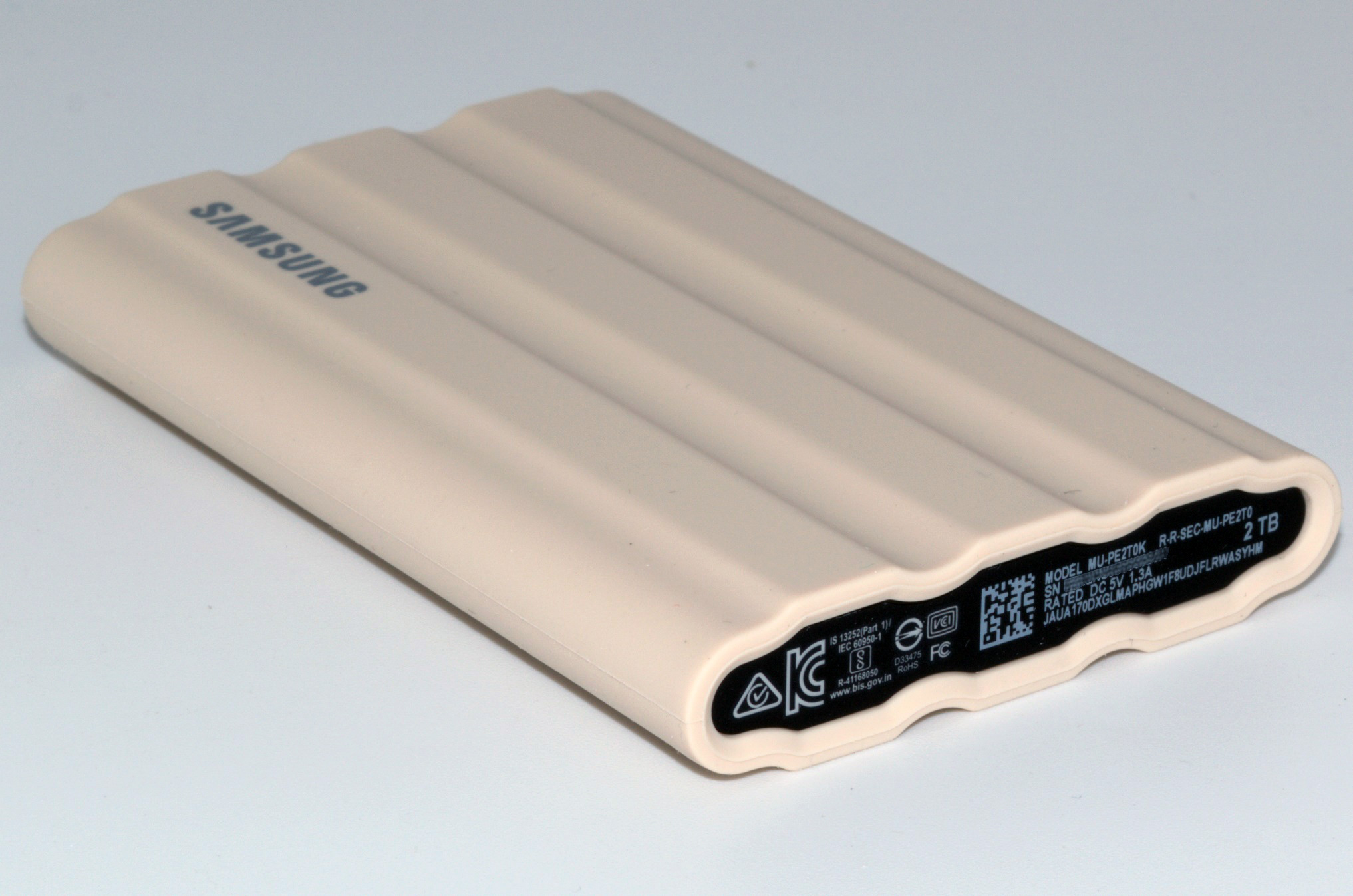
On scope for improvement, Samsung would do well to explore DRAM-equipped PSSDs in a slightly premium line - those could deliver better performance for non-DAS workloads (and PSSDs are starting to get treated on par with internal SSDs by power users already). They could also explore supplying a single Type-C to Type-C cable along with an attached Type-C to Type-A adapter (similar to the solution delivered by manufacturers like OWC in their Envoy Pro).
The silent star of the T7 Shield show is actually the update to the internal flash. The move to 6th Gen. 128L (136T) V-NAND has enabled the T7 Shield to provide unparalleled performance consistency in its class for typical DAS workloads, while maintaining excellent thermals and low power consumption. In our opinion, the improvements in the T7 Shield over the T7 / T7 Touch are significant enough to call it a worthy successor, rather than just an addition to the T7 family.
Originally published at https://www.anandtech.com/show/17478/samsung-portable-ssd-t7-shield-review-flagship-pssd-gets-ip65-avatar (Wayback Machine).