
Supermicro SYS-E100-12T-H Review: Fanless Tiger Lake for Embedded Applications
Power Consumption and Thermal Characteristics
The power consumption at the wall was measured with a 4K display being driven through the HDMI port of the system. In the graph below, we compare the idle and load power of the Supermicro SM-E100-12T-H with other systems evaluated before. For load power consumption, we ran the AIDA64 System Stability Test with various stress components, as well as our custom stress test with Prime95 / Furmark, and noted the peak as well as idling power consumption at the wall.
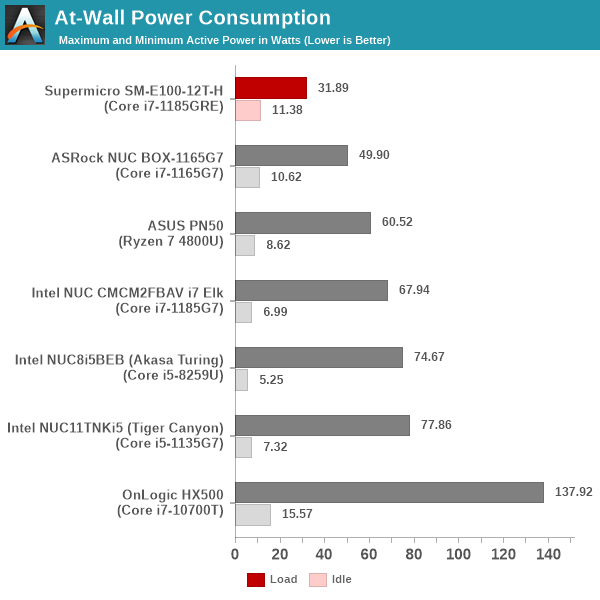
The numbers are consistent with the TDP and suggested PL1 / PL2 values for the processors in the systems, and do not come as any surprise. With the PL1 and PL2 set conservatively to just 15W by Supermicro, the peak power consumption is less than 32W and is sustained in nature. The idling power is a bit high, but can be explained by the presence of various high-speed I/Os and their supporting chips on the board.
Stress Testing
Our first thermal stress routine starts with the system at idle, followed by four stages of different system loading profiles using the AIDA64 System Stability Test (each of 30 minutes duration). In the first stage, we stress the CPU, caches and RAM. In the second stage, we add the GPU to the above list. In the third stage, we stress the GPU standalone. In the final stage, we stress all the system components (including the disks). Beyond this, we leave the unit idle in order to determine how quickly the various temperatures in the system can come back to normal idling range. Traditionally, this test used to record the clock frequencies - however, with the increasing number of cores in modern processors and fine-grained clock control, frequency information makes the graphs cluttered and doesn't contribute much to understanding the thermal performance of the system. The focus is now on the power consumption and temperature profiles to determine if throttling is in play.


The AIDA64 SST workloads place the sustained at-wall load power consumption around 30W for the system. The package power consumption holds steady at 15W which matches the PL1 / PL2 setting in the BIOS for the processor. The peak iGPU power budget seems to be around 10W, while the cores themselves seem to top out around 12W. The package temperature tops out around 75C, and the SSD doesn't cross 65C even when subject to stress.
The second thermal stress routine is our custom stress test with Prime95 and Furmark. The Prime95 stress test is allowed to run for 30 minutes before the Furmark load is added. After 30 minutes of simultaneous Prime95 and Furmark, the Prime95 process is terminated and Furmark is allowed free run for another 30 minutes. The system is allowed to idle after being subject to this 90-minute stress routine. The parameters recorded in the course of the AIDA64 SST are also recorded here.


The custom stress test manages to stress the system a lot more from the CPU perspective. We see more variations in the power numbers as the system tries to provide the maximum performance while ensuring that the package power doesn't go beyond the 15W limit. The iGPU tops out around 7W, much lesser than the 10W seen in the AIDA workload. The temperatures remain similar to the AIDA64 SST case, though.
Thermal Performance
One of the key aspects of fanless systems is the thermal profile under load. Our stress test saw the internal package temperature go as high as 75C, and the chassis (doubling up as a heat-sink) managed to keep it stable around that mark.

Using a FLIR One Pro thermal camera, the maximum case temperature under extreme stress at normal room temperature (25C) was determined to be around 54C.


The gallery above presents additional thermal photographs taken at the end of the simultaneous CPU and GPU loading segment of the custom stress test. We can see that the case is more than capable of handling the 15W TDP of the Core i7-1185GRE.
Originally published at https://www.anandtech.com/show/17424/supermicro-syse10012th-review-fanless-tiger-lake-for-embedded-applications (Wayback Machine).