
nForce4 Ultra Roundup: Charting the Mainstream
- Posted in
- Motherboards
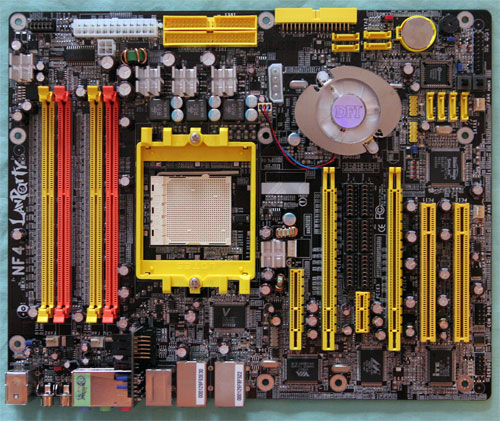
DFI LANParty UT nF4 Ultra-D: Features and Layout
| Specification | DFI LANParty UT nF4 Ultra-D |
| CPU Interface | Socket 939 Athlon 64 |
| Chipset | nForce4 Ultra (single chip) |
| BUS Speeds | 200MHz to 456MHz (in 1MHz increments) |
| PCI/AGP Speeds | Asynchronous (Fixed) |
| PCI Express | 100MHz to 145MHz in 1MHz increments |
| Core Voltage | Auto, 0.8V to 1.55V in 0.025V increments (Normal) PLUS *104%, 110%, 113%, 123%, 126%, 133%, 136% (Special - to 1.85V) |
| CPU Startup Voltage | Startup, 0.825V to 1.550V in 0.025V increments |
| DRAM Voltage | 2.5V to 3.2V in 0.1V increments (3V jumper) 2.5V to 4.0V in 0.1V increments (5V jumper) |
| Chipset Voltage | 1.5V, 1.6V, 1.7V, 1.8V |
| Hyper Transport Ratios | Auto, 1.0, 1.5, 2.0, 2.5, 3.0, 4.0, 5.0 |
| LDT Bus Transfer | 16/16, 16/8, 8/16, 8/8 |
| LDT Voltage | 1.2V, 1.3V, 1..4V, 1.5V |
| CPU Ratios | Auto, 4x to 25x in 0.5x increments |
| Cool'n'Quiet MAX FID | Auto, 8.0 to 13.0 in 0.5x increments |
| DRAM Speeds | Auto, 100, 120, 133, 140, 150, 166, 180, 200 (Plus DDR433, 466, 500 with Rev. E Processor) |
| Memory Command Rate | Auto, 1T, 2T |
| Memory Slots | Four 184-pin DDR Dual-Channel Slots Unbuffered ECC or non-ECC Memory to 4GB Total |
| Expansion Slots | 2 x16 PCIe Slots 1 x4 PCIe 1 x1 PCIe 2 PCI Slots |
| SLI Setup | Six 16-pin Jumper Blocks |
| Onboard SATA | 4-Drive SATA 2 by nF4 |
| Onboard IDE | Two Standard NVIDIA ATA133/100/66 (4 drives) |
| SATA/IDE RAID | 4-Drive SATA 2 PLUS 4-Drive IDE (8 total) Can be combined in RAID 0, 1 |
| Onboard USB 2.0/IEEE-1394 | 10 USB 2.0 ports supported nF4 2 1394A FireWire ports by VIA VT6307 |
| Onboard LAN | Dual Gigabit Ethernet PCIe by Vitesse VSC8201 PHY PCI by Marvel 88E8001 |
| Onboard Audio | Karajan Audio Module based on Realtek ALC850 8-Channel codec with 6 UAJ audio jacks, CD-in, front audio, and coaxial SPDIF In and Out |
| Other Features | AMD X2 Support with 5/10/2005 or higher BIOS Diagnostic LEDs, Power and Reset momentary switches |
| BIOS | Award 7/01/2005 Release |
The DFI LANParty UT nF4 Ultra-D was tested when it was launched in DFI nForce4: SLI and Ultra for Mad Overclockers. We also included the DFI LANParty nF4 SLI-DR in our SLI roundup in nForce4 SLI Roundup: Painful and Rewarding. This is significant because the designs of the Ultra and SLI versions of the DFI are exactly the same. Both board layouts are essentiallly the same - the only difference is the SLI chipset on the SLI and Ultra chipset on the Ultra. As we detailed in Morphing nForce4 Ultra into nForce4 SLI, the SLI and Ultra chipsets are exactly the same, with the SLI features turned on in the SLI chipset. NVIDIA has modified the nForce4 chipset, making it more difficult to convert the Ultra to nF4, but the principles are still the same.
For more information on the features or layout of the DFI, please refer to any of these aforementioned reviews.
Originally published at https://www.anandtech.com/show/1727 (Wayback Machine).