
Dual Core Linux Performance: Two Penguins are Better than One
- Posted in
- Linux
Multitasking Scenario 4: DVD Burning
Thanks to NeroLINUX, we can now run the first benchmark we did in reverse. We will be paying particular attention to the buffer for NeroLINUX. If the burn continually empties the buffer, then the system is playing catch-up to the burner. We will count the number of times the buffer dies and graph this separately. We used a NEC 3520A burner and a 4.5GB ISO image for the burn.
- Open FireFox 1.0.4 and load all 5 web pages.
- Open XMMS and start playing a Nine Inch Nails CD ripped to Ogg
- Open Thunderbird for news
- Login to our news server and start downloading headers for our subscribed news groups
- Begin an ISO burn with NeroLINUX and start timing
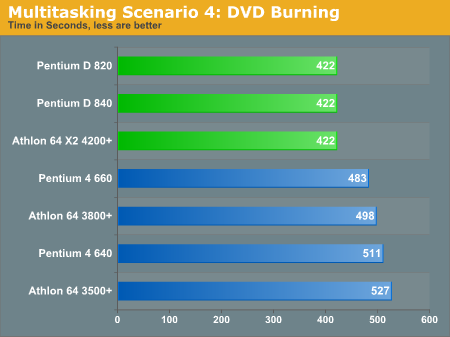
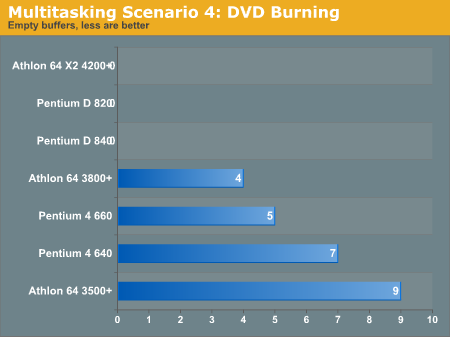
There seems to be a very linear correlation between the number of buffer dumps and the speed at which the discs burned. We really only saw the buffer even come in danger of decreasing at the beginning of the burn and when Thunderbird took a little too long to process something coming in from the news server.
Even though the processors we used in this analysis are more than capable, the additional tasks of FireFox and Thunderbird proved just a tad too much for the chips to handle at all once. This benchmark is a great illustration of where dual core (or dual socket) goes so wonderfully well on the desktop. The additional overhead to run XMMS, FireFox and the other applications is not very substantial, but when FireFox decides to chew up resources while the only CPU is managing the write buffer on a DVD burn, the results can be quite dramatic.
Originally published at https://www.anandtech.com/show/1725 (Wayback Machine).