
A Look at Solaris 10 and Sun's Dual Core Fire V40z
- Posted in
- Systems
Rendering Benchmarks
We include Mental Ray and Shake as a point of reference, although both applications are strictly 32-bit at this time. Mental Ray is further hindered by the fact that the version we have is not SMP-aware.
Mental Ray 3.3.3
You may be interested to see how some single CPU setups perform on the same test render here. Once again, we are running the same Maya benchmark file found in our other reviews. While Solaris allows us to run some Linux binaries with emulation, we could not get the license servers to install correctly, which made this a Linux-only portion of the test. We ran Mental Ray via Maya using the command below:
# maya_render_with_mr -file Benchmark_Mental.mb
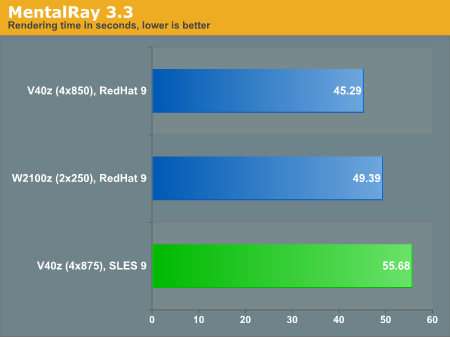
Since Mental Ray cannot utilize all eight physical cores, this benchmark doesn't do the V40z a lot of justice. Nevertheless, you can see how a single core from an Opteron 875 stacks up against a single Opteron 250 from the previous two benchmarks.
Shake 3.5c
Apple develops a great digital effects package called Shake. We took the opportunity to run a benchmark script by Lindsay Adams, which you can download here. The benchmark script renders 10 frames under various effects using one or multiple CPUs. We sum the render times and display them below. The times recorded are the averages of three runs.
The command run for this benchmark is:
# shake -exec hardware_test_v01.shk -vv
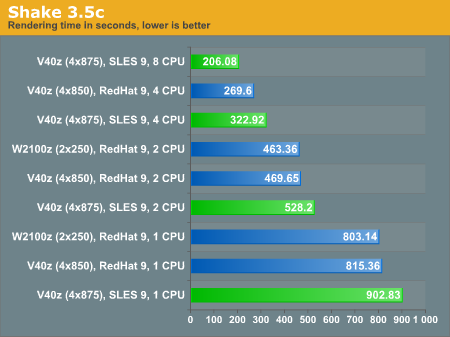
Even though Shake seems to support all the processor cores, there is a scaling issue. This is just one case in many where having lots of slower processors might not be as efficient as having fewer faster processors instead.
Originally published at https://www.anandtech.com/show/1724 (Wayback Machine).